|
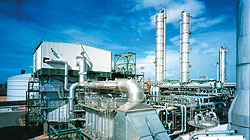
Trinidad and Tobago’s energy sector has long been important to its economy. Today, it accounts for approximately 26 per cent of the country’s GDP, generates 21 per cent of Government revenues, and (including petrochemicals) represents 72 per cent of the country’s exports. The country’s hydrocarbon resource and, in particular, its natural gas (proven reserves are 17.3 trillion cubic feet and increasing) have enabled it to become the most industrialised Caribbean nation.
Crude oil production commenced in 1908 and the first oil refinery was established in 1912. Further, the state has been granting licences for the exploration of large offshore areas and the resultant activity should translate into increased reserves and ultimately enhanced production levels. Amoco has recently announced an oil find which is expected to increase oil reserves by between 40 and 70 million barrels.
|
HIGH OCTANE: The energy sector now accounts for approximately 26 per cent of the country’s GDP. And it’s growing even as you read this |
 |
Production of natural gas has been increasing rapidly. Based on abundant reserves of natural gas combined with Government incentives, Trinidad and Tobago has become the largest supplier of liquefied natural gas to the United States, at the same time developing an important petrochemical industry.
Gas is now more important to the economy than oil. The gas is used primarily for electricity generation, petrochemical manufacture, steel and metal production, cement manufacture and light industry.
|
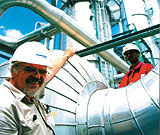
Oil refining operations commenced in T&T in 1912 and petrochemical production in 1959. Thus there are large numbers of people trained in process plant type operations as well as in oil and gas production |
Trinidad and Tobago is rightly aiming at using energy resources to reach ambitious development goals before energy reserves are exhausted. Efforts are focused on creating conditions for the development of a vibrant and sustainable non-energy sector that can generate strong output growth in the event of a major decline in energy prices and/or ahead of the envisaged depletion of energy resources. Key to this goal is the transformation of the energy wealth into a balanced combination of external financial assets, and physical and human capital. The challenge is to implement a prudent mix of macroeconomic and structural policies, as this is essential to support an orderly and efficient absorption of the increased energy earnings over time. These policies also need to take into account the intergenerational aspects associated with the exploitation of exhaustible resources.
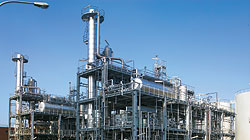 |
DIVERSIFICATION: The country is making progress in the petrochemicals sector with considerable investments in ammonia, methane and LNG |
The high economic growth experienced for over a decade has been the result of the important reforms implemented in the 1990s and more recently a buoyant energy sector. Trinidad and Tobago's performance has been remarkable in a regional context and in comparison to other energy producing economies. Despite the temporary reduction in energy output in the early months of the year, the economy is expected to expand at around 6 percent in 2007.
|
The high economic growth experienced for over a decade has been the result of the important reforms implemented in the 1990s |
Given the maturity of the energy sector in Trinidad & Tobago its natural resources are supported by a large number of skilled and well trained people. Oil refining operations commenced in Trinidad & Tobago in 1912 and petrochemical production in 1959. Thus there are large numbers of people trained in process plant type operations as well as in oil and natural gas production.
There are significant numbers of service companies which provide support services to the major producers. In addition, a large number of experienced qualified individuals, firms and companies exist to provide services in fields such as architecture, engineering (civil, mechanical, electrical, petroleum) geology, and contracting (all types). In fact, all major projects in Trinidad have been constructed with the significant involvement of local contracting companies including high pressure pipeline construction, steel fabrication and erection, civil works etc. All the local organisations involved in the sector are quite comfortable dealing with international
organisations.
|
More recently, the state has been divesting itself of its interests except where these interests are seen as being of strategic importance |
The country is also making progress in the petrochemicals sector with considerable investments in ammonia, methane and LNG production. T&T is well experienced in exploration, production, refining and other process plant type operations, for example, petrochemicals. Gas is presently used for electricity production, petrochemical, heavy industrial and light industrial use. Expansion into liquefied natural gas production is taking place. There are possibilities for aluminium smelting. By the year 2000, Trinidad & Tobago is expected to be the world’s largest exporter of ammonia and methanol.
The Government is stimulating development of the energy sector by participating as an equity investor either on its own or on a joint venture basis. More recently, the state has been divesting itself of its interests except where these interests are seen as being of strategic importance. It has announced its intention to publish in the very near future a "Green Paper" on Energy Policy for public comment.
|