

Modi Shapes Momentum
At the historic Johannesburg G20 Summit, Prime Minister Narendra Modi blended diplomacy, vision, and activism to push for a fairer, more resilient global order.
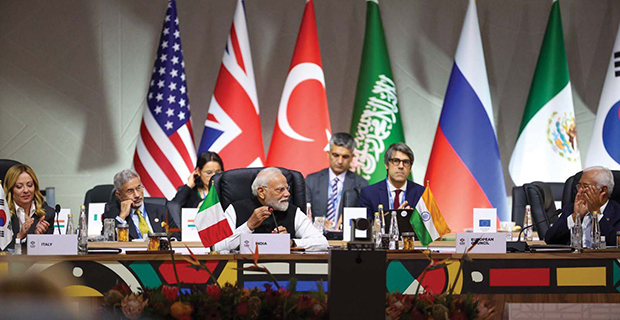
Johannesburg felt charged with symbolism as leaders from the world’s largest economies gathered under South Africa’s chairmanship for the first G20 Summit ever hosted on African soil. Into this charged environment stepped Prime Minister Narendra Modi, a leader who has over successive G20 cycles positioned India as a bridge between the Global North and Global South. His message this time was unmistakably clear: economic progress must evolve beyond growth metrics and embrace planetary mindfulness, human-centric models, and equitable global governance.
During the opening session, held under the banner “Inclusive and sustainable economic growth leaving no one behind,” Modi anchored his intervention in the Indian civilisational idea of Integral Humanism—the belief that individuals, society, and nature must coexist in organic harmony. The Prime Minister lauded South Africa’s focus on digital innovation, AI, skilled mobility, food security, women’s empowerment, and tourism, pointing out that several initiatives from India’s New Delhi presidency had found thoughtful continuity in Johannesburg.
Yet he stressed that the moment demanded more than continuity; it called for bold reinvention. Modi introduced a series of forward-looking proposals designed to help the G20 adapt to accelerating global disruptions and structural inequities.
A Six-Point Vision for a Changing World
To build a G20 that is more agile, inclusive and equipped for crises, Modi proposed:
- A Global Traditional Knowledge Repository, capturing the world’s indigenous and classical wisdom systems.
- A G20 Africa Skills Multiplier, aimed at training a million African youth through certified trainers.
- A G20 Global Healthcare Response Team, envisioned as a multinational health emergency unit.
- A G20 Open Satellite Data Partnership, ensuring that developing nations can access space-based tools for agriculture, fisheries, climate monitoring, and disaster management.
- A G20 Critical Minerals Circularity Initiative, promoting recycling, urban mining, and second-life batteries.
- A G20 mechanism to counter the Drug–Terror Nexus, a transnational threat Modi described as corrosive to societies and economies alike.
These announcements dovetailed with India’s long-standing insistence that sustainable development must drive global systems, not remain a secondary concern. Modi reiterated that real progress requires a shift from a “response-centric” to a “development-centric” model of disaster risk management—a philosophy India has enshrined through the Disaster Risk Reduction Working Group and the Coalition for Disaster Resilient Infrastructure.
The Climate–Food–Energy Triad
The second session—“A Resilient World: Disaster Risk Reduction; Climate Change; Just Energy Transition; Food Systems”—saw Modi expand on the triad that shapes the vulnerabilities of the developing world. Climate change, he warned, is no longer a distant threat; it is today’s most pressing menace to food systems.
He cited India’s national experience, from running the world’s largest food security and nutrition programme to its comprehensive health-insurance and crop-insurance schemes, as evidence that inclusive welfare architecture is central to resilience. India’s push to popularise Shree Anna (millets), he added, is both a nutritional solution and a climate-resilient strategy.
Clean energy transitions, Modi said, must be just, not punitive. He urged developed nations to honour commitments on climate finance and technology transfer—an expectation many developing nations have repeatedly voiced.
Related News.
-

September 2026 Gorillas Find Names
-

September 2026 India–Kiribati Deepen Cooperation
-

September 2026 India, Ethiopia Deepen Defence Ties
-

September 2026 JAMAICA AT 64,TIES DEEPEN

EDITOR'S DESK, Sep 2026
 Our cover takes us to Volcanoes National Park, where Rwanda recently hosted the 21st Kwita Izina, its annual Gorilla Naming Ceremony. Twenty-two baby mountain gorillas received their names, but the significance of the occasion went far beyond a celebration of wildlife...
more...
Our cover takes us to Volcanoes National Park, where Rwanda recently hosted the 21st Kwita Izina, its annual Gorilla Naming Ceremony. Twenty-two baby mountain gorillas received their names, but the significance of the occasion went far beyond a celebration of wildlife...
more...
Ads Spot

Comments.