

Trade, Resources, Corridors
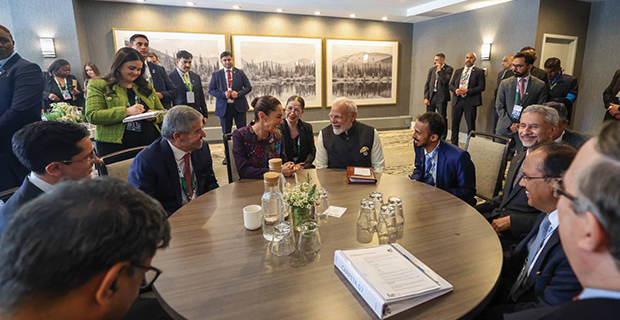
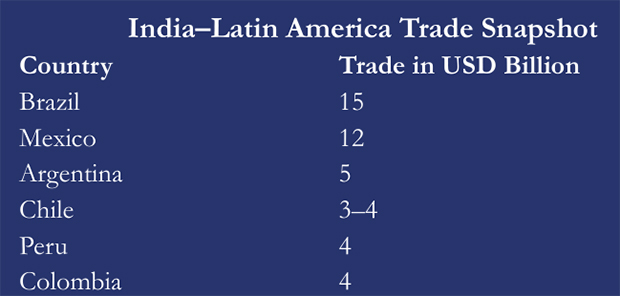
If one were to draw a map of India–Latin America relations not by geography but by economics, it would look like a network of corridors connecting resources, markets and industries across continents. The relationship between India and Latin America is increasingly being shaped by what may be called economic corridors — flows of energy, minerals, food, manufactured goods and technology moving between the two regions.
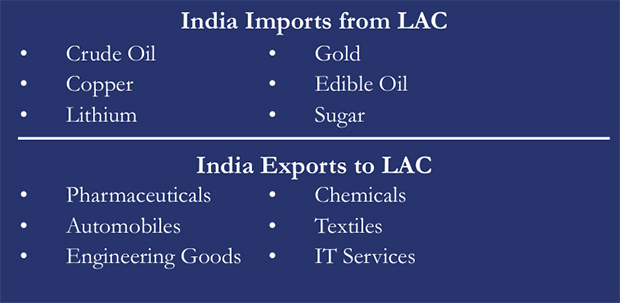
Latin America is one of the most resource-rich regions in the world. For India, the region is important as a source of crude oil, copper, lithium, gold and agricultural commodities such as edible oils and sugar. These are not marginal imports; they are critical inputs for India’s energy security, infrastructure expansion, manufacturing growth and food security. Copper from Chile and Peru is essential for electrical equipment and renewable energy systems. Lithium from Argentina and Bolivia will be important for India’s electric mobility and battery storage industries. Crude oil from Brazil, Colombia and other producers helps India diversify its energy sources. Agricultural imports from countries such as Argentina and Paraguay contribute to India’s food supply chain.
At the same time, India exports pharmaceuticals, automobiles, auto components, engineering goods, chemicals, textiles and information technology services to Latin America. Indian pharmaceutical companies play an important role in supplying affordable medicines across the region, while Indian automobile and engineering companies have established a strong presence in several Latin American markets. Indian IT companies, too, have built delivery centres and technology operations across Latin America, creating a digital bridge between India and the Americas.
Seen together, these flows form a set of economic corridors — an energy corridor, a minerals corridor, an agriculture corridor, a manufacturing corridor, a digital corridor and a logistics corridor. These corridors are gradually transforming India–Latin America relations from a distant trading relationship into a structured and long-term economic partnership.
Related News.
-

September 2026 Gorillas Find Names
-

September 2026 India–Kiribati Deepen Cooperation
-

September 2026 India, Ethiopia Deepen Defence Ties
-

September 2026 JAMAICA AT 64,TIES DEEPEN

EDITOR'S DESK, Sep 2026
 Our cover takes us to Volcanoes National Park, where Rwanda recently hosted the 21st Kwita Izina, its annual Gorilla Naming Ceremony. Twenty-two baby mountain gorillas received their names, but the significance of the occasion went far beyond a celebration of wildlife...
more...
Our cover takes us to Volcanoes National Park, where Rwanda recently hosted the 21st Kwita Izina, its annual Gorilla Naming Ceremony. Twenty-two baby mountain gorillas received their names, but the significance of the occasion went far beyond a celebration of wildlife...
more...
Ads Spot

Comments.