

REPORT URGES DURABLE TIES
A new report argues that India and Canada should use their recent diplomatic reset to build a more resilient relationship, supported by trade, security cooperation and mechanisms to manage disputes.
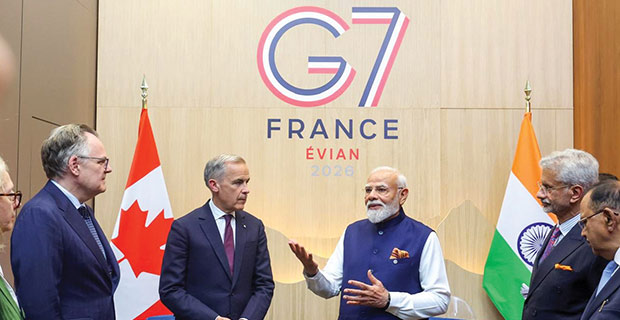
NEW DELHI: After a prolonged diplomatic rupture, India and Canada have begun to repair their bilateral relationship to focus on economic complementarities and shared strategic interests, according to a new report. The visits of Canadian Foreign Minister Ms Anita Anand and International Trade Minister Mr Maninder Sidhu, preceded by security consultations between Mr David Morrison and National Security Adviser (NSA) Ajit Doval, signal a determined effort to rebuild confidence. The aim should not be to recreate the pre-crisis relationship, but to build a more resilient partnership.
This requires stronger economic foundations, credible security cooperation and institutional safeguards against another diplomatic crisis of the kind witnessed in 2024, according to an article in India Narrative. India offers Canada a large and expanding market, industrial capacity and a growing technology ecosystem. It also provides Ottawa an opportunity to diversify its trade and investment relationships and reduce its concentration on the United States. Canada, in turn, brings strengths in energy, critical minerals, agriculture, aerospace, advanced technologies, education and institutional investment. Both countries have compelling reasons to diversify supply chains and strengthen economic resilience, states the article by India’s former high commissioner to Canada, Mr Sanjay Kumar Verma.
The current phase began during Prime Minister Mark Carney’s visit to India from February 27 to March 2, 2026, following renewed engagement between Mr Carney and Prime Minister Narendra Modi at the G7 summit in 2025. The leaders supported the reconstitution of the India-Canada CEO Forum, a Finance Ministers’ Economic and Financial Dialogue, stronger security cooperation and regular trade and investment engagement. These mechanisms are intended to sustain cooperation even when political disagreements arise. In their telephone conversation on October 13, Mr Modi and Mr Carney reaffirmed their commitment to concluding CEPA at the earliest opportunity. Mr Modi’s anticipated visit to Canada in December could provide another opportunity to demonstrate that the reset is producing tangible results.
The political framework is in place; implementation will determine its credibility. The report argues that the 2024 crisis demonstrated the need for a structured early-warning mechanism. Designated senior officials should be able to communicate emerging concerns promptly, assess their implications, and refer unresolved issues to the national security advisers or foreign ministers. Regular reviews and agreed procedures for information sharing would help prevent misunderstandings from escalating into wider diplomatic crises. Such a mechanism would not eliminate disagreements, but it could prevent them from repeatedly derailing the partnership. For India, the activities of pro-Khalistan extremist organisations operating from Canadian territory have long been a source of concern.
The legitimate concern is whether Canadian territory is being used to facilitate intimidation, violence or other unlawful activities directed against India’s sovereignty and territorial integrity. The author argues that Khalistani extremists are not merely a threat to India; they also threaten Canada’s own security and way of life. This is not simply an Indian assessment. The Canadian Security Intelligence Service (CSIS), in its ‘2025 Public Report’, identified the continuing involvement of Canada-based Khalistani extremists in violent extremist activities as a national security threat to Canada and Canadian interests.
Related News.
-
November 2026 “We Need to Bridge the Gap”
-

November 2026 Trinidad Eyes Indian Trade
-

November 2026 “Business Needs Cultural Connection”
-

November 2026 ENVOYS DISCUSS PANAMA TIES
India Empire TV


EDITOR'S DESK, Nov 2026
 A relationship between nations is rarely built on a single summit, agreement or trade figure. It takes shape over generations: through the movement of people, the exchange of ideas, the trust created by diplomacy and the practical partnerships that improve lives. This November issue of India Empire explores that wider canvas of India’s engagement with the world...
more...
Ads Spot

Comments.