

Deeper, Structured Cooperation
Prime Minister Narendra Modi’s landmark visit to Ethiopia has elevated India–Ethiopia relations to a Strategic Partnership, blending ancient civilisational links with contemporary cooperation across diplomacy, development, trade and people-to-people ties.
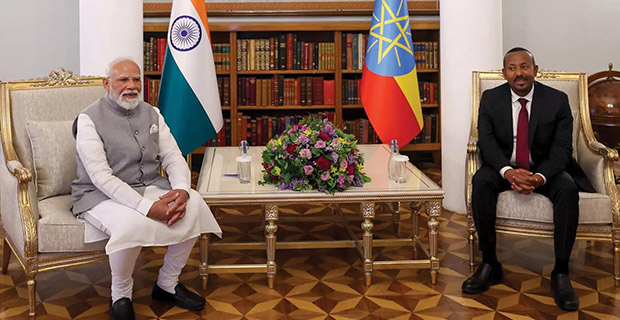
Prime Minister Narendra Modi’s visit to Ethiopia marks a defining moment in India–Africa relations and a milestone in India–Ethiopia ties in particular. Visiting Ethiopia for the first time, PM Modi described the experience as one that filled his heart with immense joy, underscoring the deep historical, cultural and civilisational connections between the two nations. India and Ethiopia, he noted, have shared contact, communication and exchange for thousands of years, and today stand together as co-passengers and partners of the Global South.
The visit comes as part of a sustained diplomatic outreach by India towards Africa over the past decade, during which New Delhi has steadily elevated its engagement with the continent. Ethiopia, with its strategic location, rich history and growing economic potential, occupies a special place in this outreach.
Elevation to a Strategic Partnership
At the heart of the visit was the decision by India and Ethiopia to elevate their bilateral relationship to a Strategic Partnership. Prime Minister Modi and Ethiopian Prime Minister Abiy Ahmed Ali held delegation-level talks at the Ethiopian National Palace in Addis Ababa, reviewing the full spectrum of bilateral cooperation and charting an ambitious roadmap for the future.
The Strategic Partnership reflects a shared intent to move beyond transactional engagement towards deeper, structured and long-term cooperation. It encompasses political consultations, economic collaboration, capacity building, technology sharing, defence and security cooperation, and closer coordination in multilateral forums, including the United Nations.
Indian Ambassador to Ethiopia Anil Kumar described the elevation as a clear signal from the leadership of both countries to convert ideas into tangible outcomes. He emphasised that the trajectory of the relationship will remain high, marked by closer engagement, mutual confidence and visible results on the ground.
Expanding Economic and Trade Ties
Economic cooperation formed a major pillar of the discussions. Prime Minister Modi highlighted that Indian companies, as trusted partners, have invested over USD 5 billion in the Ethiopian economy, particularly in manufacturing and pharmaceuticals, creating more than 75,000 local jobs. These investments have contributed significantly to Ethiopia’s industrial development, skill formation and access to affordable healthcare.
In 2024 alone, 11 Indian companies invested in Ethiopia across diverse sectors including agriculture, automobiles, iron and steel and information and communication technology. Indian investments in textiles have remained at the forefront of foreign direct investment, while India continues to be among the leading investors in Ethiopia’s pharmaceutical sector.
Bilateral trade between the two countries stood at USD 550.19 million in FY 2024–25, with Indian exports accounting for USD 476.81 million and imports USD 73.38 million. Ethiopia also benefits from India’s Duty-Free Tariff Preference scheme for least developed countries, and both sides expressed keen interest in expanding trade volumes and diversifying the trade basket.
Technology, Innovation and Capacity Building
Looking ahead, Prime Minister Modi conveyed India’s willingness to step up collaboration in areas critical to Ethiopia’s development priorities, including Digital Public Infrastructure, mining and critical minerals, clean energy, food security and agriculture. The two leaders also reviewed progress in innovation and technology, education and capacity building.
Education cooperation remains a strong pillar of the relationship. Over 2,000 Ethiopian students are currently pursuing graduation and doctoral programmes in India. As part of the new agreements, India announced the doubling of short-term scholarships for Ethiopian students under the ICCR programme, further expanding opportunities for higher education and skill development.
In addition, India will offer specialised short-term courses in Artificial Intelligence under the ITEC programme, aimed at bridging critical skill gaps in Ethiopia’s knowledge-based economy. Ambassador Anil Kumar noted that such capacity-building initiatives, ranging from two-week to one-month courses, have proved extremely effective in empowering professionals across sectors.
Related News.
-

September 2026 Gorillas Find Names
-

September 2026 India–Kiribati Deepen Cooperation
-

September 2026 India, Ethiopia Deepen Defence Ties
-

September 2026 JAMAICA AT 64,TIES DEEPEN

EDITOR'S DESK, Sep 2026
 Our cover takes us to Volcanoes National Park, where Rwanda recently hosted the 21st Kwita Izina, its annual Gorilla Naming Ceremony. Twenty-two baby mountain gorillas received their names, but the significance of the occasion went far beyond a celebration of wildlife...
more...
Our cover takes us to Volcanoes National Park, where Rwanda recently hosted the 21st Kwita Izina, its annual Gorilla Naming Ceremony. Twenty-two baby mountain gorillas received their names, but the significance of the occasion went far beyond a celebration of wildlife...
more...
Ads Spot


Comments.