

Deeper, Structured Cooperation
Diaspora and People-to-People Connect
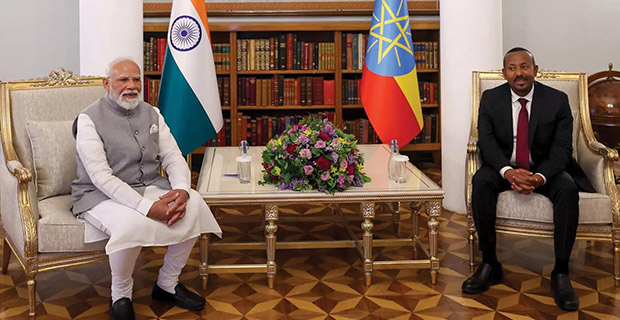
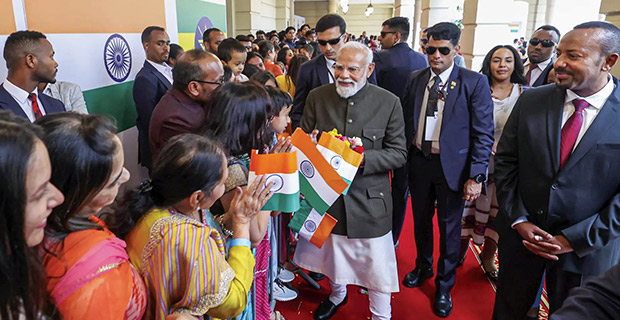
People-to-people ties and diaspora engagement were repeatedly emphasised as integral to the Strategic Partnership. Ambassador Anil Kumar underlined that the India–Ethiopia relationship is not limited to government-to-government interaction but is deeply rooted in societal and human connections.
The Indian diaspora, professionals, educators and entrepreneurs have played a significant role in strengthening bilateral ties over the years. Prime Minister Modi acknowledged this contribution while accepting Ethiopia’s highest civilian honour, stating that the award belongs to the countless Indians who have shaped and strengthened the partnership between the two nations.
Agreements and Concrete Outcomes
The visit witnessed the signing and exchange of eight key Memoranda of Understanding, giving concrete shape to the Strategic Partnership. These include agreements on cooperation and mutual administrative assistance in customs matters, establishment of a data centre at Ethiopia’s Ministry of Foreign Affairs, and an implementing arrangement for cooperation in United Nations peacekeeping operations training.
Other outcomes include an MoU on debt restructuring for Ethiopia under the G20 Common Framework, expanded ICCR scholarships, and the launch of AI-focused training programmes. India will also assist in enhancing the capacity of the Mahatma Gandhi Hospital in Addis Ababa, with a special focus on maternal healthcare and neonatal care.
These outcomes, Prime Minister Modi noted, reflect a partnership focused on growth, empowerment and people-centric development, with a strong emphasis on governance, peacekeeping, education, healthcare and digital capacity.
Global South and Multilateral Cooperation
India and Ethiopia reaffirmed their commitment to working together to amplify the voice of the Global South. The two leaders discussed cooperation in multilateral institutions and shared perspectives on global challenges.
They called for greater collaboration on climate change, renewable energy and disaster risk reduction, welcoming the role of international initiatives such as the International Big Cat Alliance, the Coalition for Disaster Resilient Infrastructure, the Global Biofuel Alliance and the International Solar Alliance.
Prime Minister Modi also noted that India looks forward to working closely with Ethiopia as BRICS partners under its presidency and in advancing preparations for the proposed India–Africa Forum Summit.
A Rare Honour, Shared Confidence
A highlight of the visit was the conferring of Ethiopia’s highest national award, the ‘Great Honour Nishan of Ethiopia’, on Prime Minister Modi. Describing it as a rare and deeply moving honour, the Prime Minister said that being recognised by one of the world’s most ancient civilisations was a matter of immense pride.
“This honour belongs to the countless Indians who have shaped and strengthened our partnership over the years,” PM Modi said, adding that India remains committed to further cementing cooperation with Ethiopia to address evolving global challenges and create new opportunities.
Ambassador Anil Kumar described the honour as a reflection of the confidence and expectations Ethiopia places in India’s leadership, noting that it brings renewed energy and motivation to convert goodwill into tangible outcomes in the months and years ahead.
Looking Ahead
Prime Minister Modi’s Ethiopia visit stands as a testament to India’s calibrated, development-centric foreign policy in Africa. By blending historical ties with forward-looking cooperation in technology, education, healthcare, trade and multilateral engagement, India and Ethiopia have laid the foundation for a partnership that is strategic in vision and human in impact.
As both nations move forward as Strategic Partners, the emphasis remains firmly on delivery, mutual benefit and shared leadership in shaping a more inclusive and resilient Global South.
Related News.
-

September 2026 Gorillas Find Names
-

September 2026 India–Kiribati Deepen Cooperation
-

September 2026 India, Ethiopia Deepen Defence Ties
-

September 2026 JAMAICA AT 64,TIES DEEPEN

EDITOR'S DESK, Sep 2026
 Our cover takes us to Volcanoes National Park, where Rwanda recently hosted the 21st Kwita Izina, its annual Gorilla Naming Ceremony. Twenty-two baby mountain gorillas received their names, but the significance of the occasion went far beyond a celebration of wildlife...
more...
Our cover takes us to Volcanoes National Park, where Rwanda recently hosted the 21st Kwita Izina, its annual Gorilla Naming Ceremony. Twenty-two baby mountain gorillas received their names, but the significance of the occasion went far beyond a celebration of wildlife...
more...
Ads Spot

Comments.