

Journey Comes Full Circle
An Arizona State University graduate, Mudit Lal represents a new generation of the Indian diaspora, global in education, rooted in purpose, and determined to build the future back home.
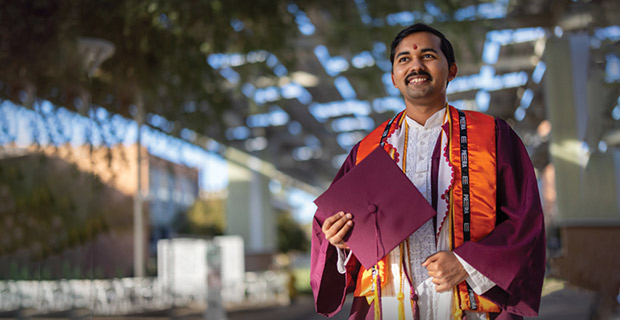
For many young Indians studying overseas, commencement marks the beginning of a career abroad. For Mudit Lal, it marks a return. The Arizona State University graduate is heading home to India, carrying not just a degree in robotics and technological entrepreneurship and management, but a conviction that global education must ultimately translate into national innovation.
Lal was among more than 12,000 students who graduated from ASU on December 15, 2025. Even before the ceremonial caps were tossed into the Arizona sky, his sights were firmly set on India. From his hometown in Lucknow, Lal plans to scale ventures spanning design, automation and India’s rapidly expanding quick-commerce ecosystem.
His journey reflects a growing trend within the Indian diaspora, one where international exposure is not an end in itself, but a preparation ground for impact back home.
Global Education, Indian Execution
While studying in the United States, Lal founded Devalok, an entrepreneurial venture that took shape within ASU’s innovation-driven academic ecosystem. Immersed in an environment that encourages interdisciplinary thinking and real-world problem-solving, he found his understanding of education fundamentally reshaped.
“The university’s focus on innovation and accessibility changed how I think about learning,” Lal has said, describing ASU as a place where ideas are meant to move quickly from concept to application.
That philosophy now underpins his India plans. Lal is building Oshm, a technology platform designed to support India’s booming quick-commerce market, and is also launching a robotics automation company that will lease robots to manufacturing plants, addressing efficiency gaps across industrial supply chains.
Returning Home to Build Teams and Trust
Rather than dispersing talent across geographies, Lal intends to consolidate his 12-member team in a new office in Lucknow. The choice of city is deliberate. It reflects the changing geography of Indian entrepreneurship, where innovation is no longer confined to metro hubs alone.
By anchoring operations in India, Lal aims to combine cost efficiency with deep local understanding, while retaining the global standards and systems he absorbed during his years abroad. For India’s diaspora entrepreneurs, this return-home model is increasingly seen as both commercially viable and socially meaningful.
Related News.
-

September 2026 Healing Beyond Borders
-

September 2026 MARRIAGE BEYOND BORDERS CROSS-BORDER JUSTICE
-

September 2026 Diaspora, Defence And Growth
-

September 2026 President in Romania

EDITOR'S DESK, Sep 2026
 Our cover takes us to Volcanoes National Park, where Rwanda recently hosted the 21st Kwita Izina, its annual Gorilla Naming Ceremony. Twenty-two baby mountain gorillas received their names, but the significance of the occasion went far beyond a celebration of wildlife...
more...
Our cover takes us to Volcanoes National Park, where Rwanda recently hosted the 21st Kwita Izina, its annual Gorilla Naming Ceremony. Twenty-two baby mountain gorillas received their names, but the significance of the occasion went far beyond a celebration of wildlife...
more...
Ads Spot


Comments.