

Gujarat–Rwanda Connect
Rwanda’s envoy to India says Gujaratis are increasingly investing in Rwanda, drawn by incentives and zero tolerance for corruption.
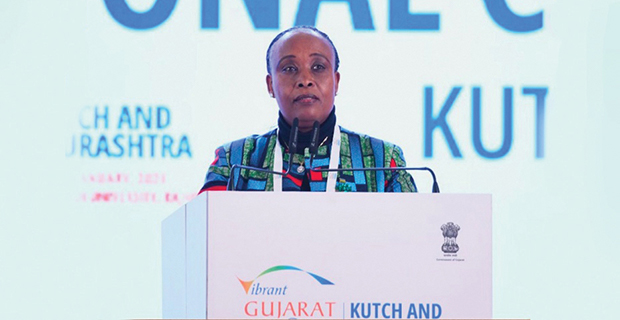
Rajkot: More Gujaratis are coming to Rwanda because they can benefit from a conducive investment environment offering fiscal and non-fiscal incentives and zero tolerance for corruption, Rwanda’s Ambassador to India Jacqueline Mukangira said.
Speaking to IANS on the sidelines of the Vibrant Gujarat Regional Conference, the envoy said Rwanda and India enjoy excellent bilateral relations, with many Indians, particularly Gujaratis, doing business in the East African country.
Trade And Investment
“In fact, India is the second-largest foreign investor in Rwanda and also its second-largest trading partner,” she said, adding that Rwanda imports pharmaceuticals, ICT machinery and equipment, as well as rice, textiles and sugar, much of which can be sourced from Gujarat.
High-Level Engagement
Prime Minister Narendra Modi paid a state visit to Rwanda in 2018 at the invitation of President Paul Kagame, marking the first-ever visit by an Indian Prime Minister to the country.
The visit was the fifth high-level interaction between the two nations in 18 months and included one-on-one talks and delegation-level discussions.
Agreements And Credit
Eight preliminary agreements were signed during the visit, covering trade, defence, dairy cooperation, agriculture, culture, leather and allied sectors, along with a $200 million line of credit for special economic zones and irrigation.
Rwanda has effectively utilised $400 million worth of Indian lines of credit. Beyond financial aid, India also supported capacity-building in education, skill development, renewable energy, healthcare, tourism, agriculture, defence and science and technology.
People-Centric Support
As part of support for President Kagame’s Girinka programme, PM Modi gifted 200 cows under the ‘one cow-one family’ initiative aimed at uplifting rural livelihoods.
The leadership of both countries also remained in touch during the Covid-19 pandemic, reinforcing cooperation during a global crisis.
Related News.
-

September 2026 Gorillas Find Names
-

September 2026 India–Kiribati Deepen Cooperation
-

September 2026 India, Ethiopia Deepen Defence Ties
-

September 2026 JAMAICA AT 64,TIES DEEPEN

EDITOR'S DESK, Sep 2026
 Our cover takes us to Volcanoes National Park, where Rwanda recently hosted the 21st Kwita Izina, its annual Gorilla Naming Ceremony. Twenty-two baby mountain gorillas received their names, but the significance of the occasion went far beyond a celebration of wildlife...
more...
Our cover takes us to Volcanoes National Park, where Rwanda recently hosted the 21st Kwita Izina, its annual Gorilla Naming Ceremony. Twenty-two baby mountain gorillas received their names, but the significance of the occasion went far beyond a celebration of wildlife...
more...
Ads Spot


Comments.