

A PLACE OF RETURN
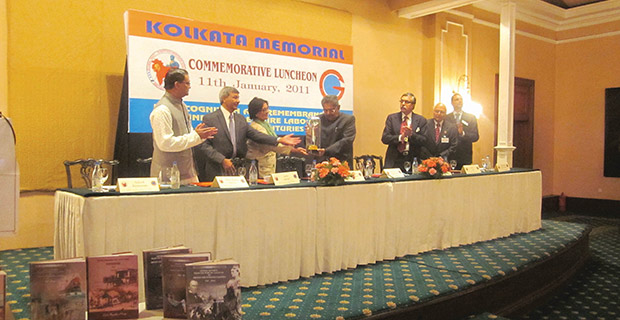
Some moments in an interview change the character of the conversation. The discussion about the Kolkata Memorial was one such moment.
The subject arose while discussing the Prime Minister’s emphasis on the Girmitiya community and the possibility of creating a greater institutional focus on the descendants of Indians who left the country during the colonial period.
India Empire pointed out that the Kolkata Memorial, developed in 2011, had remained largely neglected, despite the extraordinary global success and influence of the Girmitiya communities. The suggestion was that the site could become a place of pilgrimage and remembrance for people whose ancestors departed from India but whose cultural and emotional connection with the country remains strong.
Union Minister for Culture & Tourism Shri Gajendra Singh
Shekhawat’s response was strikingly direct. He thanked the interviewer for bringing the subject to his attention and acknowledged that the issue had not previously been discussed in his Ministry. He explained that the property falls under the administrative responsibility of the ministry dealing with ports and shipping, while the broader Girmitiya question is primarily handled by the Ministry of External Affairs.
That, however, did not lead him to pass the subject elsewhere. Instead, he said: “Since you have brought it into my knowledge I’ll discuss it.” He also recognised the emotional importance of such a place to the diaspora.
The Girmitiya experience, in his description, created a physical separation from the homeland without severing the emotional connection to it. During his own visits to countries including South Africa, Mauritius and Malaysia, he had encountered communities several generations removed from India who continued to preserve their language and culture.
Their hearts, he said, still beat for India. That observation gives the Kolkata Memorial a significance beyond that of another historical site.
It could become a physical point of connection between India and a global community whose ancestors left under profoundly different circumstances but whose descendants today occupy prominent positions in the political, business and social life of their adopted countries.
The Minister also connected the Memorial to tourism. He suggested that tourism projects could be initiated in West Bengal and argued that the state possesses enormous untapped potential, ranging from natural beauty and cultural diversity to historical monuments and sites associated with India’s freedom struggle.
The conversation then widened further. India Empire pointed out that several countries with substantial populations of Indian origin now have people of Indian descent occupying the highest political offices and that these countries could potentially participate in a broader initiative around the Memorial.
The Minister welcomed that possibility and asked for assistance in connecting with such communities and governments. His language suggested that he saw the issue not merely as a memorial project but as a potential whole-of-government engagement with the global Indian diaspora.
He noted that the relationship was a shared legacy: people who left India established themselves abroad and contributed significantly to the development of their adopted countries, while retaining their roots in India.
That is perhaps the most interesting possibility contained within this exchange. The Kolkata Memorial need not remain simply a marker of departure. It could become a place of return.
A place where descendants of Girmitiyas can encounter the story of those who left, understand the historical circumstances of their departure, and reconnect with the civilisation, culture and homeland that remained part of their identity across generations.
And perhaps that is why the subject landed so strongly in this otherwise wide-ranging conversation about culture and tourism. It brought the discussion of India’s civilisational heritage out of museums and monuments and into the lives of millions of people whose ancestors carried that heritage across oceans.
Related News.
-

October 2026 A NEW CHAPTER
-

September 2026 Gorillas Find Names
-

September 2026 India–Kiribati Deepen Cooperation
-

September 2026 India, Ethiopia Deepen Defence Ties


Comments.