

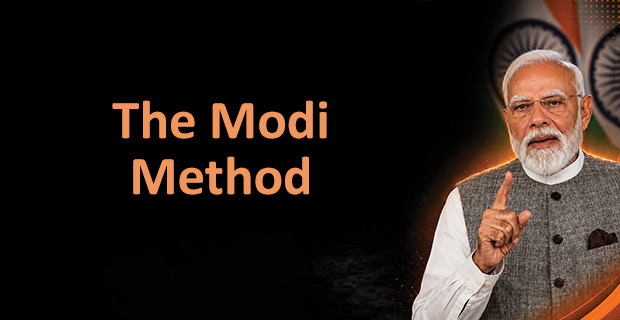
The Modi Method
Across continents, cultures and competing geopolitical theatres, India’s foreign policy is quietly revealing a defining characteristic of the Modi era: an architecture built less on alliances of convenience and more on networks of confidence, where diplomacy is measured not by isolated breakthroughs but by the steady accumulation of trusted partnerships.
There are moments in the life of a nation when individual diplomatic engagements cease to be isolated events and begin to resemble pieces of a much larger design. Read independently, the meetings, state visits, strategic dialogues and bilateral consultations that have occupied India’s diplomatic calendar over recent weeks appear to tell different stories. A President celebrating the Indian diaspora in Romania. An External Affairs Minister moving tirelessly between conference rooms in Manila. A Minister of State reinforcing partnerships in Central Asia. A new diplomatic mission taking root in Los Angeles. Mauritius reaffirming its place at the heart of India’s Indian Ocean vision. Australia, Indonesia and New Zealand assuming renewed importance within the Indo-Pacific. Yet when these episodes are viewed together, a remarkable pattern begins to emerge. They are not disconnected episodes. They are expressions of a single strategic grammar.
That grammar may well come to define what future historians describe as the Modi Method of diplomacy.
The most striking feature of this approach is its refusal to accept the traditional boundaries that once separated foreign policy into neat compartments. Earlier eras often viewed diplomacy through a limited set of lenses: defence, trade, development assistance or political engagement. Contemporary Indian diplomacy increasingly treats all these dimensions as parts of a single ecosystem. Maritime security influences commerce. Technology strengthens strategic autonomy. Universities become instruments of diplomacy. Diaspora communities become economic partners. Infrastructure reinforces geopolitical trust. Culture quietly underwrites political confidence. Foreign policy, in this conception, resembles less a series of bilateral transactions than an intricate web in which every strand strengthens the whole.
Mauritius provides perhaps the clearest illustration of this philosophy. Once regarded primarily as a country connected to India through history and ancestry, it has steadily evolved into a strategic partner encompassing healthcare, infrastructure, maritime cooperation, technology, education and regional security. The relationship no longer rests upon sentiment alone. It has become one of the Global South’s most persuasive demonstrations that shared history can serve as the foundation for shared prosperity. The language of diplomacy has moved seamlessly from memory to modernity.
A similar evolution is visible across the Indo-Pacific. For decades, discussions concerning the region were dominated by questions of military balance and strategic competition. India continues to recognise those realities, yet its own response has become noticeably broader. Partnerships with Australia, Indonesia and New Zealand are now framed as much around resilient supply chains, renewable energy, education, innovation, critical minerals and digital technologies as around maritime security itself. Rather than constructing alliances directed against others, India is constructing partnerships designed to strengthen itself and its friends simultaneously. That distinction is subtle but profound.
Another defining characteristic of the Modi Method is its extraordinary geographical confidence. There was a time when Indian diplomacy tended to concentrate upon immediate neighbourhoods or specific strategic theatres. Today’s engagement stretches comfortably from Eastern Europe to the Pacific, from the Gulf to North America, from Central Asia to the islands of the Indian Ocean, without appearing overextended. Such breadth reflects not diplomatic activism for its own sake but an understanding that the world’s strategic and economic centres have themselves become deeply interconnected. A semiconductor partnership in Europe may ultimately strengthen manufacturing in India. Maritime cooperation in Southeast Asia may reinforce energy security in the Indian Ocean. Educational exchanges in California may accelerate technological innovation in Bengaluru. Geography no longer limits diplomacy; connectivity defines it.
Perhaps nowhere is this changing philosophy more visible than in India’s relationship with its own diaspora.
Previous generations often viewed overseas Indians primarily as communities requiring consular support or cultural engagement. The present approach recognises them as strategic assets. Whether in Bucharest, where President Droupadi Murmu celebrated Indians who have become ambassadors of Indian civilisation through their contributions to Romanian society, or in Los Angeles, where entrepreneurs and professionals are helping redefine India’s image in one of the world’s most influential economic regions, the diaspora has become an extension of India’s international personality. It is difficult to identify another country whose overseas communities have become so seamlessly integrated into its diplomatic thinking.
Technology, too, has assumed a place once reserved exclusively for geopolitics. Conversations concerning artificial intelligence, semiconductors, cybersecurity, clean energy, biotechnology and digital governance now appear alongside discussions of defence, maritime security and trade. Even the proposed integration of India’s DigiLocker platform with systems in the United Arab Emirates illustrates how technological interoperability is gradually becoming a tool of international engagement. Twenty-first century diplomacy increasingly depends not only upon embassies and treaties but upon digital platforms, research laboratories and innovation ecosystems.
Equally noteworthy is the style with which this diplomacy is conducted.
There is little evidence of triumphalism. Major announcements are comparatively rare. Instead, the emphasis falls upon continuity. Ministerial meetings follow strategic roadmaps. Institutional dialogues become annual exercises. Universities sign research agreements. Defence establishments meet regularly. Business councils deepen commercial engagement. Consulates are opened not simply to provide services but to cultivate long-term ecosystems of cooperation. The cumulative effect is one of quiet momentum rather than dramatic spectacle.
That temperament reflects an older civilisational instinct adapted to contemporary realities. India’s diplomatic tradition has rarely sought influence through coercion. Its greatest successes have generally emerged from persuasion, accommodation and the patient cultivation of trust. The modern expression of that instinct is not ideological. It is deeply pragmatic. Countries engage India because they increasingly perceive it as reliable, predictable and respectful of national priorities.
This approach also explains India’s growing resonance within the Global South. Rather than presenting itself as a patron, India increasingly positions itself as a partner. Infrastructure is accompanied by capacity building. Healthcare is paired with technology transfer. Maritime cooperation is balanced by educational exchanges. Development projects emerge through consultation rather than prescription. For many developing nations, this represents an attractive alternative to more transactional models of international engagement.
Yet perhaps the most remarkable aspect of the Modi Method lies elsewhere.
It is the recognition that diplomacy ultimately remains a profoundly human enterprise.
Governments negotiate agreements, but trust is built by students who study abroad, scientists who collaborate across borders, entrepreneurs who invest in unfamiliar markets, artists who interpret one civilisation to another, doctors who save lives far from home and diaspora communities who preserve cultural memory while embracing new identities. India’s diplomacy increasingly acknowledges these quieter ambassadors alongside ministers and heads of government. In doing so, it expands the very definition of foreign policy.
The cumulative effect is beginning to reshape international perceptions of India. The country is no longer viewed merely as a rapidly growing economy or an emerging strategic power. It is increasingly seen as a nation capable of convening conversations, sustaining partnerships and connecting regions that once appeared only loosely related. That role carries responsibilities as much as opportunities, demanding patience, consistency and the confidence to think in decades rather than diplomatic news cycles.
History will ultimately decide whether this evolving framework deserves a formal place among the recognised schools of international statecraft. Yet even at this stage, one conclusion appears difficult to avoid. The individual stories emerging from Bucharest, Port Louis, Manila, Bishkek, Auckland, Los Angeles and countless other diplomatic capitals are no longer isolated dispatches from distant embassies. Together, they reveal the outlines of a coherent strategic philosophy.
It is a philosophy that understands power not merely as military capability or economic scale, but as the ability to inspire confidence across cultures, institutions and continents. In an increasingly fragmented world, that may prove to be India’s most valuable diplomatic resource of all.
Related News.
-

October 2026 A NEW CHAPTER
-

September 2026 Gorillas Find Names
-

September 2026 India–Kiribati Deepen Cooperation
-

September 2026 India, Ethiopia Deepen Defence Ties



Comments.