

Roots Reach Skyward
Whether preserving India’s civilisational legacy in distant lands or shaping the skylines of global cities, the Indian diaspora is steadily emerging as one of the country’s most enduring diplomatic assets, extending India’s influence through enterprise, culture and human aspiration.
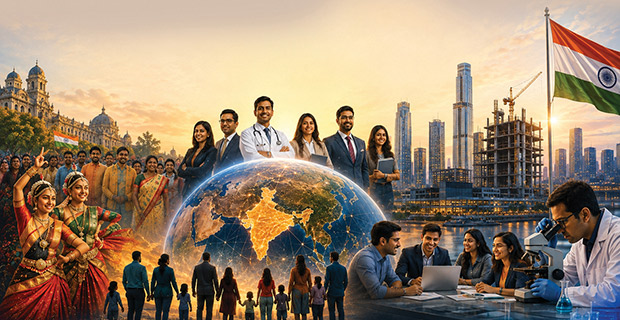
For generations, the story of the Indian diaspora was told through the language of migration. It was a story of ships crossing oceans, of families leaving familiar shores in search of uncertain futures, and of communities patiently rebuilding their lives in distant lands. Today, that narrative has entered an altogether different chapter. Across continents, overseas Indians are no longer simply participants in their adopted societies. They are increasingly among their architects, contributing to public life, business, academia, science, technology and culture while remaining deeply connected to the civilisation from which they trace their origins.
India’s diplomatic engagements over the past week offered compelling reminders of this remarkable evolution. In Bucharest, President Droupadi Murmu celebrated members of the Indian community for preserving India’s cultural heritage while making meaningful contributions to Romanian society. Thousands of kilometres away in Los Angeles, entrepreneur Dr Kali P. Chaudhary spoke passionately of his ambition to transform one of the city’s most recognisable unfinished developments into a landmark that would forever carry an unmistakable Indian imprint. Between those two stories lies the extraordinary journey of a diaspora that has become one of India’s greatest global strengths.
President Murmu’s remarks in Romania captured the quiet dignity with which Indian communities have integrated into societies across Europe without surrendering their cultural identity. Festivals continue to be celebrated, traditions preserved and languages spoken, not as nostalgic reminders of another home but as living expressions of a civilisation confident enough to flourish far beyond its geographical boundaries. Her observation that the diaspora represents India through its contributions as much as through its culture reflects a profound shift in the way New Delhi now views overseas Indians. They are no longer regarded simply as expatriate communities but as indispensable partners in India’s engagement with the world.
That philosophy is equally visible in the United States, where India’s newest Consulate General in Los Angeles has deliberately positioned itself as more than a provider of consular services. Serving a region that is home to hundreds of thousands of people of Indian origin, the mission has embraced a broader role, facilitating commercial partnerships, educational exchanges, technological collaboration and investment opportunities across one of America’s most innovative economic regions. The enthusiasm with which the diplomatic mission has been received by the local Indian community underscores the growing expectation that diplomacy should actively support the aspirations of overseas Indians while harnessing their extraordinary capabilities.
Yet perhaps no story better illustrates the emotional complexity of the diaspora experience than that of Dr Kali P. Chaudhary. Having spent years pursuing the acquisition of the long-abandoned Oceanwide Plaza development in downtown Los Angeles, he speaks of the project not primarily as a commercial investment but as a legacy. His dream of transforming the site into KPC Square, complete with an iconic skyline presence and a visible celebration of Indian identity, reflects a sentiment familiar to countless first-generation immigrants: profound gratitude towards the country that offered opportunity, coupled with an enduring affection for the country that shaped their beginnings.
His words reveal an important truth about the modern Indian diaspora. Success abroad no longer requires a diminishing of identity. On the contrary, confidence in one’s Indian heritage increasingly accompanies professional achievement on the global stage. For Dr Chaudhary, displaying the Indian flag in one of America’s great cities symbolises not separation from his adopted homeland but the confidence of a community comfortable embracing both identities simultaneously. His admiration for India’s growing international stature reflects a wider sentiment shared by many overseas Indians who increasingly see the country’s global rise as intertwined with their own journeys.
This changing reality has also transformed the practice of diplomacy itself. Indian embassies and consulates today engage diaspora communities not merely through ceremonial events but as partners in investment promotion, educational collaboration, technological innovation and cultural outreach. Overseas Indians have become valuable connectors between institutions, businesses, universities and governments, often creating opportunities that formal diplomatic channels alone could never achieve.
Their contribution is especially significant in countries such as the United States, where Indian-origin professionals occupy leadership positions across medicine, finance, academia, engineering, public policy and entrepreneurship. Their influence extends well beyond individual success stories. Collectively, they strengthen confidence in India as a partner in innovation, advanced manufacturing, artificial intelligence, biotechnology and higher education, sectors that increasingly define the future of bilateral engagement.
There is also a deeper civilisational dimension to this global presence. Unlike many diaspora communities whose connections with their ancestral homelands gradually weaken across generations, Indians abroad have often sustained remarkably resilient cultural bonds. Festivals, literature, cuisine, spirituality and family traditions continue to thrive across successive generations, ensuring that identity evolves rather than disappears. That continuity has become one of India’s most distinctive forms of soft power, impossible to manufacture through policy yet invaluable in strengthening international goodwill.
As India’s global influence continues to expand, the role of its diaspora is likely to become even more significant. Governments negotiate agreements, businesses create wealth and universities generate knowledge, but it is communities that give international relationships their enduring human character. The Indian diaspora has become precisely such a community, one capable of carrying India’s story into boardrooms, laboratories, classrooms, hospitals and city skylines across the world.
In the final analysis, the greatest monuments built by overseas Indians may not always be made of steel, glass or concrete. They are equally found in reputations earned through integrity, institutions strengthened through leadership and friendships cultivated across cultures. Those are achievements that no diplomatic communiqué can fully capture, yet they remain among the strongest foundations upon which India’s relationships with the world continue to grow.
Related News.
-

September 2026 Healing Beyond Borders
-

September 2026 MARRIAGE BEYOND BORDERS CROSS-BORDER JUSTICE
-

September 2026 Diaspora, Defence And Growth
-

September 2026 President in Romania



Comments.