

INDIA’S AFRICA PARTNERSHIP
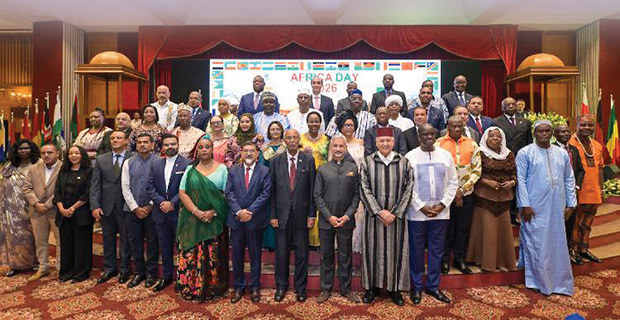
New Delhi: India’s engagement with Africa is increasingly focused on capacity-building, human capital and long-term economic cooperation rather than resource extraction, according to a report by India Narrative in August. The report presents India’s engagement with the continent as a model that combines trade and investment with training, healthcare, infrastructure and technology, emphasizing support for structural transformation rather than creating dependency.
The report points to several initiatives that illustrate this approach. India has supplied foodgrains to African countries facing shortages, sent medical equipment to the Africa Centres for Disease Control and Prevention during health emergencies, and provided artificial limbs to conflict victims. More than 80,000 Africans have benefited from scholarship and training programmes over the past decade, with beneficiaries going on to become engineers, diplomats, doctors and technicians.
“As Africa recalibrates its place in a changing world order, India’s approach to the continent offers a useful, if imperfect, case study in what a genuinely reciprocal partnership can look like,” the report noted.
The economic relationship has expanded alongside these capacity-building initiatives. India-Africa bilateral trade has climbed to around $93 billion, placing India among the continent’s largest trading partners, while Indian investment in Africa exceeds $80 billion. The investments are spread across telecommunications, energy, pharmaceuticals, agriculture and digital services—sectors that African governments have prioritised for structural transformation rather than simply the extraction of raw commodities.
The report also highlighted more than 190 Lines of Credit worth over $10 billion, which have financed projects ranging from power plants to water systems. It cited an IIT campus in Zanzibar and a forensic sciences institute in Uganda as examples of Indian initiatives aimed at strengthening African human capital and institutional capabilities.
The argument is reinforced by developments in Kenya, where India’s relationship is increasingly viewed through the prism of shared capabilities and innovation rather than conventional donor-recipient economics. A report in Daily Nation said the relationship was entering a new phase centred on shared capacity, innovation and interests, building on decades of cooperation in scholarships, professional training, affordable medicines and infrastructure.
“The partnership is rooted in decades of cooperation, with thousands of Kenyan professionals trained in India through scholarships and the Indian Technical and Economic Cooperation programme. It now aligns with Kenya’s ambition to become a regional digital and innovation hub,” the report said.
A key example is the DigiLocker partnership, which is expected to enable secure digital storage and verification of official documents, helping Kenya reduce fraud and improve access to public services. The initiative illustrates how the relationship is moving towards technology-enabled institutional capacity rather than simply financing individual projects.
Economic ties have also strengthened, with bilateral trade rising to more than $4 billion annually. Cooperation in energy is expanding as well, with Kenya partnering with India’s Power Grid Corporation and Africa50 to develop high-voltage transmission lines and substations aimed at improving grid reliability, integrating renewable energy sources and strengthening electricity supply across Western and Northern Kenya.
India’s support has also extended to healthcare and skills development. Kenya has received a Bhabhatron-II radiotherapy machine, while India supplied medicines and vaccines during the Covid-19 pandemic and supported disease-outbreak preparedness. Kenyan professionals and students have also acquired skills in renewable energy, governance, technology and disaster management through ITEC programmes and scholarships.
“India-Kenya relations should no longer be viewed through the old donor-recipient lens. What is emerging is a partnership focused on building the systems, skills and institutions needed for long-term competitiveness. The next phase is about shared capacity, innovation and interests rather than simply financing projects,” the Daily Nation report said.
The same evolution is visible in India’s bilateral engagement with Egypt. Mr Piyush Goyal, Commerce and Industry Minister, met Dr Mohamed Farid Saleh, Minister of Investment and Foreign Trade, Egypt, on the sidelines of the BRICS India 2026 Trade and Industry Ministers’ Meeting in August.
The two sides discussed measures to enhance two-way investment flows, reinforce bilateral economic cooperation and facilitate smoother trade in digitally delivered services. The meeting added a contemporary bilateral dimension to India’s wider engagement with Africa, bringing investment and digital trade into the conversation alongside capacity-building and economic partnership.
India’s broader BRICS priorities also reinforce this direction. Addressing the BRICS Industry Ministers’ Meeting in Jaipur under India’s 2026 Chairship, Mr Goyal said member countries had a unique opportunity to strengthen manufacturing competitiveness, deepen technological collaboration, build resilient value chains and promote sustainable industrial growth.
He said India was emphasising stronger micro, small and medium enterprises (MSMEs), startup innovation, expanded clean-energy cooperation and technology-enabled logistics ecosystems as priorities for sustainable industrial development.
At the political level, the relationship with Kenya has also received renewed attention. In June, Prime Minister Mr Narendra Modi met Mr William Ruto, President of Kenya, on the sidelines of the Group of Seven (G7) Summit in Evian, France. Mr Modi described India and Kenya as longstanding partners whose relationship is anchored in the aspirations of the Global South and reaffirmed India’s commitment to working together for the well-being of their peoples.
The emerging pattern across these engagements is therefore broader than conventional development assistance. From professional training and healthcare to digital public infrastructure, energy networks, investment and trade, India’s African partnerships are increasingly oriented towards building capabilities that can generate sustained economic value.
The Kenya experience, in particular, gives substance to the broader argument that India’s relationship with Africa is moving towards shared capacity rather than dependency, innovation rather than prescription, and mutual interests rather than a one-way transfer of resources.
As the India Narrative report put it: “Africa’s demographic weight and India’s technological momentum together represent one of the more compelling economic combinations of this century.”
Related News.
-

October 2026 A NEW CHAPTER
-

October 2026 “We Can Be A Gateway”
-

October 2026 “Come And See Ecuador”
-

October 2026 Confidence Across Continents
India Empire TV


EDITOR'S DESK, Oct 2026
 The October 2026 issue of India Empire explores a world in which diplomacy, commerce, innovation and human connections increasingly shape one another. Across our stories, a recurring theme emerges: relationships acquire lasting value when goodwill is translated into practical outcomes...
more...
The October 2026 issue of India Empire explores a world in which diplomacy, commerce, innovation and human connections increasingly shape one another. Across our stories, a recurring theme emerges: relationships acquire lasting value when goodwill is translated into practical outcomes...
more...
Ads Spot

Comments.