

Lines of Life
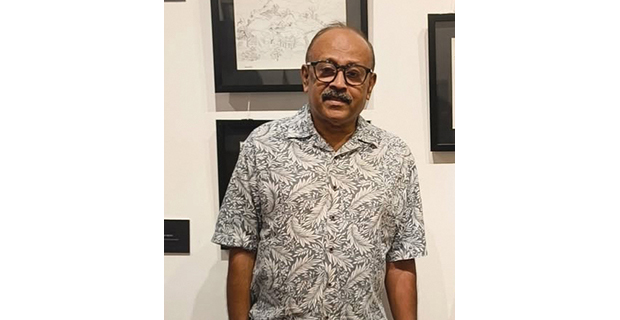
T.K. Manoj Kumar occupies a rare, almost paradoxical space where the disciplines of governance and art converse fluently. A former civil servant deeply familiar to the Indian diaspora, Manoj Kumar’s public life has been marked by substance and service, while his artistic journey has unfolded with quiet intensity and remarkable clarity. From policy rooms to sketchbooks, his life traces a continuum rather than a divide.
Between 2012 and 2016, as Joint Secretary for Diaspora Services in the then Ministry of Overseas Indian Affairs, Manoj Kumar played a central role in shaping India’s engagement with its global diaspora. The Pravasi Bharatiya Diwas conventions, the Know India Programmes, and the Scholarship Programme for Diaspora Children all bore his imprint. Earlier, as Secretary of the Department of Non-Resident Keralite Affairs in the Government of Kerala from 2010 to 2012, he worked at the intersection of migration, welfare, and policy. These years immersed him in human stories that would later surface, subtly yet powerfully, in his art.
His artistic foundations, however, were laid much earlier. Trained as an engineer at IIT Delhi, Manoj Kumar was drawn not merely to equations but to graphic science and machine design, disciplines that sharpened his ability to visualise complex, multidimensional forms with mathematical precision. Alongside this technical training ran a lifelong habit of close observation. An early love for reading and drawing encouraged him to record the world around him with whatever tools were available. Chalk on slate yielded to pencil on wall and paper, and eventually to fine brushes and technical pens. Today, he is convinced that the disciplined economy of black and white, rendered through India ink, can capture the essence of the world, almost entirely.
Joining the Indian Administrative Service in 1987 did not still this impulse. Instead, it gave his art a wider field. Manoj Kumar has emerged as a distinctive voice in pen-and-ink works, specialising in landscapes, urban cityscapes, and abstract forms. His compositions often balance movement and stillness: the bustle of city life set against quiet natural forms, or architecture poised within breathing spaces of light and shadow. What stands out is his attention to detail without surrendering the larger narrative. Each line serves both structure and story.
This synthesis was visible in two notable exhibitions in 2025: Past Forward at the India Habitat Centre and Between Delhi and the Clouds, a solo exhibition at the India International Centre, New Delhi. The works, many of which now belong to private collections, depict Delhi, Mussoorie, and other parts of India with a sense of lived intimacy. His illustrations have also enriched books such as Gup and Gossip from the Hills, Clouds End and Beyond, and Fragrant Words, as well as the illustrated diary Mussoorie Notebook. His latest work, My Lodi Garden Notebook, is an annotated diary that transforms a familiar public space into a meditative visual narrative.
Beyond the studio, Manoj Kumar has taught in Indian and international institutions and held senior governmental positions with distinction. His intellectual interests extend to migration, the training of public servants, and food security. In his art, as in his public life, there is a steady insistence on seeing clearly, drawing carefully, and understanding the human condition through disciplined lines and thoughtful silence.
Related News.
-

January 2025 Photo Gallery
-

November 2024 PHOTO GALLERY
-

July 2024 Photo Gallery
-

April 2024 A NEW ERA IN PHOTOGRAPHY

EDITOR'S DESK, Sep 2026
 Our cover takes us to Volcanoes National Park, where Rwanda recently hosted the 21st Kwita Izina, its annual Gorilla Naming Ceremony. Twenty-two baby mountain gorillas received their names, but the significance of the occasion went far beyond a celebration of wildlife...
more...
Our cover takes us to Volcanoes National Park, where Rwanda recently hosted the 21st Kwita Izina, its annual Gorilla Naming Ceremony. Twenty-two baby mountain gorillas received their names, but the significance of the occasion went far beyond a celebration of wildlife...
more...
Ads Spot


Comments.