

Digital World Home
Geopolitics And Strategic Autonomy
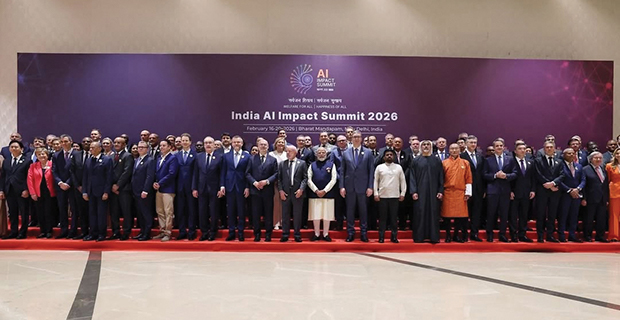
Macron placed India’s achievements within a broader geopolitical context. Artificial intelligence, he said, has become a field of strategic competition, with big technology players growing ever more powerful. Recalling the France–India co-hosted AI Action Summit in Paris the previous year, he said both countries had argued for AI as an enabler of humanity, capable of transforming healthcare, energy, mobility, agriculture, and public services.
At the same time, Macron praised India’s sovereign choices in AI development, including its focus on task-specific language models and the deployment of tens of thousands of government-funded GPUs to support startups. These decisions, he suggested, demonstrate that technological independence and innovation need not be mutually exclusive.
Returning to his opening anecdote, Macron concluded by rejecting the notion that India’s population size was a barrier to digital inclusion. India, France, and Europe, he said, would help shape an AI future that balances innovation with responsibility and technology with humanity.
The Platform Shift Of A Lifetime
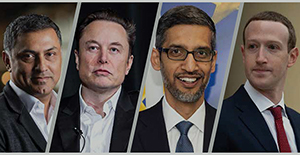
For Sundar Pichai, the summit was an opportunity to articulate why artificial intelligence represents, in his words, the biggest platform shift of our lifetimes. Addressing the opening ceremony, he said no technology had inspired him to dream bigger.
AI, Pichai said, is driving “hyper progress,” compressing decades of scientific research into years or even months. He pointed to AlphaFold, Google DeepMind’s protein-folding breakthrough, now used by millions of researchers across more than 190 countries, accelerating work on diseases such as malaria.
Yet Pichai was careful to stress that positive outcomes are neither automatic nor guaranteed. Governments and industry, he said, must act boldly but responsibly, ensuring that the benefits of AI are broadly shared.
India As An AI Investment Hub
Pichai highlighted Google’s expanding footprint in India, including a full-stack AI hub in Visakhapatnam as part of a US$15 billion infrastructure investment. The facility, he said, would house gigawatt-scale compute capacity and a new international subsea cable gateway, bringing advanced AI capabilities and jobs to the country.
He also noted the construction of multiple new subsea optic cable systems linking India and the United States, reinforcing the country’s role as a central node in the global digital economy.
AI’s impact on employment, Pichai acknowledged, will be profound. Some roles will be automated, others transformed, and entirely new careers created. Google’s efforts to train 100 million people in digital skills, he said, are aimed at helping workers adapt to this shift.
Related News.
-

October 2026 A NEW CHAPTER
-

October 2026 “We Can Be A Gateway”
-

October 2026 “Come And See Ecuador”
-

October 2026 Confidence Across Continents
India Empire TV

EDITOR'S DESK, Oct 2026
 The October 2026 issue of India Empire explores a world in which diplomacy, commerce, innovation and human connections increasingly shape one another. Across our stories, a recurring theme emerges: relationships acquire lasting value when goodwill is translated into practical outcomes...
more...
The October 2026 issue of India Empire explores a world in which diplomacy, commerce, innovation and human connections increasingly shape one another. Across our stories, a recurring theme emerges: relationships acquire lasting value when goodwill is translated into practical outcomes...
more...
Ads Spot


Comments.