

NINE BILLION BILATERAL TRADE
India and Tanzania elevate a steadily expanding economic partnership, layering trade growth with strategic depth across sectors and systems.
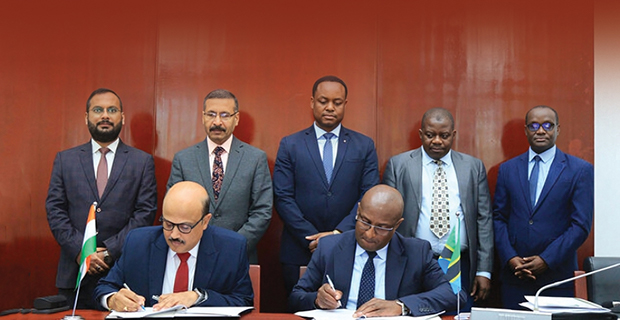
New Delhi: Bilateral trade between India and Tanzania reached $9.02 billion in 2025–26, rising from $8.64 billion in 2024–25, the government said in early May. It’s a progression that reflects not merely incremental growth but the quiet consolidation of a partnership gaining both breadth and ballast. What emerges is not a spike but a pattern: a trade relationship increasingly underwritten by policy intent, institutional dialogue and sectoral alignment.
Against this widening arc, the fifth session of the India-Tanzania Joint Trade Committee (JTC) convened in Dar es Salaam. Discussions moved beyond routine exchanges into the architecture of future engagement. From enabling trade settlement in local currencies to easing long-term business visas for Indian businesspersons, and from tightening regulatory collaboration in pharmaceuticals to expanding capacity building in health, AYUSH, education and shipbuilding, the agenda revealed a partnership intent on reducing friction while deepening capability.
The meeting, co-chaired by Commerce Secretary Rajesh Agrawal and Dr. Samwel William Shelukindo, Permanent Secretary in Tanzania’s Ministry of Foreign Affairs and East African Cooperation, reaffirmed the JTC’s role as more than a consultative forum, positioning it instead as a working instrument shaping the rhythm and direction of bilateral economic ties. Beneath the formal exchanges lay a clear recognition that sustained engagement, rather than episodic interaction, now defines India-Tanzania cooperation.
“Collaboration in the mining sector including geological exploration and mining, value addition in the gemstone sector, regulatory developments related to gemstone exports, and opportunities for capacity building and skill development were discussed.”
If mining and gemstones spoke to resource collaboration, education and skills pointed to long-term investment in human capital. The emphasis on IIT Madras Zanzibar as an emerging regional hub for science and technology carried symbolic and strategic weight, signalling India’s intent to embed knowledge partnerships within Africa’s growth story. Alongside, enhanced MSME cooperation and the exploration of new institutional linkages suggested an effort to democratise economic participation, extending opportunity beyond large enterprises into the wider industrial ecosystem.
Related News.
-

October 2026 A NEW CHAPTER
-

September 2026 Gorillas Find Names
-

September 2026 India–Kiribati Deepen Cooperation
-

September 2026 India, Ethiopia Deepen Defence Ties



Comments.