

WEARING A NEW JERSEY
A young Indian-American candidate is seeking to redefine New Jersey politics, positioning himself as a voice for generational change, affordability and stronger US-India ties.
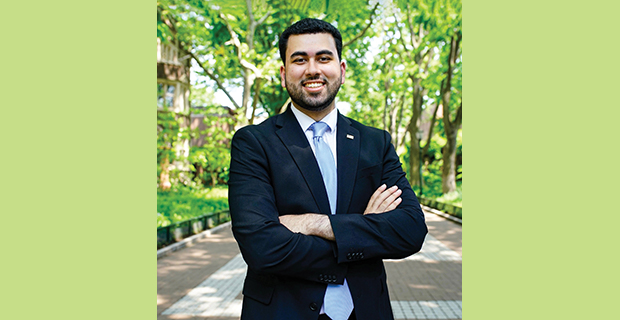
WASHINGTON: A 28-year-old former White House and Department of Energy official is aiming to make political history in New Jersey by becoming both the state’s first Gen Z and first Indian-American member of Congress. Jay Vaingankar, the son of immigrants from Mumbai, is among a crowded field of Democratic candidates contesting the primary for New Jersey’s 12th Congressional District, an open seat created by the retirement of veteran Congresswoman Bonnie Watson Coleman after a long public career.
With only days remaining before the primary, Vaingankar told IANS in an exclusive interview that his campaign is centred on affordability, clean energy investment and political reform. He believes voters are increasingly weary of political stagnation and are looking for leaders who better reflect the aspirations and realities of younger generations. If elected, he would become New Jersey’s first Gen Z representative in Congress and the first South Asian to represent the state at the federal level.
Vaingankar said his decision to enter the race followed widespread encouragement from community members after Watson Coleman’s retirement announcement. Many residents, he noted, felt it was time to move beyond entrenched political succession and instead support candidates who genuinely respond to community concerns. He argued that elected representatives must earn public trust through engagement and performance rather than entitlement or longevity.
Drawing on his experience in Washington, Vaingankar said frequent journeys between the capital and Central New Jersey exposed him to the mounting economic pressures facing ordinary families. While serving in the Biden administration, he regularly travelled home and witnessed rising grocery prices, growing household expenses and widespread dissatisfaction with political leadership. Those experiences, he said, reinforced his belief that affordability remains the defining challenge confronting voters today.
For Vaingankar, tackling the cost of living is inseparable from investing in the future. He advocates expanding clean energy technologies, arguing that renewable and alternative energy sources can simultaneously create jobs, lower utility bills and combat climate change. Rejecting what he calls the false choice between affordable energy and environmental responsibility, he has championed greater investment in solar, wind and nuclear technologies while emphasising the need to strengthen American competitiveness in the global green technology sector.
The Democratic primary features 12 candidates, making it one of the most competitive and unpredictable races in the state. Vaingankar acknowledges that vote splitting could play a decisive role, with victory potentially achievable through a relatively small share of the total vote. Nevertheless, he believes younger voters and the growing South Asian community are increasingly engaged and eager to support candidates who represent generational change and broader diversity in public office.
On foreign policy, Vaingankar underscored the importance of a strong US-India partnership. He described India as one of the world’s fastest-growing economies and argued that closer cooperation between Washington and New Delhi should be grounded in democratic values, economic collaboration and long-term strategic interests. He believes a stronger bilateral relationship will benefit both countries as they navigate an evolving global landscape.
Vaingankar’s own story mirrors that of many Indian-American families. Born in Trenton to parents who emigrated from Mumbai, he was raised in East Windsor and Hightstown, studied at the Wharton School of the University of Pennsylvania, served in Washington and later returned to New Jersey. As the district prepares to choose a successor to Watson Coleman, his candidacy has attracted attention from political observers, Asian-American organisations and a growing network of young volunteers eager to help shape the next generation of leadership.
Related News.
-

October 2026 A NEW CHAPTER
-

September 2026 Gorillas Find Names
-

September 2026 India–Kiribati Deepen Cooperation
-

September 2026 India, Ethiopia Deepen Defence Ties


Comments.