

Many Tables, One Vision
From the Gulf to the Pacific, External Affairs Minister Dr S. Jaishankar’s intensive diplomatic engagements on the sidelines of ASEAN meetings in Manila reflected India’s expanding foreign policy canvas, where every bilateral conversation contributes to a larger strategic architecture spanning the Indo-Pacific and beyond.
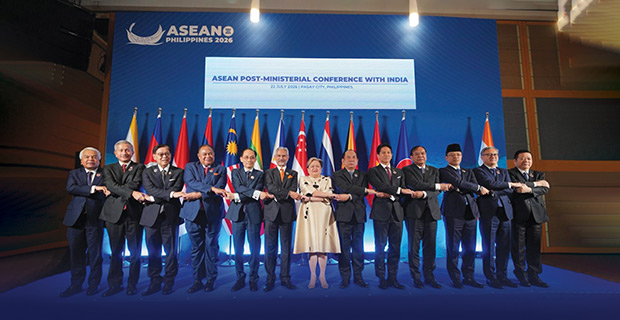
International diplomacy has evolved far beyond the era of singular headline-making summits. Today’s foreign policy is frequently advanced in the corridors of multilateral conferences, where ministers move from one meeting room to another, stitching together a mosaic of bilateral engagements that collectively shape the international landscape. Each conversation may last only a few minutes, yet together they define strategic priorities, reinforce partnerships and create the trust that sustains diplomacy long after formal declarations have faded from public attention.
That quiet but consequential diplomacy was on full display as External Affairs Minister Dr S. Jaishankar undertook an intensive series of bilateral meetings during the ASEAN-related ministerial gatherings in Manila. Far from being routine diplomatic courtesy calls, the engagements revealed the remarkable breadth of India’s contemporary foreign policy, encompassing West Asia, Southeast Asia, Europe, the Pacific Islands and South Asia within the space of a single multilateral forum.
Among the most significant discussions was Dr Jaishankar’s meeting with Oman’s Foreign Minister Sayyid Badr bin Hamad Al Busaidi. Coming at a time of heightened uncertainty in West Asia, the interaction underscored the importance both countries attach to maintaining close consultations on regional developments. India and Oman have long shared one of the Gulf region’s most stable and enduring relationships, founded upon centuries of maritime trade, economic cooperation and a vibrant Indian community. Against the backdrop of renewed regional tensions, the decision by both ministers to remain in close contact reflected a shared commitment to dialogue and stability rather than confrontation.
Equally significant was Dr Jaishankar’s interaction with Netherlands Foreign Minister Tom Berendsen, where discussions focused on translating the momentum generated by Prime Minister Narendra Modi’s recent visit into concrete areas of cooperation. The elevation of India-Netherlands relations to a Strategic Partnership has opened fresh avenues across semiconductors, green hydrogen, water management, healthcare and culture, sectors that increasingly define the future of international cooperation. What was once viewed primarily as a traditional European bilateral relationship is now evolving into a technology-driven partnership aligned with the emerging priorities of the global economy.
The Manila meetings also reflected India’s continuing commitment to humanitarian engagement. Dr Jaishankar’s interaction with Christian Saunders, the Acting Commissioner-General of the United Nations Relief and Works Agency for Palestine Refugees, focused on India’s longstanding support in healthcare and capacity building. Even amid complex geopolitical realities, New Delhi continues to emphasise humanitarian assistance as an integral component of its international engagement, balancing strategic interests with developmental commitments.
As host nation, the Philippines naturally occupied an important place in the minister’s schedule. Calling on President Ferdinand R. Marcos Jr., Dr Jaishankar conveyed Prime Minister Modi’s greetings while reaffirming India’s support for the Philippines’ ASEAN chairmanship. The meeting also reflected the expanding scope of the India-Philippines Strategic Partnership, which now extends well beyond traditional diplomatic exchanges into defence cooperation, maritime security, connectivity and regional coordination. The implementation of the India-Philippines Plan of Action 2025-2029 signals a relationship steadily acquiring greater strategic substance within the wider Indo-Pacific framework.
India’s outreach, however, extended far beyond its immediate neighbourhood. Meetings with Papua New Guinea and Brunei illustrated New Delhi’s growing engagement with the wider Pacific. Discussions with Papua New Guinea centred upon development partnerships, capacity building and maritime security through the Forum for India-Pacific Islands Cooperation, reaffirming India’s determination to deepen ties with island nations whose strategic importance has increased considerably in recent years. Simultaneously, conversations with Brunei highlighted emerging areas of collaboration in artificial intelligence, drones, digital technologies and innovation, while reinforcing India’s commitment to advancing its Act East Policy through stronger engagement with ASEAN.
The minister’s interactions with Sri Lanka, Bangladesh and the European Union’s High Representative Kaja Kallas further demonstrated the diversity of India’s diplomatic priorities. While each discussion addressed its own bilateral agenda, together they reflected India’s determination to maintain regular, high-level political engagement with neighbours, regional organisations and global partners alike. Such continuity has increasingly become a hallmark of Indian diplomacy, recognising that relationships are strengthened not merely through landmark agreements but through consistent dialogue across multiple platforms.
Related News.
-

October 2026 A NEW CHAPTER
-

September 2026 Gorillas Find Names
-

September 2026 India–Kiribati Deepen Cooperation
-

September 2026 India, Ethiopia Deepen Defence Ties


Comments.