

A DECLARATION DESPITE DIVIDES
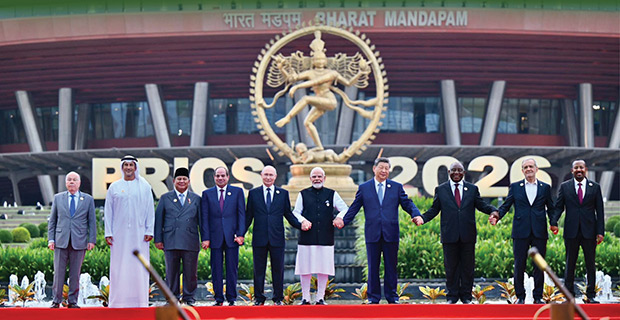
Hong Kong: India helped steer the expanded BRICS grouping towards a joint declaration at its 18th Summit in New Delhi, navigating differences among the 11 members over global conflicts and the international order while keeping the focus on trade, technology and a greater voice for developing countries, according to analysts cited by the South China Morning Post (SCMP).
The summit, held in New Delhi over the weekend, brought together leaders of the expanded BRICS grouping to deliberate on international conflicts, trade tensions and global economic governance before adopting a joint declaration. As chair, India placed emphasis on digital public infrastructure, a fairer global financial system and greater representation for developing countries. Analysts quoted by SCMP described the agreement as a product of India’s effort to accommodate divergent positions without allowing geopolitical disagreements to prevent consensus.
Manoj Kewalramani, geopolitical analyst and Chairman of the Takshashila Institution’s geostrategy programme in India, told SCMP that reaching agreement on the declaration was “no easy feat”. He said the document addressed key issues without entering into what he termed “the politics of apportioning blame”. In his assessment, Prime Minister Narendra Modi’s approach at the summit centred less on a contest between Western and non-Western powers and more on the exclusion of developing countries from international decision-making.
“The solution, therefore, is larger representation and a stake in rule-making. This is the anti-West vs non-West distinction between the two,” Kewalramani said. His comments point to one of the central themes running through India’s BRICS chairmanship: seeking a larger role for developing countries in the institutions and processes that shape global economic governance, while accommodating members whose geopolitical positions differ sharply.
The challenge was particularly evident in the lead-up to the summit. Sarang Shidore, Director of the Global South programme at the Washington-based Quincy Institute, told SCMP that BRICS foreign ministers had been unable to agree on a joint statement in May because of differences between new members Iran and the United Arab Emirates over the conflict in the Middle East. India, he said, found a way through the impasse at the summit.
Shidore pointed to language in the final declaration expressing “deep concern” and calling for “maximum restraint” amid rising tensions, while avoiding direct attribution of blame to any particular country. The formulation allowed the members to acknowledge the seriousness of the conflict without requiring the expanded grouping to adopt a common position on responsibility, a particularly significant consideration for a forum whose membership now encompasses a wider range of geopolitical interests.
The enlargement of BRICS has made consensus more complex while also broadened the grouping’s geographic and political reach. The New Delhi summit consequently placed a premium on finding areas of common ground. Trade, technology, digital public infrastructure and global financial reform offered subjects around which the members could engage despite differences over conflicts and the wider international order.
Related News.
-

October 2026 A NEW CHAPTER
-

October 2026 “We Can Be A Gateway”
-

October 2026 “Come And See Ecuador”
-
October 2026 Confidence Across Continents
India Empire TV


EDITOR'S DESK, Oct 2026
 The October 2026 issue of India Empire explores a world in which diplomacy, commerce, innovation and human connections increasingly shape one another. Across our stories, a recurring theme emerges: relationships acquire lasting value when goodwill is translated into practical outcomes...
more...
Ads Spot

Comments.