

India’s Diaspora Conversations
Plenaries on Indenture, Gulf Migration and Soft Power
Plenary Session 3, chaired by Prof. Naresh Kumar, Chairperson, Centre for Diaspora Studies, Central University of Gujarat, brought together senior scholars including Prof. Amba Pande (Jawaharlal Nehru University) on Indians in Myanmar; Prof. Anisur Rahman on Gulf migration patterns; Prof. Mukesh Kumar, Magadh University, on diaspora as India’s default soft power; and Shobha Ramsumair, USA, on Indo-Trinidadian identity.
Plenary Sessions 4 and 5, chaired respectively by Dr. Indrani Rampersad and Prof. Amba Pande, focused on indenture, gender, and postcolonial resistance. Particularly notable was Dr. Rampersad’s paper, The Mandir-in-the-Sea: Sadhu-Embodied Indian Soft Power, Colonial Defiance, and Postcolonial Resistance in the Trinidad Girmitiya Diaspora, which situated religious space as a site of cultural endurance and political assertion.
Global Conversations Online and Day Three
The online sessions expanded the conference’s global reach, featuring voices from South Africa, Indonesia, Guyana, Trinidad, Europe, and North America. Contributions included Dr. Thomas Abraham, Chairman, GOPIO International, on mobilising diaspora for India’s growth, and Suman Kapoor, community leader from Hamilton, New Zealand, speaking on diaspora and culture.
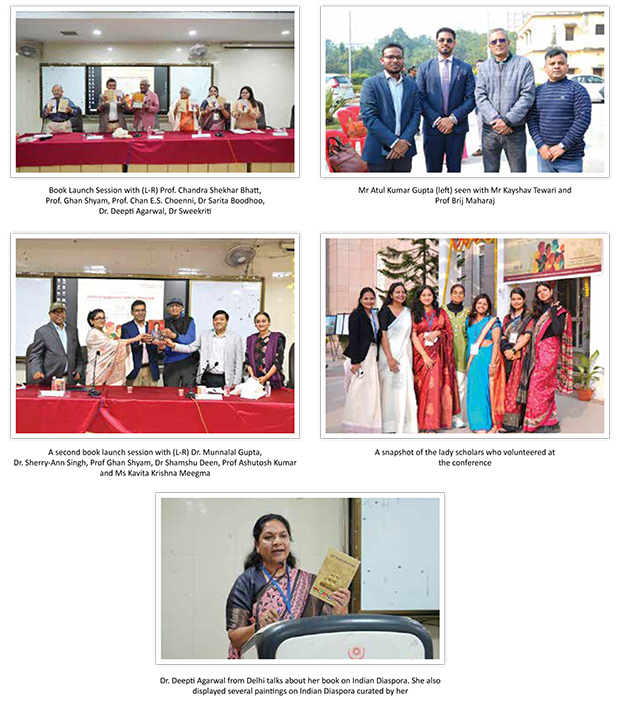
Day Three foregrounded literary, cultural, and policy-oriented perspectives, with papers addressing diasporic theatre, folk traditions, caste identities, digital belonging, climate diplomacy, and postcolonial memory. The final plenary, chaired by Prof. Ashutosh Kumar, Department of History, BHU, featured Dr. Sherry-Ann Singh, University of the West Indies, delivering A Doorway into the Caribbean: The Legacy of India’s Indentured Diaspora, alongside contributions from Dr. Rewa Singh, Dr. Munnalal Gupta, Assistant Professor, MGAHV Maharashtra, and Kavita Krishna Meegma.
Valediction and Conclusion
The Valedictory Session, chaired by Prof. Ashok Kumar Upadhyay, Dean, Faculty of Social Sciences, BHU, brought the conference to a thoughtful close. Prof. Brij Maharaj delivered the valedictory lecture, emphasising the need to integrate historical consciousness with contemporary policy imperatives, while Mr. Hemraj Ramdath reflected on entrepreneurship and diaspora narratives beyond indentureship. The proceedings concluded with a vote of thanks by Dr. Arpita Mitra, from BHU’s Department of History and Organising Secretary of the Conference, alongside Dr. Ghan Shyam.
Concluding Reflection
In many ways, the conference echoed Pandit Madan Mohan Malaviya’s founding vision of education as a force for self-reliance, social responsibility, and national service. By situating diaspora engagement within deep historical memory, lived cultural experience, and future-oriented policy thinking, the deliberations moved beyond symbolism toward informed, differentiated, and ethically grounded strategies. Hosted at an institution conceived to serve both nation and humanity, the conference reaffirmed that India’s global diaspora is not merely an external constituency, but an extension of its intellectual, cultural, and civilisational self—one that must be engaged with knowledge, empathy, and purpose as India navigates its 21st-century global role.
Related News.
-

September 2026 Healing Beyond Borders
-

September 2026 MARRIAGE BEYOND BORDERS CROSS-BORDER JUSTICE
-

September 2026 Diaspora, Defence And Growth
-

September 2026 President in Romania

EDITOR'S DESK, Sep 2026
 Our cover takes us to Volcanoes National Park, where Rwanda recently hosted the 21st Kwita Izina, its annual Gorilla Naming Ceremony. Twenty-two baby mountain gorillas received their names, but the significance of the occasion went far beyond a celebration of wildlife...
more...
Our cover takes us to Volcanoes National Park, where Rwanda recently hosted the 21st Kwita Izina, its annual Gorilla Naming Ceremony. Twenty-two baby mountain gorillas received their names, but the significance of the occasion went far beyond a celebration of wildlife...
more...
Ads Spot


Comments.