

CROSSING SEAS, MERGING FAITHS
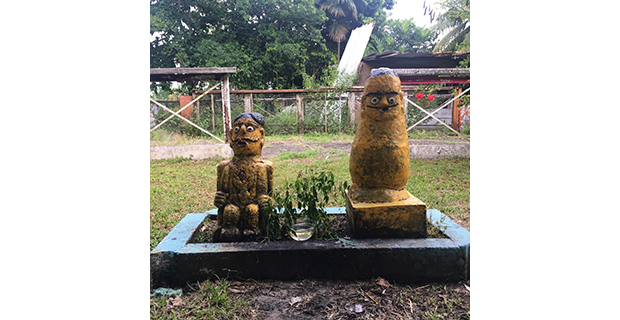
Guardians at the entrance of a Hindu temple in Martinique
Faith at Sea
The “curse of the black waters” severed the migrants from the protective presence of their gods. During violent storms at sea, the question arose: to whom could they pray? The Hindu pantheon offered no maritime protector. Instead, the labourers turned to Nagur Mira, a sixteenth-century Muslim saint revered in Tamil Nadu for safeguarding sailors.
According to Indo-Martinican oral memory, Nagur Mira intervened during treacherous storms, saving the vessel from disaster. Upon arrival, the migrants erected a mast in his honour and performed rituals of gratitude. Over time, Nagur Mira became an enduring object of devotion among Indo-Caribbean communities in Guadeloupe and Martinique, a striking testament to cross-religious faith born at sea.
Social Crucible
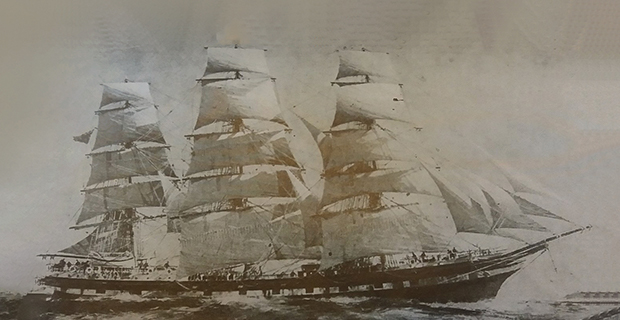
The crossing itself lasted three to four months via the Cape of Good Hope and unfolded under brutal conditions. Migrants were confined to cramped, poorly ventilated quarters, plagued by heat, humidity, disease, and death. Cholera, dysentery, and scurvy were common. Food was rationed without regard to ritual purity. The dead were consigned to the ocean.
This enforced proximity dismantled long-standing caste and communal boundaries. Brahmins shared space with so-called untouchables. Muslims participated in Hindu rituals improvised on deck. Hierarchies dissolved under the weight of shared suffering. A new fraternity emerged, forged through storms, hunger, fear, and collective endurance.
Syncretic Consciousness
From this shared ordeal arose an unprecedented identitary recomposition. The migrants developed hybrid devotional practices, blending Hindu invocations with Muslim prayers. Traditional affiliations receded as the experience of migration itself became the primary marker of identity. What emerged was not simply coexistence, but a new collective consciousness grounded in solidarity.
By the time the labourers disembarked in the Caribbean, they did so as a single Indian community, transcending the divisions they had carried from the subcontinent. The syncretism initiated during the crossing laid the foundations for a distinct Indo-Creole religiosity.
Related News.
-

October 2026 Seva Pakhwada Reaches Rwanda
-

October 2026 Diaspora Seeks Stronger Voice
-

September 2026 Healing Beyond Borders
-

September 2026 MARRIAGE BEYOND BORDERS CROSS-BORDER JUSTICE
India Empire TV


EDITOR'S DESK, Oct 2026
 The October 2026 issue of India Empire explores a world in which diplomacy, commerce, innovation and human connections increasingly shape one another. Across our stories, a recurring theme emerges: relationships acquire lasting value when goodwill is translated into practical outcomes...
more...
The October 2026 issue of India Empire explores a world in which diplomacy, commerce, innovation and human connections increasingly shape one another. Across our stories, a recurring theme emerges: relationships acquire lasting value when goodwill is translated into practical outcomes...
more...
Ads Spot

Comments.