

Building Manufacturing Ecosystems
LML historically had a strong mobility legacy. Do you see opportunities where industrial infrastructure and mobility manufacturing could intersect again in the future?
Manufacturing ecosystems naturally create synergies across sectors. Mobility, engineering, electronics, and component manufacturing often evolve together when the underlying infrastructure exists.
While our immediate focus is industrial ecosystems, strong infrastructure platforms often attract clusters of specialised manufacturing over time. When that happens, mobility manufacturing could certainly find its place within such ecosystems.
Many Indian companies are increasingly looking toward Africa as a manufacturing and market opportunity. Do you see lessons from India’s industrial infrastructure model that could eventually apply there?
Africa represents a very interesting growth story, particularly in terms of demographics and industrialisation potential. However, our current focus remains firmly on India.
The opportunity here is large, underserved, and immediate. We are in the early stages of building what we believe can become a defining industrial infrastructure platform for this country. Our philosophy at this stage is to go deep before we go wide.
Several Indian businesses are also exploring partnerships in Latin America. From a strategic perspective, how do you view that region’s long-term potential for Indian industry?
Latin America has important markets and strong industrial sectors of its own. Many Indian companies are exploring trade and manufacturing linkages there.
That said, LML Realty is currently focused on addressing India’s domestic infrastructure gap. Affordable land, integrated utilities, compliance readiness, and workforce housing remain pressing challenges here. Our priority is to build a scalable model within India first.
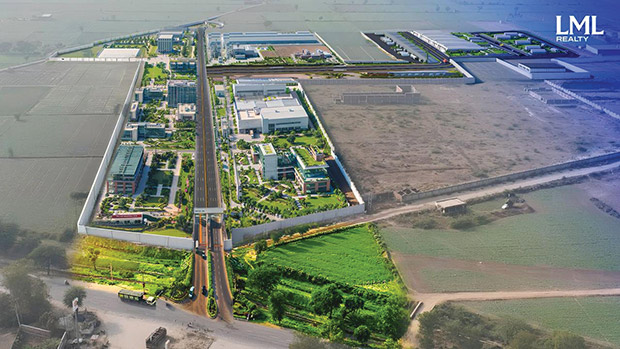
Your PADMA Cluster project involves close collaboration with the Government of Haryana. How important are public–private partnerships in developing industrial infrastructure at scale?
Public–private collaboration is essential.
Government policy frameworks create the enabling environment, while disciplined private execution delivers the infrastructure on the ground. The PADMA Cluster framework demonstrates what can be achieved when those two elements align effectively.
Our immediate priority is to deepen these partnerships within India and replicate successful models across other regions of the country.
Looking ahead five years, what would define success for LML Realty?
Success will be measured in three ways.
First, the number of MSMEs operating from infrastructure that we have developed. Second, the employment generated within those ecosystems. And third, the credibility of LML as an institution that both governments and industry stakeholders trust.
We are not building for a short-term exit. We are building a platform that compounds in scale, governance quality, and national relevance. If LML industrial parks become the address that serious Indian manufacturers choose, we will have achieved what we set out to do.
Related News.
-

September 2026 Beyond Four Walls
-

September 2026 Tewolde Takes Charge
-

September 2026 Minerals Drive Engagement
-

September 2026 APEDA Opens Global Doors

EDITOR'S DESK, Sep 2026
 Our cover takes us to Volcanoes National Park, where Rwanda recently hosted the 21st Kwita Izina, its annual Gorilla Naming Ceremony. Twenty-two baby mountain gorillas received their names, but the significance of the occasion went far beyond a celebration of wildlife...
more...
Our cover takes us to Volcanoes National Park, where Rwanda recently hosted the 21st Kwita Izina, its annual Gorilla Naming Ceremony. Twenty-two baby mountain gorillas received their names, but the significance of the occasion went far beyond a celebration of wildlife...
more...
Ads Spot

Comments.