

“Universities Must Produce Talent”
In this conversation with India Empire, Tan Sri Joseph Adaikalam speaks about the evolution of the ISP model, the concept of “the world as a campus”, the importance of industry–academia partnerships, entrepreneurship, employability, and the future of universities in an age shaped by artificial intelligence, global competition and technological disruption.

In an era where universities across the world are grappling with questions of relevance, employability and industry integration, few educationists have attempted to fundamentally redesign the university model itself. Tan Sri Datuk Professor Joseph Adaikalam, Founder and Executive Chairman of Binary University, Malaysia, is among those rare institution builders who have spent four decades reimagining how universities should function in a rapidly changing global economy.
From introducing the Industry Specialist Professional (ISP) model in the 1980s to building deep partnerships with multinational corporations, and from creating a global entrepreneurial ecosystem to launching highly specialised premium postgraduate programmes, Tan Sri Joseph’s work has consistently focused on one central idea: universities must produce industry-ready talent, not just academically qualified graduates.
Binary University has long emphasised the integration of industry and academia through the ISP model. What inspired you to develop this approach, and how has it evolved into ISP 9.0?
When we started Binary in 1984, there were fewer than ten private institutions in Malaysia. We positioned ourselves as a specialist college for Business and IT because we believed that no college could be the best in everything. But by the late 1980s, many institutions began copying this specialist model, so we realised we needed a completely different strategy to stand out.
That was when we developed the Industry Specialist Professional model. The main difference was that we decided to serve two customers: students and employers. Employers became central to curriculum development and to enhancing the student experience. All our specialisations became industry-specific, which differentiated our graduates from others.
This model attracted world-class IT companies such as Sun Microsystems, IBM, Oracle, SAP, Lotus and Microsoft. We invested heavily in industry-standard laboratories so that students could train on real platforms used by industry. We began producing what we called “just-in-time graduates” for employers.
Over time, the model evolved from ISP 1.0 to ISP 9.0. Today ISP 9.0 includes World is Our Campus (WOCA), Learning in Industry (LII), and the Binary Talent Internship (BTI) Network. These are all part of our strategy to produce extraordinary talents rather than just graduates.
You often say that “the world is our campus.” How does this work in practice?
We believe that no university can be the best in everything. To provide the best experience to our students, we must expose them to other universities that offer new technologies, cultural experiences and career opportunities.
Through the “World is Our Campus” concept, Binary students have the opportunity to participate in study abroad programmes at world-class universities. This gives them global exposure and prepares them for international careers.
Education today must be global. If we want to produce global talents, we must give students global exposure and international learning experiences.
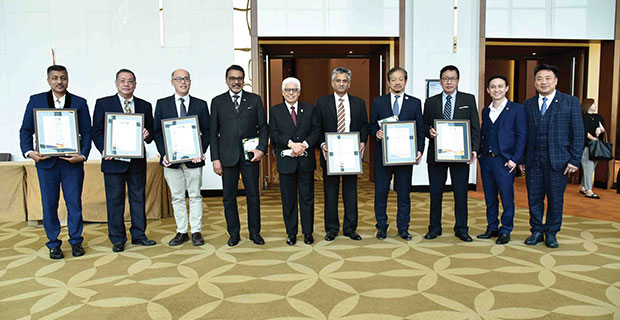
Industry leaders are always engated meaningfully in Binary’s curriculum development
Your model emphasises learning directly in industry environments. How does this approach work?
Learning in Industry is a symbiotic relationship between universities and industry. Universities supply extraordinary talents, and industry provides real-world learning environments.
For example, we offer MBA programmes for engineering graduates specialising in semiconductor technology and advanced manufacturing systems. These programmes are designed based on industry demand, particularly in Malaysia and Singapore where there is a strong semiconductor ecosystem.
Students experience real industry environments and interact with industry leaders. This makes them very valuable to employers. As a result, our graduates have achieved very high employability and can command premium salaries because they are industry-ready from day one.
Binary University has built a large employer network through the Binary Talent Internship Network. How does this network function?
In most universities, graduates look for jobs. At Binary, it has been the other way around for more than 30 years. Industry looks for our graduates.
The Binary Talent Internship Network includes thousands of employers who are looking for ISP talents. When a student enrols in a specialised programme, employers in that sector are informed that a talent will be available the following year.
All employers in the network offer a minimum internship allowance that is significantly higher than typical internship allowances. This shows the value that industry places on ISP talents. The network transforms internships into a structured talent pipeline between universities and industry.
Tell us about the Asia Centre for Entrepreneurship and how it supports students.
The Asia Centre for Entrepreneurship plays two important roles. First, it inculcates an entrepreneurial mindset among students. Second, it creates entrepreneurial opportunities for students who want to start businesses.
Entrepreneurs use the platform to find partners, franchisees, distributors and joint venture partners from among our students. Students get mentoring, business opportunities and sometimes funding for their start-ups.
We believe real entrepreneurs should train future entrepreneurs. With thousands of entrepreneurs in our network, we have created a global platform for nurturing young entrepreneurs.

Happy parents attend a Binary Convocation
Many government entrepreneurship programmes remain underutilised. Why does this happen?
Many young people are afraid to take risks, and many do not know how to run a business. To access funding, entrepreneurs must have realistic and workable business plans.
Universities must therefore teach students not just theory but also how to identify business opportunities, manage risk and build sustainable enterprises. At Binary, we match students with real entrepreneurs and real business opportunities so that they learn to take calculated risks.
Binary has introduced highly specialised postgraduate programmes. What is the thinking behind this?
The education landscape has changed dramatically due to global competition, technology and artificial intelligence. Universities must offer highly targeted programmes aligned with industry needs.
We introduced premium postgraduate programmes in specialised areas such as semiconductor technology, telecommunications, advanced manufacturing, investment banking, logistics and automotive marketing, as well as IT programmes in cybersecurity, data science and artificial intelligence.
These programmes include paid internships and work opportunities so that graduates gain both academic knowledge and industry experience. The aim is to prepare graduates for high-income global careers.
You have spent nearly four decades in higher education. What major changes have you observed?
One major issue globally is that universities and industry often operate separately. Strong industry–academia partnerships require long-term commitment, but university leadership often changes every few years, which makes long-term partnerships difficult to sustain.
Another issue is that many universities still focus mainly on academic excellence without practical training. Industry is looking for graduates who can contribute immediately, not just academically qualified graduates.
Universities must therefore redesign their programmes around industry needs and build long-term partnerships with industry.
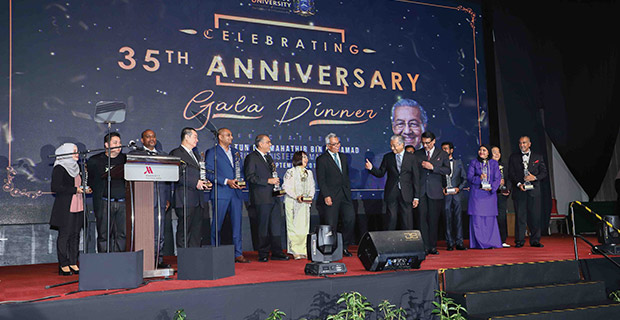
PM Tun Dr. Mahathir recognises youth and senior entrepreneurs
How do you see the role of entrepreneurship evolving in the age of AI and automation?
Graduate unemployment is increasing in many parts of the world because there are more universities and more graduates than before. Graduates who rely only on academic qualifications will face increasing competition.
However, entrepreneurship has become easier today because of digital opportunities. Graduates can start businesses with relatively low capital. At Binary, we emphasise both entrepreneurship and intrapreneurship so that graduates can either start businesses or contribute innovatively within organisations.
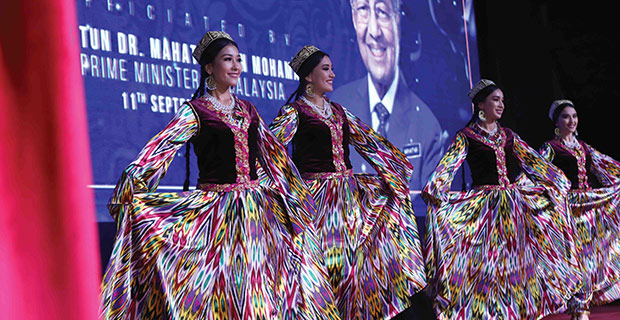
Students from over 60 countries at an international culture performance at Binary
What is your long-term vision for Binary University and for Asian education?
For more than 40 years, Binary University has focused on producing talents rather than just graduates. We have constantly reinvented ourselves to remain relevant in the global education landscape.
Our vision remains the same: to create extraordinary talents and transform communities. But how we do this will continue to evolve as the world changes. Universities must continue to innovate and remain relevant to industry and society.
Traditional Models Challenged
Tan Sri Professor Joseph Adaikalam’s ideas challenge the traditional university model by placing industry, entrepreneurship and global exposure at the centre of education. His argument is simple but powerful: in a world shaped by technological disruption, artificial intelligence and global competition, universities can no longer operate in isolation from industry. Institutions that continue to produce graduates without industry relevance will struggle, while those that build ecosystems involving employers, entrepreneurs and global partners will define the future of higher education. As universities across Asia and the world rethink their role, models such as the one developed at Binary University may offer important lessons on how education can remain relevant in the 21st century.
Related News.
-

June 2026 “GAME CHANGING OUTCOMES”
-

June 2026 “Open For Business”
-

June 2025 “Partners in Progress”
-

June 2025 “Strategic Partners, Shared Aspirations”

EDITOR'S DESK, Sep 2026
 Our cover takes us to Volcanoes National Park, where Rwanda recently hosted the 21st Kwita Izina, its annual Gorilla Naming Ceremony. Twenty-two baby mountain gorillas received their names, but the significance of the occasion went far beyond a celebration of wildlife...
more...
Our cover takes us to Volcanoes National Park, where Rwanda recently hosted the 21st Kwita Izina, its annual Gorilla Naming Ceremony. Twenty-two baby mountain gorillas received their names, but the significance of the occasion went far beyond a celebration of wildlife...
more...
Ads Spot


Comments.