

“GAME CHANGING OUTCOMES”
From crude oil and aircraft manufacturing to Ayurveda and digital public infrastructure, Brazil’s Ambassador to India, H.E. Kenneth Félix Haczynski da Nóbrega, outlines why India-Brazil ties are entering their most dynamic phase yet. In a wide-ranging conversation with Editor-in-Chief Sayantan Chakravarty, the Ambassador speaks about trade, technology, pharma, culture, and the democratic values binding two emerging powers of the Global South together.
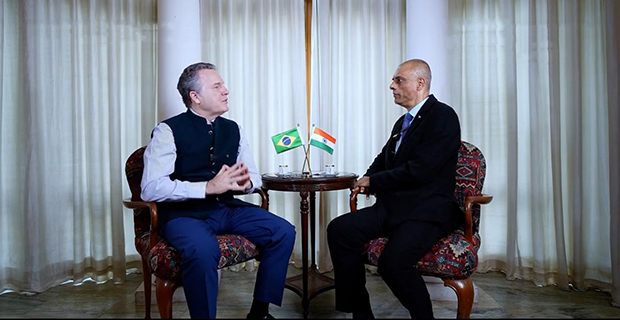

Excellency, President Lula’s recent visit to India followed Prime Minister Narendra Modi’s visit to Brazil last year. What tangible outcomes do you see emerging most rapidly from these exchanges?
We should really look at both state visits together because they have collectively produced game-changing outcomes for India-Brazil relations. Prime Minister Modi’s visit to Brazil in July last year and President Lula’s visit to India less than a year later have created enormous momentum.
We are already witnessing concrete developments. Embraer has moved forward with an understanding alongside Adani to manufacture civil aircraft in India. Vale, one of the world’s largest mining companies, is investing substantially in India. Indian companies such as Bajaj, Mahindra and TCS are expanding operations in Brazil. There are many more examples across sectors, and importantly, most of this momentum is now being driven directly by the private sector.
India and Brazil are often described as important voices of the Global South. How do you see both countries shaping that narrative today?
India played a very important role during its G20 Presidency by placing Global South concerns prominently on the international agenda. Issues such as climate change, debt burdens, energy transition and technology transfer were highlighted with great clarity.
Brazil’s G20 Presidency built upon those priorities. Today, even within BRICS discussions, the challenges of the Global South are becoming increasingly central. Historically, both India and Brazil have spoken consistently for developing countries, and I believe that convergence is only strengthening.
Energy security has become a major strategic concern for India. Brazil is now emerging as an important crude oil supplier. How significant is this development?
It is very significant. During India Energy Week in Goa, an important agreement was concluded that substantially increases Brazilian crude exports to India.
While Brazil may account for around three per cent of India’s crude oil imports, that is still a meaningful contribution to India’s energy diversification strategy. It reflects the growing strategic trust between our two countries.
At the same time, our energy partnership extends well beyond fossil fuels. Ethanol cooperation and renewable energy initiatives are equally important pillars of the relationship.
Beyond energy, which sectors do you believe will define the future trajectory of India-Brazil ties?
There are several strategic sectors shaping the relationship today: energy, agriculture, healthcare, defence and digital public infrastructure.
In pharmaceuticals, we achieved important breakthroughs during President Lula’s visit. A key agreement was signed between Brazil’s regulatory authority ANVISA and Indian counterparts, which will streamline approvals for Indian medicines in Brazil. This is extremely important because it allows Brazil to secure affordable medicines while simultaneously attracting Indian pharmaceutical investments into the Brazilian market.
India’s pharmaceutical sector has extraordinary scale and capability. Brazil has universal healthcare coverage, which means we need dependable access to medicines and greater domestic manufacturing capacity. Therefore, we are encouraging Indian companies to invest in Brazil through incentives and procurement assurances. It is truly a mutually beneficial partnership.
Digital Public Infrastructure has become one of India’s strongest global offerings. Is there growing cooperation with Brazil in this field?
Certainly. Brazil also has strong ambitions in Digital Public Infrastructure, and we are exploring ways to deepen collaboration.
For example, a joint DPI centre involving Brazilian and Indian companies was recently established in Santa Catarina in southern Brazil. India is also assisting pilot initiatives aimed at facilitating credit approvals for small family farmers in Brazil through digital systems.
These collaborations demonstrate how technology can directly improve governance and citizen services.
Embraer’s growing footprint in India has attracted considerable attention. How do you see Brazilian investments evolving here?
Brazilian investments in India are definitely increasing. Embraer’s plans for a final assembly line for civil aircraft in India represent a major opportunity.
At the same time, Embraer had already signed an understanding with Mahindra regarding defence aircraft cooperation linked to Indian defence procurement programmes. These parallel tracks in civil and defence aviation could become transformative for bilateral industrial cooperation.
Conversely, how substantial are Indian investments in Brazil today?
A conservative estimate places Indian FDI stock in Brazil at around seven billion dollars, and the investments are highly diversified.
You have companies such as TCS, Mahindra, IFFCO, Bajaj, Hero MotoCorp and Sterlite operating successfully across sectors ranging from technology and agriculture to automobiles and infrastructure.
This economic dynamism is also reflected in our bilateral trade figures. Trade crossed approximately 15 billion dollars in 2025, representing more than 25 per cent growth over the previous year. The first quarter of this year has already shown another strong increase.
Related News.
-

June 2026 “Open For Business”
-
April 2026 “Universities Must Produce Talent”
-

June 2025 “Partners in Progress”
-

June 2025 “Strategic Partners, Shared Aspirations”

EDITOR'S DESK, Sep 2026
 Our cover takes us to Volcanoes National Park, where Rwanda recently hosted the 21st Kwita Izina, its annual Gorilla Naming Ceremony. Twenty-two baby mountain gorillas received their names, but the significance of the occasion went far beyond a celebration of wildlife...
more...
Our cover takes us to Volcanoes National Park, where Rwanda recently hosted the 21st Kwita Izina, its annual Gorilla Naming Ceremony. Twenty-two baby mountain gorillas received their names, but the significance of the occasion went far beyond a celebration of wildlife...
more...
Ads Spot

Comments.