

TENSION IN FRISCO
Across American cities, the Indian-American community has emerged as one of the most visible success stories of modern immigration. Yet recent moments in Frisco, Texas, suggest that visibility is now being interpreted in more complex and, at times, uncomfortable ways.
Over the past three decades, Indian-Americans have come to occupy a distinctive and visible place in the United States. Their presence is felt early, in classrooms where they have consistently excelled in national spelling, science and geography competitions. It continues into professional life, where Indian-origin leaders head major Fortune 500 companies, contribute to institutions such as NASA, shape academia, build businesses, and increasingly participate in public office. This trajectory has widely been read as a model of integration through education, enterprise, and professional contribution.
Yet visibility, while often a marker of success, can also invite scrutiny. In August 2022, an incident in Plano, Texas, brought this into focus. A verbal outburst directed at Indian-origin women in a parking lot, captured on video, circulated rapidly across digital platforms. The language used was not unfamiliar in historical terms, but its emergence in an everyday setting, and its amplification online, gave it renewed force. The episode did not disrupt the city’s functioning, but it lingered, entering a broader conversation about how minority communities are perceived in public space.
By early 2026, attention had shifted to Frisco, a rapidly growing city within the Dallas–Fort Worth metropolitan region. Over the past decade, Frisco has seen a notable rise in its Indian-origin population, driven by employment opportunities in technology and allied sectors, as well as strong public schooling. Indian-Americans today form a visible part of the city’s economic and civic life. Their presence is reflected not only in professional sectors, but also in neighbourhoods, local businesses, and school systems. This visibility, while rooted in broader demographic and economic patterns, has also brought the community into sharper focus within local discourse.
It was within this context that a series of public meetings in March and April 2026 drew attention. These were formal civic forums, governed by procedure and open participation. Yet across multiple evenings, certain themes began to recur. Speakers expressed concerns about demographic change, often linking these concerns to immigration and cultural difference. References to visa programmes, assertions of imbalance, and broader unease about the pace of change surfaced in different forms. The language was not identical, but the direction of argument was often similar. What might otherwise have remained isolated remarks began, through repetition, to suggest a pattern.
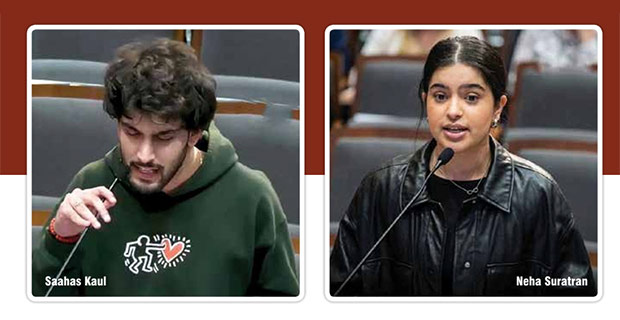
It is at this point that the responses from within the Indian-American community acquired particular significance. Neha Suratran, addressing one such meeting, brought the discussion back to institutional clarity. She noted that immigration policy, including visa regimes frequently referenced in the remarks, falls outside the jurisdiction of local councils. She also challenged the basis of several claims, pointing out the lack of verified evidence supporting allegations of widespread misuse or imbalance. In doing so, she reframed the discussion not as one of policy failure, but of narrative construction, where repetition can give weight to claims that are not grounded in fact.
Related News.
-

September 2026 Healing Beyond Borders
-

September 2026 MARRIAGE BEYOND BORDERS CROSS-BORDER JUSTICE
-

September 2026 Diaspora, Defence And Growth
-

September 2026 President in Romania


Comments.