

TENSION IN FRISCO
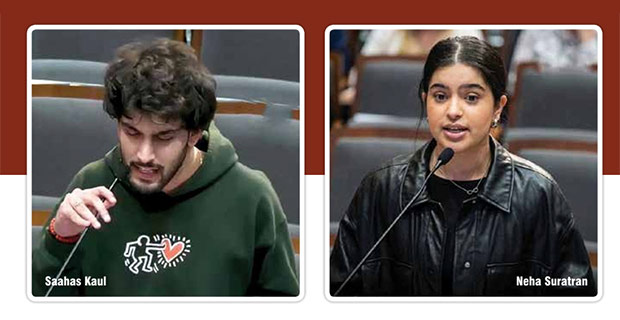
If Suratran’s intervention re-centred the discussion on facts and jurisdiction, Saahas Kaul approached the issue from a broader lens. Rather than addressing individual claims, he focused on their recurrence. The similarity of themes across different speakers and meetings, he suggested, indicated that these were not entirely spontaneous expressions of concern. Instead, he argued, such forums were increasingly being used as platforms where statements could be delivered within a formal civic setting and then amplified beyond it. In his reading, the audience was not confined to the room; it extended to a wider digital space where repetition could transform isolated remarks into perceived consensus.
Kaul’s intervention, in particular, introduces a crucial dimension to the unfolding narrative. It shifts attention from what is being said to how it is being circulated. The city council chamber, traditionally a site of local governance, becomes in this framing a stage that lends institutional legitimacy to statements designed for broader consumption. The pattern, as he suggested, is not defined by volume or intensity alone, but by recurrence and amplification.
Beyond these formal settings, a quieter layer of concern has also emerged. Some individuals report that when confronted with hostile or exclusionary speech, the scope for legal recourse remains limited unless such speech crosses into explicit threat or violence. This reflects the wide protections afforded to expression within the American legal framework. At the same time, it highlights a gap between what is legally actionable and what is socially experienced, particularly for communities navigating questions of belonging.
Parallel to these developments, instances of explicit anti-Indian sentiment have appeared on social media platforms, including posts that question the presence or acceptance of Indians in certain regions. While such expressions do not represent mainstream opinion, their visibility contributes to a broader atmosphere in which perception is shaped not only by lived experience, but also by digital amplification.
Taken together, these developments do not point to a unified or organised movement, nor do they replicate earlier periods of formal exclusion in American history. However, they do reveal emerging social fissures, where demographic change, economic mobility, and cultural visibility intersect with unease about identity and belonging. These dynamics are neither entirely new nor unique, but they acquire renewed significance in a context shaped by rapid communication and heightened visibility.
For the Indian-American community, the present moment is therefore one of both continuity and reassessment. The foundations of its presence remain strong, built over decades of contribution and engagement. Yet visibility now carries an additional dimension. It is not only recognition, but interpretation, and interpretation is shaped by narratives that extend beyond immediate experience.
What gives this period its particular significance is not any single incident, but the pattern that emerges across them. Events separated by geography and time begin to echo each other in subtle ways. They do not form a straight line, but they create a sense of recurrence that is difficult to dismiss.
For future readers, these moments may be understood not as isolated disruptions, but as part of a broader social negotiation. The question is not whether Indian-Americans belong, their presence is well established, but how that presence is perceived, discussed, and situated within evolving narratives of identity.
In that sense, the distance between Plano in 2022 and Frisco in 2026 marks more than the passage of time. It reflects a shift in tone, in framing, and in the nature of public conversation itself. And it is within that shifting conversation that this story continues to unfold.
Related News.
-
September 2026 Healing Beyond Borders
-

September 2026 MARRIAGE BEYOND BORDERS CROSS-BORDER JUSTICE
-

September 2026 Diaspora, Defence And Growth
-

September 2026 President in Romania


Comments.