

Across Arctic Frontiers
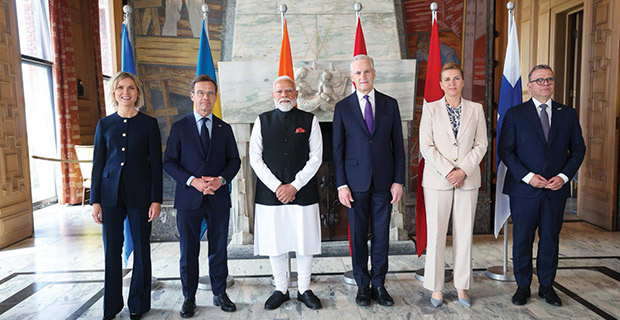
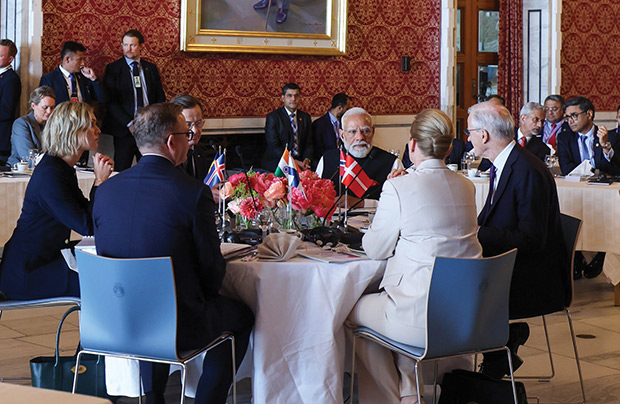
Prime Minister Modi’s participation in the India-Norway Business and Research Summit added another layer to the Oslo visit. Business leaders, technology stakeholders, research institutions and policymakers from both countries discussed future opportunities in green shipping, offshore energy, maritime innovation, digital transformation and sustainable industrial ecosystems. The emphasis throughout remained on combining India’s market scale and skilled talent pool with Nordic technological expertise and capital strength.
In a major symbolic gesture, Mr Modi was personally received at the airport by Mr Store, underlining the importance Oslo attached to the visit. It was the first visit by an Indian Prime Minister to Norway in more than four decades, adding additional diplomatic weight to the engagements.
Mr Modi also held an audience with Norway’s King Harald V at the Royal Palace in Oslo. The discussions reportedly touched upon the growing collaboration between Indian and Norwegian companies in emerging sectors and the wider strengthening of bilateral relations. King Harald later hosted a luncheon in honour of the visiting Indian leader.
During the Norway visit, Prime Minister Modi was conferred with the Grand Cross of the Royal Norwegian Order of Merit, Norway’s highest civilian honour awarded to foreign Heads of Government. Accepting the honour, he dedicated it to the people of India and described it as a tribute to the enduring friendship between India and Norway.
The Sweden leg of the tour had already established the broader tone of the Nordic outreach. In Gothenburg, Prime Minister Modi and Swedish Prime Minister Ulf Kristersson elevated bilateral relations to a Strategic Partnership and announced a series of future-oriented initiatives aimed at boosting innovation and technology cooperation.
Among the most notable outcomes were the launch of the Joint Innovation Partnership 2.0 and the India-Sweden Technology and Artificial Intelligence Corridor. These initiatives are expected to encourage deeper collaboration in research, digital infrastructure, advanced manufacturing, clean technologies, healthcare innovation and artificial intelligence applications.
Mr Modi’s engagements in Sweden also carried a wider European dimension. Alongside Swedish Prime Minister Kristersson and European Commission President Ursula von der Leyen, he addressed the European Round Table for Industry, bringing together some of Europe’s most influential business leaders. Discussions focussed on India-Europe economic convergence, infrastructure expansion, clean mobility, healthcare cooperation, digital transformation and the evolving India-European Union Free Trade Agreement negotiations.
The interactions highlighted Europe’s growing interest in India as a long-term investment destination and strategic technology partner. India’s reforms in manufacturing, logistics, digital governance and startup ecosystems received considerable attention during the discussions.
The Sweden visit also carried strong symbolic resonance. Prime Minister Modi became the first Asian leader to receive Sweden’s prestigious Royal Order of the Polar Star, Degree Commander Grand Cross. The honour recognised his contribution towards strengthening India-Sweden relations and expanding cooperation across multiple sectors.
One of the most memorable moments of the visit came through the exchange of commemorative gifts centred on Gurudev Rabindranath Tagore. Swedish Prime Minister Ulf Kristersson presented Prime Minister Modi with replicas of handwritten epigrams by Tagore discovered in the Swedish National Archives. Prime Minister Modi, in turn, gifted a collection of Tagore’s literary works along with a handcrafted Shantiniketan bag inspired by the Nobel Laureate’s artistic philosophy.
Related News.
-
September 2026 Gorillas Find Names
-
September 2026 India–Kiribati Deepen Cooperation
-
September 2026 India, Ethiopia Deepen Defence Ties
-

September 2026 JAMAICA AT 64,TIES DEEPEN
EDITOR'S DESK, Sep 2026
 Our cover takes us to Volcanoes National Park, where Rwanda recently hosted the 21st Kwita Izina, its annual Gorilla Naming Ceremony. Twenty-two baby mountain gorillas received their names, but the significance of the occasion went far beyond a celebration of wildlife...
more...
Our cover takes us to Volcanoes National Park, where Rwanda recently hosted the 21st Kwita Izina, its annual Gorilla Naming Ceremony. Twenty-two baby mountain gorillas received their names, but the significance of the occasion went far beyond a celebration of wildlife...
more...
Ads Spot

Comments.