

Oneness Beyond Borders
Prime Minister Narendra Modi’s visit to Uzbekistan has elevated a relationship rooted in centuries of shared history and cultural affinity to a Comprehensive Strategic Partnership, while trade, energy, institutional cooperation and a vibrant Indian diaspora point towards a more ambitious future.
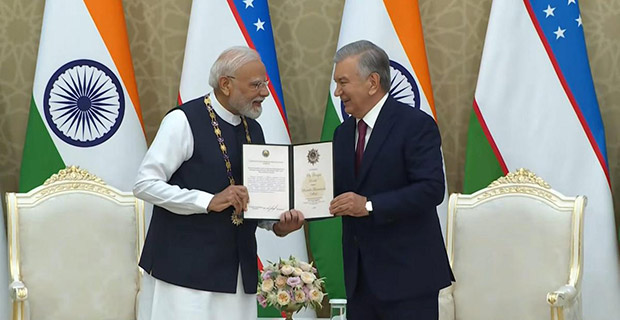
The warmth surrounding Prime Minister Narendra Modi’s two-day State Visit to Uzbekistan on August 30 was matched by the significance of what emerged from his talks with President Shavkat Mirziyoyev. India and Uzbekistan elevated their relationship to a Comprehensive Strategic Partnership, marking a new phase in bilateral ties that have steadily gathered momentum over the past decade. President Mirziyoyev described the development as historic and credited Mr Modi with making an “invaluable personal contribution” to the milestone. He also praised the Indian Prime Minister as an “outstanding statesman” and a “wise political leader”, linking India’s rapid development and growing international influence closely with his leadership.
The language was unusually warm. Addressing Mr Modi as his “dear brother”, President Mirziyoyev thanked him for his openness, sincerity and warmth towards Uzbekistan, saying discussions on historical ties, areas of cooperation and future plans had been highly productive. He also spoke of India’s modernisation and achievements across sectors, saying Uzbekistan took great pleasure in the country’s progress. The new strategic designation therefore represents more than diplomatic nomenclature. It provides a broader framework for a relationship increasingly encompassing trade, energy, technology, institutional cooperation and the wider Global South.
Dostlik As Diplomacy
For Mr Modi, the honour and the upgraded relationship were inseparable from the historical character of the two countries’ friendship. After being conferred with Uzbekistan’s highest honour, the Oliy Darajali Do’stlik Order, he dedicated the recognition to the centuries-old friendship and shared heritage between India and Uzbekistan. The word “Dostlik”, meaning friendship, became the emotional shorthand for his response. Mr Modi noted that “Dost”, or friend, is a word used constantly in India, and said the Uzbek gesture embodied its essence. He made clear that he regarded the award not as a personal distinction but as an honour for all 1.4 billion Indians.
The decoration was conferred by President Mirziyoyev in recognition of Mr Modi’s contribution to strengthening bilateral ties. Yet the symbolism of this particular award lies in the word at its centre: friendship. In the India–Uzbekistan relationship, history is not simply something to be remembered. It is increasingly being used as a platform from which to construct contemporary cooperation.
From Friendship To Trade
The economic ambition is substantial. President Mirziyoyev said bilateral trade currently stands at around US$1 billion, but made clear that Tashkent does not regard that figure as a ceiling. Uzbekistan is targeting US$5 billion as the first benchmark, with the Uzbek President expressing confidence that trade could eventually reach US$10 billion. The numbers give the new strategic partnership a measurable economic objective.
The institutional architecture is also being strengthened. India and Uzbekistan will establish a Coordination Council at Foreign Minister level, while the existing Joint Commission will be elevated from the Secretary level to the ministerial level. The two countries will jointly organise a Business Summit bringing together business leaders from India and Uzbekistan. Three sister-city and sister-state arrangements are also being formalised, creating additional channels through which commercial, cultural and institutional relationships can develop.
Energy cooperation is entering a particularly important phase. Mr Modi announced that India and Uzbekistan will establish a long-term arrangement for the supply of uranium, adding a strategic dimension to the expanding relationship. He also referred to Uzbekistan’s New Tashkent project and India’s GIFT City, suggesting that delegations could exchange experiences and study the use of technology in large-scale urban development.
The Diaspora Bridge
Yet perhaps the most human dimension of the visit came not from the formal talks but from the Indian community in Tashkent.
Mr Modi received a warm welcome from members of the Indian diaspora, who gathered to greet him with chants of “Modi Modi”, “Vande Mataram” and “Bharat Mata Ki Jai”. Several women from the community also tied a rakhi on his hand. For an official State Visit centred on strategic partnership, the scene offered a reminder that diplomacy between India and Uzbekistan is also sustained by people who live, work and build lives between the two countries.
The Prime Minister captured that role in particularly evocative language when he described the Indian diaspora in Uzbekistan as “a living bridge between India and Uzbekistan”, strengthening the friendship between the two countries. The phrase gives the community a significance beyond its numerical presence. Diaspora communities carry memories, traditions, professional networks and cultural familiarity across borders, giving bilateral relations a social dimension that formal agreements alone cannot manufacture.
The cultural welcome reinforced that bridge. Mr Modi highlighted an Indian-Uzbek fusion performance in which the tabla blended with the doira and chang, describing it as evidence of the deep cultural connection between the two countries. It was an apt metaphor for the partnership itself: distinct traditions retaining their individual character while producing something shared.
Related News.
-

October 2026 A NEW CHAPTER
-

October 2026 “We Can Be A Gateway”
-

October 2026 “Come And See Ecuador”
-
October 2026 Confidence Across Continents
India Empire TV

EDITOR'S DESK, Oct 2026
 The October 2026 issue of India Empire explores a world in which diplomacy, commerce, innovation and human connections increasingly shape one another. Across our stories, a recurring theme emerges: relationships acquire lasting value when goodwill is translated into practical outcomes...
more...
The October 2026 issue of India Empire explores a world in which diplomacy, commerce, innovation and human connections increasingly shape one another. Across our stories, a recurring theme emerges: relationships acquire lasting value when goodwill is translated into practical outcomes...
more...
Ads Spot

Comments.