

Oneness Beyond Borders
India In Uzbekistan, Uzbekistan In India
The cultural intimacy extended into the official programme. President Mirziyoyev personally received Mr Modi at Tashkent airport, a gesture that underlined the warmth of their relationship. The Prime Minister, who described the visit as his fourth to Uzbekistan, expressed gratitude for the welcome and said the gesture reflected the depth and growing momentum of bilateral relations.
The Uzbek welcome itself carried unmistakable Indian touches. Mr Modi recalled the dinner hosted by President Mirziyoyev, including performances by talented Uzbek children, and remarked that the experience felt as though India itself had been brought to life in Uzbekistan. The city was illuminated in the colours of the Indian tricolour, a gesture he described as deeply touching and reflective of how close India is to the Uzbek President’s heart.
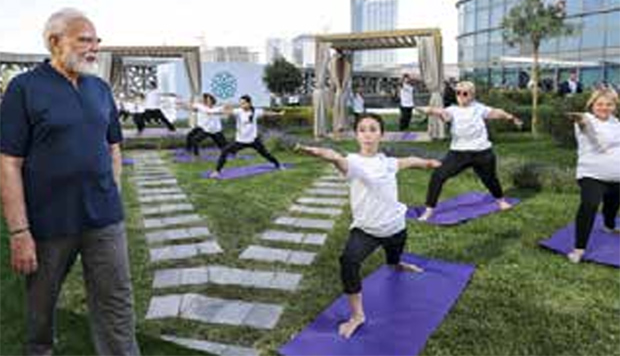
A special yoga session involving 52 practitioners from Uzbekistan added another cultural layer. Six participants were members of the Yoga Federation of Uzbekistan who had represented their country at the First World Yogasana Championship in Ahmedabad in June 2026. Mr Modi’s observation that “Uzbekistan loves Yoga!” was light-hearted, but the session demonstrated how practices associated with India are finding enthusiastic resonance in Uzbek society.
A Global South Partnership
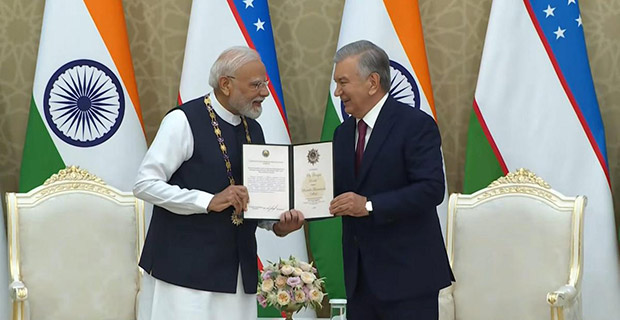
The strategic significance of the new relationship extends beyond bilateral interests. Mr Modi said India would remain steadfast in upholding its friendship with Uzbekistan and that the two countries would work together as a united voice for the Global South. His acceptance of the Uzbek honour was therefore framed not merely as an acknowledgement of the past but as a responsibility towards a broader international agenda.
This gives the Comprehensive Strategic Partnership a wider geopolitical context. India and Uzbekistan are not simply attempting to increase trade or deepen political contacts. They are also positioning their relationship within a changing international order in which developing countries seek greater voice, connectivity and agency.
The new framework can consequently serve several purposes at once: expanding commerce, strengthening energy security, facilitating institutional exchanges, creating new opportunities for businesses and encouraging greater people-to-people interaction.
A Friendship With A Future
There is something particularly appropriate about the fact that Dostlik became central to Mr Modi’s response to Uzbekistan’s highest honour. The relationship already possesses a powerful cultural and historical foundation, but August 30 suggests that friendship is now being given a more substantial strategic structure. The next stage will be measured in outcomes: movement from US$1 billion towards the US$5 billion trade benchmark, the long-term uranium arrangement, ministerial coordination, business engagement and sister-city partnerships.
The diaspora, meanwhile, supplies the human dimension that gives those arrangements a deeper social context. The welcome in Tashkent, the rakhi, the fusion of tabla with doira and chang, the Uzbek children’s performances and the yoga session all pointed to a relationship that is simultaneously strategic and human, institutional and cultural. India and Uzbekistan have now given their longstanding friendship a new strategic frame. The task ahead is to fill that frame with trade, technology, energy, people and purpose, while ensuring that the warmth represented by Dostlik remains at the heart of the partnership.
Related News.
-

October 2026 A NEW CHAPTER
-

October 2026 “We Can Be A Gateway”
-

October 2026 “Come And See Ecuador”
-

October 2026 Confidence Across Continents
India Empire TV


EDITOR'S DESK, Oct 2026
 The October 2026 issue of India Empire explores a world in which diplomacy, commerce, innovation and human connections increasingly shape one another. Across our stories, a recurring theme emerges: relationships acquire lasting value when goodwill is translated into practical outcomes...
more...
The October 2026 issue of India Empire explores a world in which diplomacy, commerce, innovation and human connections increasingly shape one another. Across our stories, a recurring theme emerges: relationships acquire lasting value when goodwill is translated into practical outcomes...
more...
Ads Spot

Comments.