

“We Can Be A Gateway”
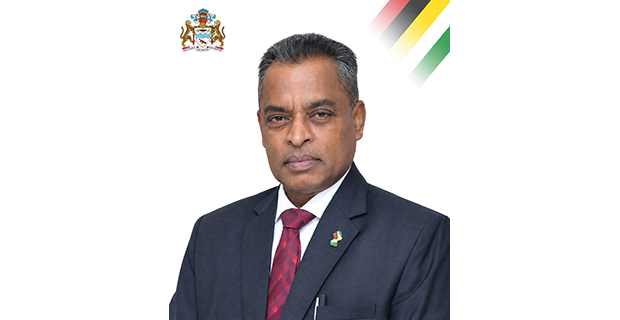
H.E. Mr Dharamkumar Seeraj, High Commissioner of Guyana to India, is interviewed by Sayantan Chakravarty, Editor-in-Chief, India Empire, and Director, LAC FIRST.
The relationship between India and Guyana stretches back nearly two centuries, to the arrival of Indian indentured labourers in 1838. Six decades after diplomatic relations were established, that historic people-to-people connection is acquiring a distinctly contemporary dimension, shaped by trade, oil and gas, infrastructure, agriculture, healthcare, digital technology and Guyana’s rapidly expanding economy.
H.E. Mr Dharamkumar Seeraj, a former parliamentarian who served for 17 years, comes from an agricultural background and has worked extensively in Guyana’s rice sector, drainage and irrigation and water management. As High Commissioner in New Delhi, he sees India not only as a historical partner but as a source of technology, investment, expertise and ideas for Guyana’s next phase of development.
In this conversation with Sayantan Chakravarty, he discusses Guyana’s emergence as an oil producer, opportunities for Indian companies, the country’s ambition to become the “breadbasket of the Caribbean” and a healthcare hub, plans for a UPI-like payment platform, the renewed interest in Indian culture among younger Guyanese, and the significance of Prime Minister Narendra Modi’s 2024 visit to Guyana.
Let us look at the historical ties. They began on 5 May 1838, when the Hesperus docked in Guyana. What does that history mean today?
The 5th of May 1838 is indeed historic. Actually, there were two vessels, Hesperus and Whitby. Both arrived on the same day with about 296 men, women and children.
After the abolition of slavery in 1834, the British needed labour for their sugar plantations. They came to India and, because of similar tropical conditions in some parts of India, moved Indians to Guyana. That is how people like me came to be in Guyana. We are fourth- and fifth-generation people of Indian origin.
By and large, we have managed to retain aspects of our culture, notwithstanding the fact that the British tried to erase our identity by taking away names, language, religion and culture.
The relationship has now evolved from people-to-people ties into a strategic partnership. How do you see that evolution?
Guyana is a country of about one million people, with a landmass of about 214,000 square kilometres. For many years our economy was not doing well, and Guyana was not on the international map.
India too was looking inward, addressing its own infrastructure and economic development. Even when India began looking outward, Guyana was on the other side of the globe.
Nevertheless, we maintained contact because of the people of Indian origin in Guyana. Over time, the relationship expanded. Today, bilateral trade is about US$431 million. Guyana is one of the fastest-growing economies in the world. In the first half of this year, we grew by 33 per cent, and in 2024 by 62 per cent. We have had an average growth rate of about 22 per cent for the past six years.
Oil production has contributed to that dramatic growth, while India’s expanding international footprint has also brought the two countries closer. India is using not only its economic strength but also its soft power, Bollywood, yoga, cricket, culture and language.
You have also seen India’s expanding international footprint at first hand. What stands out from your own experience?
I recall that in 2018, when I came here as a Member of Parliament, I was invited by the Government of India under Prime Minister Modi to attend an international conference of Members of Parliament of Indian Origin. Guyana had the largest delegation. I think there were just over 24 or 25 Members of Parliament from Guyana, from both the Government and Opposition sides, many of whom were of Indian origin.
That was another dimension of how India was reaching out through different forums to expand its growing footprint in the international community.
India is importing crude from Guyana. Can Indian companies also participate in refining, petrochemicals and wider oil and gas development?
Most definitely. Indian businesses have shown interest in investing in Guyana’s infrastructure and oil and gas sector, not only to purchase crude but also to invest in refining and bid for blocks where they can become involved in oil development and drilling.
At the same time, Guyana is pursuing a low-carbon development strategy. We want to target 100 per cent of our energy needs from renewable sources, although that will take a few decades. Indian companies are already playing a major role in solar projects. There is an ongoing project by Oriana Power to make Cheddi Jagan International Airport self-sufficient in renewable energy through a solar farm.
There are great avenues for investment in Guyana: renewable energy, oil and gas, infrastructure, medical services, education, hospitals and pharmaceuticals.
You have spoken about Indian investment going beyond the purchase of crude. Can you give us a concrete example of where Indian companies are already looking at Guyana?
Only this morning I had a meeting with an Indian company that specialises in the construction of roads and railways, as well as drainage and irrigation projects. Its portfolio also includes hospitals and medical care. Two of its representatives are already in Guyana.
They are looking to get involved in a project to expand the road network between the Mahaica River and the Abary River. It is about 27 kilometres along the east coast of Guyana. We want to expand the existing two-lane road into a four-lane highway. I personally would be very happy if Indian companies could get involved.
We already have an Indian company, Ashoka Buildcon, which constructed a road network from our Ogle Airport. Guyanese will tell you that it is one of the best highways in Guyana. The work was of good quality, and we do welcome that.
Related News.
-

October 2026 A NEW CHAPTER
-

October 2026 “Come And See Ecuador”
-
October 2026 Confidence Across Continents
-
October 2026 THIMPHU TALKS COOPERATION

Comments.