

Confidence Across Continents
As India’s diplomatic outreach broadens across regions and institutions, one constant remains unmistakable: the country’s foreign policy continues to invest patiently in relationships where trust, continuity and shared aspirations carry greater weight than fleeting geopolitical headlines.
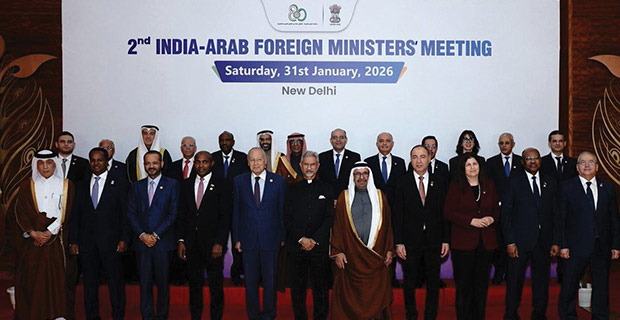
Diplomatic history is rarely written in dramatic moments alone. More often, it is composed through hundreds of conversations, repeated engagements and carefully nurtured partnerships that gradually reshape the strategic landscape. The past week’s diplomatic activity offers precisely such a picture of India’s external engagement, revealing a foreign policy that is simultaneously expansive in geography and remarkably consistent in purpose. Whether engaging the Indian diaspora in Eastern Europe, strengthening maritime cooperation across the Indian Ocean, reinforcing partnerships in Southeast Asia, deepening strategic ties with the Pacific, or broadening dialogue across Central Asia, India continues to pursue an approach rooted in continuity rather than spectacle.
One of the defining characteristics of this evolving diplomacy is its refusal to view relationships through a single lens. The traditional distinction between strategic partnerships, economic cooperation and cultural engagement has become increasingly blurred. Infrastructure projects are discussed alongside educational exchanges; defence cooperation develops in tandem with technological collaboration; diaspora communities become ambassadors of culture while simultaneously serving as bridges for commerce and innovation. The result is a foreign policy that is more comprehensive than at any previous stage in India’s post-independence history.
The Indian diaspora occupies a particularly significant place within this broader framework. From Bucharest to Los Angeles, overseas Indians have emerged not merely as successful professionals but as enduring instruments of India’s soft power. Their achievements reinforce India’s international reputation, while their continued attachment to Indian culture creates reservoirs of goodwill that governments alone could scarcely replicate. Increasingly, New Delhi recognises that diplomacy flourishes most naturally when official engagement is reinforced by vibrant people-to-people relationships.
Equally striking is the geographical breadth of India’s engagement. Few countries today conduct substantive diplomatic conversations within the same week across the Gulf, Europe, Southeast Asia, Oceania, Central Asia, the Indian Ocean and North America. Such diversity reflects more than ambition. It demonstrates a growing confidence that India’s interests can no longer be pursued through narrowly defined regional policies. Instead, New Delhi increasingly views international affairs as an interconnected strategic ecosystem in which developments across one region invariably influence opportunities elsewhere.
This interconnected thinking is especially evident in the Indo-Pacific, where partnerships with Australia, Indonesia, New Zealand, Thailand and the Philippines are now viewed as complementary rather than separate initiatives. Maritime security, resilient supply chains, clean energy, digital innovation and critical technologies increasingly form a common strategic vocabulary across these relationships. India’s diplomacy has therefore evolved beyond balancing regional interests towards constructing an integrated network of trusted partners capable of addressing shared challenges together.
Related News.
-

October 2026 A NEW CHAPTER
-

October 2026 “We Can Be A Gateway”
-

October 2026 “Come And See Ecuador”
-

October 2026 THIMPHU TALKS COOPERATION


Comments.