

“Mobilising Diaspora for India’s Growth”
In an era where nations increasingly draw strength from their global communities, few diasporas match the scale, reach, and influence of India’s. In this wide-ranging conversation, Dr Thomas Abraham, Chairman of the Global Organization of People of Indian Origin (GOPIO), reflects on how the Indian Diaspora has evolved into a strategic global asset and how its economic power, professional expertise, and cultural influence can be more meaningfully aligned with India’s long-term development and global leadership. He is in conversation with Editor Sayantan Chakravarty.
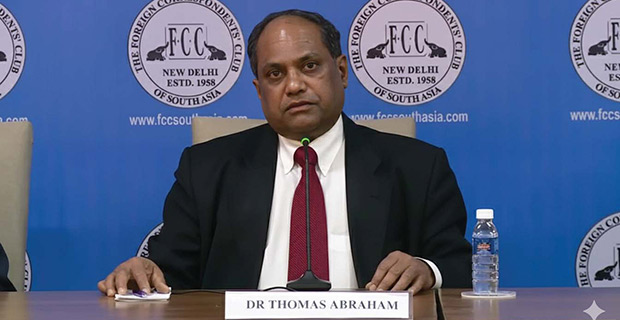
Dr Abraham, how do you assess the scale and significance of the Indian Diaspora today?
The Indian Diaspora today is not merely large in number; it is extraordinary in its reach and impact. With more than 35 million people spread across over 150 countries, it represents one of the most globally embedded communities in modern history. Economically, its collective annual output is estimated at close to one trillion US dollars, a figure that surpasses the GDP of several major economies. Equally significant is the fact that remittances by the diaspora to India have reached a historic high of 135 billion US dollars in the 2025 fiscal year.
However, numbers alone do not tell the full story. What makes the Diaspora truly strategic for India is the breadth of its engagement. Beyond remittances, it contributes through entrepreneurship, technology transfer, global advocacy, policy influence, and cultural diplomacy. This combination of economic strength and intellectual capital positions the Diaspora as a long-term partner in India’s global journey.
How has the character of the Indian Diaspora changed over time?
The Diaspora has undergone a profound transformation. In earlier decades, it was largely perceived as a migrant workforce seeking economic opportunity abroad. Today, that image is outdated. Indian-origin professionals now occupy leadership positions in multinational corporations, research laboratories, hospitals, universities, and public institutions across continents.
Equally important is the rise of second and third-generation Indians who are deeply rooted in the civic and political life of their host countries while retaining a strong cultural connection to India. This evolution has enabled the Diaspora to function as a bridge between India and the world, influencing innovation ecosystems, global supply chains, and international policy conversations in ways that were unthinkable a generation ago.
GOPIO has been central to this global engagement. How did the organisation’s mission take shape?
GOPIO was founded in 1989 during the First Global Indian Diaspora Convention in New York, at a time when the Indian community abroad lacked a unified global voice. The initial focus was necessarily defensive. Many Diaspora communities faced discrimination, immigration challenges, and exclusion from political processes in their host countries.
Over the last 36 years, GOPIO has evolved into a constructive and forward-looking institution. While advocacy and welfare remain core concerns, the organisation today is equally focused on promoting economic cooperation, civic engagement, cultural exchange, and policy dialogue. GOPIO works closely with the Government of India as well as host-country governments, positioning itself as a credible bridge between India and its global community.
Dual Nationality has often been cited as a milestone in Diaspora engagement. Why was GOPIO’s advocacy on this issue so consequential?
The question of legal belonging has always been central to Diaspora engagement. GOPIO was the first organisation to formally support the idea of Dual Nationality through a resolution adopted in 1989. At the time, it was a bold and forward-looking position.
This sustained advocacy eventually contributed to the introduction of the PIO Card in 2002 and later the Overseas Citizen of India programme in 2006. The OCI framework fundamentally altered the relationship between India and its Diaspora by allowing people of Indian origin to live and work in India without surrendering their foreign citizenship. This sense of legal security and emotional reassurance significantly deepened Diaspora participation in India’s economic and social life.
Related News.
-

September 2026 Healing Beyond Borders
-

September 2026 MARRIAGE BEYOND BORDERS CROSS-BORDER JUSTICE
-

September 2026 Diaspora, Defence And Growth
-

September 2026 President in Romania

EDITOR'S DESK, Sep 2026
 Our cover takes us to Volcanoes National Park, where Rwanda recently hosted the 21st Kwita Izina, its annual Gorilla Naming Ceremony. Twenty-two baby mountain gorillas received their names, but the significance of the occasion went far beyond a celebration of wildlife...
more...
Our cover takes us to Volcanoes National Park, where Rwanda recently hosted the 21st Kwita Izina, its annual Gorilla Naming Ceremony. Twenty-two baby mountain gorillas received their names, but the significance of the occasion went far beyond a celebration of wildlife...
more...
Ads Spot

Comments.