

AFRICA FIRST - Corridors of Commitment
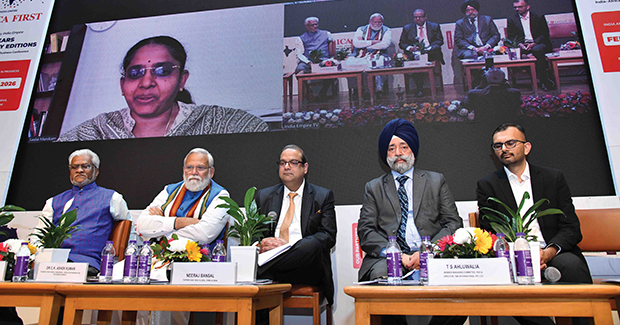
Plenary II panelists listen to Ms Saalai Manikam (on large screen), Promoter and MD, Arima Group, Accra, Ghana, give her presentation virtually from Ghana. Seated on dais are (from left) Dr. Manoharan Krishna, Chief Advisor, Hazaa Naturaa Organica Africa; Dr C.K. Ashok Kumar, Founder, First World Community; Mr Neeraj Bansal, Partner and Head Global, KPMG in India (moderator); Mr T S Ahluwalia, Managing Committee Member, FIEO, and Director, TMA International Pvt Ltd; Mr Shamik Joshi, Head-Presales & Gateway, Amnex Infotechnologies Pvt Ltd
The Transmission Chamber
Plenary Session II shifted the conversation from philosophy to mechanics. Moderated by Mr Neeraj Bansal, Partner and Head – Global at KPMG in India, the session examined the architecture required to transmit intent into impact.
India–Africa trade has grown from USD 70 billion to over USD 100 billion within a decade. Yet expansion alone does not guarantee resilience. Volatility in global supply chains demands structural depth. Investment must be organised. Risks must be distributed. Financing must be predictable rather than episodic.
Africa’s consumer expenditure is projected to reach USD 2.5 trillion by 2030. The scale is undeniable. The design, however, must be deliberate.
Ground Truth From The Field
Mr T.S. Ahluwalia, Managing Committee Member of FIEO and Director, TMA International Pvt Ltd, brought operational clarity. Fifteen years ago, Indian tractors were scarcely visible across African markets. Through phased localisation, patient relationship-building and adaptive distribution, they now operate in more than 20 countries.
Motorcycle manufacturers embraced distributed production models, embedding supply chains across geographies instead of exporting finished units alone. Engineering goods, machinery and ICT services demonstrate that India’s industrial capability is not theoretical. It is deployable.
Yet deployment requires calibration. Technology must align with voltage conditions, climatic patterns, capital access and local skill matrices. Sophistication without suitability collapses under real-world constraints. He also underscored an overlooked friction point: visa delays for business travellers impede momentum. Export ecosystems flourish when mobility is fluid.
Entrepreneurship As Engine
Dr C.K. Ashok Kumar introduced an entrepreneurial lens. Travelling from Chennai, he reflected on Africa’s shifting global perception. The narrative is evolving from extraction to opportunity.
He invoked India’s sachet revolution in FMCG as an instructive precedent. By aligning product pricing with purchasing power, consumption was democratised. Africa demands comparable contextual innovation.
Aquaculture, agro-processing, wellness industries and beauty services represent sectors where small-scale entrepreneurship can scale rapidly when supported by appropriate frameworks. Development, he argued, must remain people-centric rather than capital-centric.
Africa’s youthful demographic dividend is not self-activating. It must be channelled into structured enterprise ecosystems. Skill development pipelines, micro-entrepreneur incubation platforms and locally anchored manufacturing clusters can convert consumption markets into productive economies. For him, partnership achieves legitimacy when aspiration is translated into scalable entrepreneurship.
Related News.
-

September 2026 Gorillas Find Names
-

September 2026 India–Kiribati Deepen Cooperation
-

September 2026 India, Ethiopia Deepen Defence Ties
-

September 2026 JAMAICA AT 64,TIES DEEPEN

EDITOR'S DESK, Sep 2026
 Our cover takes us to Volcanoes National Park, where Rwanda recently hosted the 21st Kwita Izina, its annual Gorilla Naming Ceremony. Twenty-two baby mountain gorillas received their names, but the significance of the occasion went far beyond a celebration of wildlife...
more...
Our cover takes us to Volcanoes National Park, where Rwanda recently hosted the 21st Kwita Izina, its annual Gorilla Naming Ceremony. Twenty-two baby mountain gorillas received their names, but the significance of the occasion went far beyond a celebration of wildlife...
more...
Ads Spot

Comments.