

AFRICA FIRST - Corridors of Commitment
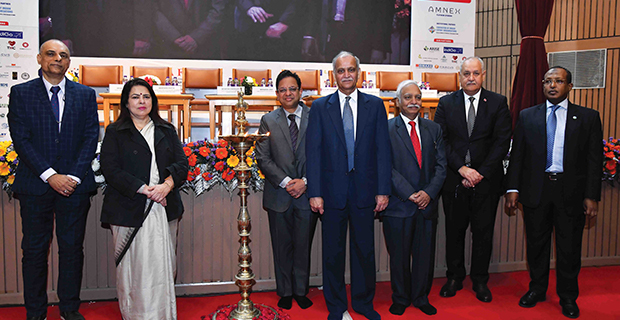
The Engine Room
Where Frameworks Replaced Formulas
If earlier sessions of AFRICA FIRST established philosophical alignment and institutional architecture, Strategic Session I, the Country Presentations, translated vision into executable pathways.
Moderated by Mr Sayantan Chakravarty, Editor-in-Chief and Publisher, India Empire Magazine, and Organiser of AFRICA FIRST, the session accomplished something subtle yet decisive. It shifted Africa from abstraction to specificity.
No longer was “Africa” a collective noun.
It became Rwanda.
It became Botswana.
It became South Africa.
Each carried differentiated strategy, regulatory posture and industrial ambition. This was not ceremonial diplomacy. It was investment cartography.
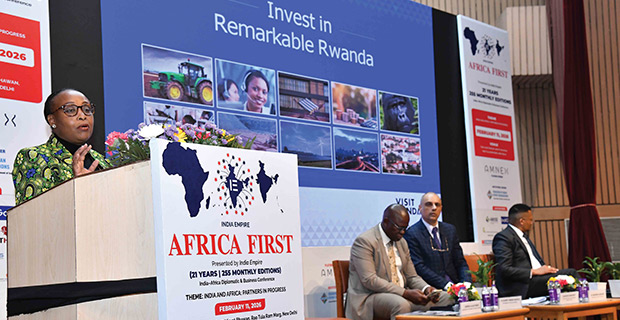
H.E. Ms MUKANGIRA Jacqueline, High Commissioner of the Republic of Rwanda in India, making a presentation on Rwanda
Rwanda: Reform As Leverage
When H.E. Ms Mukangira Jacqueline, High Commissioner of the Republic of Rwanda to India, addressed the gathering, her presentation reflected a state that treats governance as economic capital.
Rwanda’s model, she clarified, is not defined by size. It is defined by speed.
Business registration within six hours. Visa on arrival for global citizens. One-month free visas for Commonwealth and African nationals. Zero tolerance for corruption.
These are not symbolic reforms. They are friction-reduction instruments engineered to accelerate capital deployment. Rwanda positions itself among Africa’s most reform-oriented states, frequently ranking high in safety and ease-of-doing-business indicators. Yet emphasis rests not on ranking tables but on operational functionality.
Integration amplifies scale. Membership in the East African Community links Rwanda to a regional market exceeding 450 million people. COMESA expands that footprint. AfCFTA embeds Rwanda within a continental marketplace of more than 1.3 billion.
For Indian investors, Rwanda is not landlocked. It is a regulatory gateway.
Priority sectors identified included ICT and digital services, agro-processing and value addition, mining and minerals, infrastructure development, tourism and MICE, healthcare and education. Kigali’s ambition to evolve into a technology and services hub within East Africa resonated with India’s digital and export stakeholders.
Her message was direct. Rwanda’s competitive edge lies in predictability. In environments where political risk clouds economic promise, governance stability becomes a strategic asset.
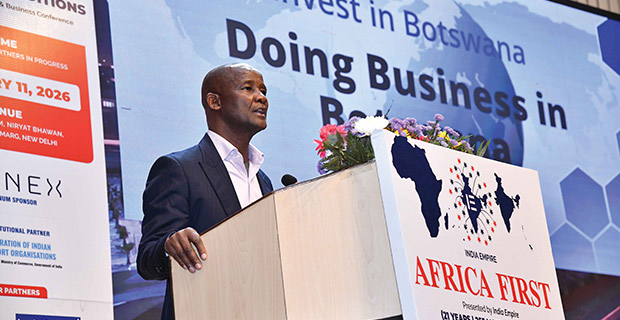
H.E. Mr. Gilbert Shimane Mangole, High Commissioner of the Republic of Botswana, making a presentation on Botswana
Botswana: Stability With Direction
If Rwanda symbolised reform velocity, H.E. Mr Gilbert Shimane Mangole, High Commissioner of the Republic of Botswana to India, embodied macroeconomic steadiness.
Botswana’s narrative rests upon continuity. Since independence in 1966, democratic stability, peaceful political transitions and prudent fiscal stewardship have defined its trajectory. The recent electoral shift following decades under one ruling party signalled institutional maturity rather than volatility.
With a population near 2.5 million and GDP per capita approaching upper-middle-income thresholds, Botswana combines political predictability with measurable purchasing power.
Yet stability must now evolve into diversification. Botswana is integrated across layered trade architectures: the Southern African Customs Union, Southern African Development Community, African Continental Free Trade Area, African Growth and Opportunity Act and the EU–SADC Economic Partnership Agreement.
This architecture transforms Botswana from a small domestic economy into an export platform.
Priority sectors for Indian collaboration include mineral beneficiation, diamond value addition, renewable energy, agriculture and agro-processing, ICT and innovation, tourism and financial services.
Foreign investors may retain 100 percent ownership. No mandatory local equity requirement applies. Special Economic Zones provide preferential tax rates ranging between 5 and 10 percent for targeted industries.
Vision 2036, Botswana’s long-term development blueprint, seeks transition into a high-income, knowledge-driven economy.
The High Commissioner’s message remained composed and precise. Botswana offers not volatility, but structured opportunity anchored in governance continuity.
Related News.
-

September 2026 Gorillas Find Names
-

September 2026 India–Kiribati Deepen Cooperation
-

September 2026 India, Ethiopia Deepen Defence Ties
-

September 2026 JAMAICA AT 64,TIES DEEPEN

EDITOR'S DESK, Sep 2026
 Our cover takes us to Volcanoes National Park, where Rwanda recently hosted the 21st Kwita Izina, its annual Gorilla Naming Ceremony. Twenty-two baby mountain gorillas received their names, but the significance of the occasion went far beyond a celebration of wildlife...
more...
Our cover takes us to Volcanoes National Park, where Rwanda recently hosted the 21st Kwita Izina, its annual Gorilla Naming Ceremony. Twenty-two baby mountain gorillas received their names, but the significance of the occasion went far beyond a celebration of wildlife...
more...
Ads Spot

Comments.