

AFRICA FIRST - Corridors of Commitment
Beneficiation As Imperative
Where macro-architecture defined context, Mr Dipopego Julius Tsheko, Trade Representative, High Commission of the Republic of Botswana, provided industrial granularity.
He presented a statistic that sharpened attention: nearly 90 percent of Botswana’s diamonds are exported in rough form to Surat, India. This pattern is not simply trade flow. It is a developmental paradox.
Botswana aims to deepen value addition domestically through cutting, polishing, jewellery manufacturing and branding, rather than exporting unprocessed wealth.
For Indian industry, this shift signals partnership rather than displacement. Joint ventures in beneficiation would integrate value chains more deeply across borders.
He also referenced reserves of coal, copper, manganese and soda ash, minerals essential to contemporary supply chains and energy transitions.
The Botswana Investment and Trade Centre functions as a one-stop facilitation mechanism, streamlining licensing, land allocation and regulatory approvals.
The tone remained pragmatic. Botswana is not seeking assistance. It is inviting industrial co-creation grounded in reciprocity.
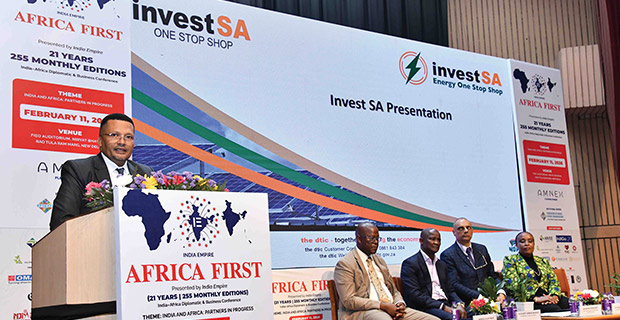
Mr Cedrick C. Crowley, Deputy High Commissioner, High Commission of the Republic of South Africa, making a presentation on South Africa
South Africa: Scale And Sophistication
If Rwanda conveyed agility and Botswana conveyed stability, Mr Cedric C. Crowley, Deputy High Commissioner, High Commission of the Republic of South Africa, conveyed scale.
South Africa’s proposition rests on industrial maturity. With a population exceeding 60 million, advanced manufacturing ecosystems and maritime positioning connecting the Atlantic and Indian Oceans, it is not merely a gateway but an anchor economy.
Bilateral trade with India approximates USD 20 billion, reflecting established depth. He underscored automotive assembly ecosystems integrated into global value chains, mineral beneficiation capacity, pharmaceutical manufacturing potential, renewable energy expansion in solar and wind and agricultural complementarity with India.
Automotive clusters offer plug-in compatibility for Indian manufacturers seeking continental reach. Renewable projects are procurement-ready rather than aspirational.
Seasonal agricultural complementarity enables year-round trade in fruit and produce. Integration within AfCFTA extends South Africa’s reach beyond domestic scale into continental networks.
His conclusion carried quiet assurance. Invest in South Africa not solely to access its market, but to manufacture for Africa.
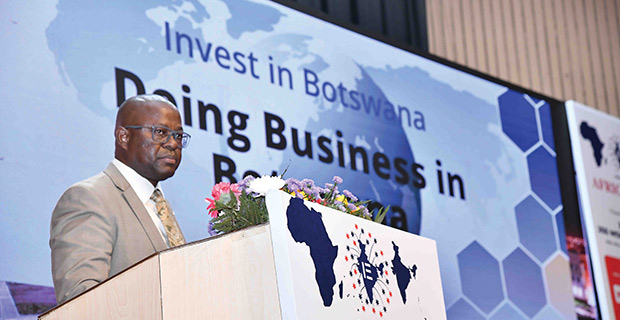
Mr Dipopego Julius Tsheko, Trade Representative, High Commission of the Republic of Botswana, makes a presentation on Botswana
A Mosaic In Motion
What emerged from the Engine Room was differentiation rather than uniformity.
Rwanda articulated governance velocity. Botswana articulated stability coupled with diversification. South Africa articulated industrial depth and continental leverage.
Three economic archetypes. Three strategic postures. One continent in motion.
This differentiation signals maturity. Africa no longer speaks in singular tones of untapped potential. It speaks in calibrated frameworks oriented toward execution. For Indian exporters, financiers and policymakers present, the insight crystallised clearly.
Africa is not requesting exploration. It is inviting structured partnership under defined regulatory, fiscal and logistical parameters.
The Engine Room did not embellish AFRICA FIRST. It defined it.
It was here, within discussions of tax regimes, beneficiation strategies, trade bloc integration and sectoral priorities, that Africa First ceased to be an abstract phrase.
It became architecture. And architecture, aligned with sustained commitment, constructs corridors that endure across cycles and generations.
Related News.
-

September 2026 Gorillas Find Names
-

September 2026 India–Kiribati Deepen Cooperation
-

September 2026 India, Ethiopia Deepen Defence Ties
-

September 2026 JAMAICA AT 64,TIES DEEPEN

EDITOR'S DESK, Sep 2026
 Our cover takes us to Volcanoes National Park, where Rwanda recently hosted the 21st Kwita Izina, its annual Gorilla Naming Ceremony. Twenty-two baby mountain gorillas received their names, but the significance of the occasion went far beyond a celebration of wildlife...
more...
Our cover takes us to Volcanoes National Park, where Rwanda recently hosted the 21st Kwita Izina, its annual Gorilla Naming Ceremony. Twenty-two baby mountain gorillas received their names, but the significance of the occasion went far beyond a celebration of wildlife...
more...
Ads Spot

Comments.