

Across Caribbean Shores
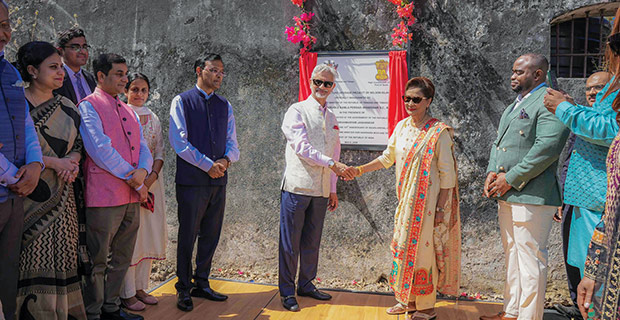
The most important thing Paris gave me was a perspective on Latin America
Gabriel José García Márquez
The year was 1982. The month, December. Gabriel José García Márquez, affectionately known as Gabo to millions across the Spanish-speaking world and beyond, was being interviewed by The New York Times shortly after being awarded the Nobel Prize for Literature. Reflecting on his years as a struggling correspondent in Paris during the 1950s, the Colombian writer spoke about how distance had unexpectedly helped him discover Latin America itself. Through the Latins he met there, he said, he began to understand not only the differences between Latin America and Europe, but also the many differences among Latin American nations.
The distance, dialogue and displacement that shaped Gabo’s understanding of Latin America may now, in an altogether different way, be shaping the geopolitical moment unfolding between India and the Latin American and Caribbean (LAC) region.
Across Kingston, Paramaribo and Port of Spain, New Delhi’s latest diplomatic outreach revealed a region no longer viewed merely through the prism of diaspora nostalgia or post-colonial memory. Instead LAC is now an increasingly important strategic corridor within the wider Global South.
From healthcare partnerships and cricket diplomacy to artificial intelligence, renewable energy and digital cooperation, India’s engagement with Latin America and the Caribbean is acquiring fresh depth and rhythm. External Affairs Minister S. Jaishankar’s recent visit to Jamaica, Suriname and Trinidad & Tobago, alongside Minister of State for External Affairs Pabitra Margherita’s participation in the swearing-in ceremony of Costa Rica’s new President Laura Fernandez, formed part of that widening arc.
Their engagements reflected something larger than diplomatic choreography. They showed how India is steadily transforming its Caribbean outreach from symbolism into structure.
That transition has been gathering momentum over the past two years. Prime Minister Narendra Modi’s participation in the India-CARICOM process in Guyana in 2024, followed by his landmark visit to Trinidad & Tobago in July 2025, helped elevate India-Caribbean ties beyond cultural affinity into a more strategic framework involving healthcare, digital public infrastructure, disaster resilience, education, renewable energy and South-South cooperation. Guyana Vice President Bharrat Jagdeo’s participation in the AI Summit in New Delhi earlier this year further signalled how the relationship is steadily moving into future-facing domains such as artificial intelligence, innovation and digital governance.
If the earlier phase reopened the Caribbean chapter in India’s diplomacy, Dr Jaishankar’s latest tour appeared focused on writing the operational details into that script.
Related News.
-

September 2026 Gorillas Find Names
-

September 2026 India–Kiribati Deepen Cooperation
-

September 2026 India, Ethiopia Deepen Defence Ties
-

September 2026 JAMAICA AT 64,TIES DEEPEN
EDITOR'S DESK, Sep 2026
 Our cover takes us to Volcanoes National Park, where Rwanda recently hosted the 21st Kwita Izina, its annual Gorilla Naming Ceremony. Twenty-two baby mountain gorillas received their names, but the significance of the occasion went far beyond a celebration of wildlife...
more...
Our cover takes us to Volcanoes National Park, where Rwanda recently hosted the 21st Kwita Izina, its annual Gorilla Naming Ceremony. Twenty-two baby mountain gorillas received their names, but the significance of the occasion went far beyond a celebration of wildlife...
more...
Ads Spot

Comments.