

Across Caribbean Shores
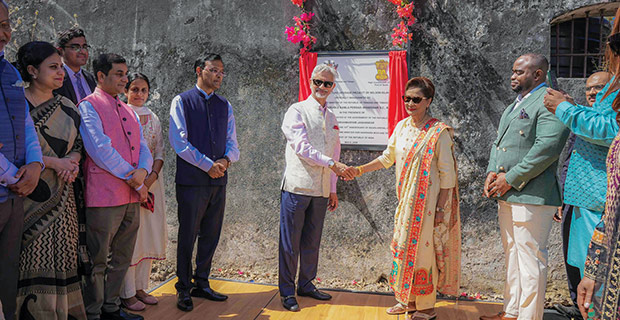
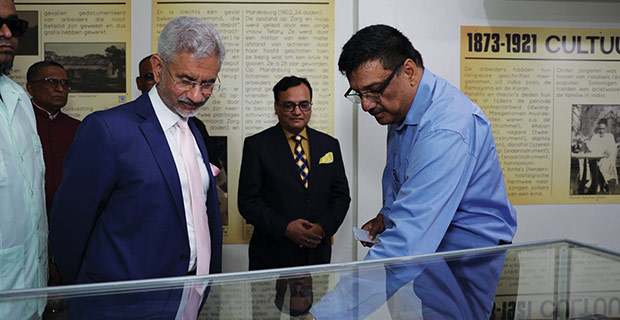
EAM at the Lalla Rookh museum of Indo-Surinamese heritage. He said, “The courage and resilience of Girmityas continue to inspire generations and remain at the heart of our enduring friendship.”
Global Bridges
If Jamaica highlighted cultural affinity and development cooperation, Suriname became the stage for articulating India’s wider geopolitical philosophy.
Speaking in Paramaribo on the theme “Partnership for Progress,” Dr Jaishankar argued that a fractured and uncertain world still required collective advancement through trusted partnerships. India, he suggested, sought to reconcile national interest with global good through development assistance, workforce mobility, humanitarian response and practical cooperation.
The language resonated strongly in Suriname, where Indo-Surinamese heritage remains deeply woven into national identity. Dr Jaishankar’s visit to the Lalla Rookh Museum of Indo-Surinamese heritage paid tribute to the resilience of the Girmitiya community whose descendants continue to shape Suriname’s social, political and cultural life.
Development cooperation again formed the operational backbone of the visit. Dr Jaishankar handed over a fruit-processing facility in Paramaribo established with Indian financial assistance under a US$ 1 million Small and Medium Enterprises grant. The project, aimed at promoting local value addition and self-reliance, reflected India’s preferred diplomatic model: targeted partnerships with direct grassroots impact.
“India will always be a reliable partner,” Dr Jaishankar said, underlining New Delhi’s growing emphasis on delivery-oriented diplomacy rather than rhetorical positioning alone.
Meetings with Foreign Minister Melvin Bouva, Agriculture Minister Nike Noersalim and National Assembly Chair Michael Ashwin Adhin further expanded discussions on parliamentary exchanges, democratic cooperation and institutional partnerships.
Even symbolic gestures carried strategic undertones. The planting of a sapling at India House under the “Ek Ped Maa Ke Naam” initiative blended environmental consciousness with cultural continuity, much like India’s broader attempt to combine civilisational diplomacy with contemporary development partnerships.
In Suriname, India’s diplomacy appeared less transactional than narrative-driven. The message was unmistakable: the Caribbean and the wider Global South are steadily moving closer to the centre of India’s strategic imagination.
Ancestral Bonds
Among the three Caribbean stops, Trinidad & Tobago perhaps offered the clearest demonstration of how history, politics and strategy now intersect within India’s diplomacy.
Calling the country a “home away from home,” Dr Jaishankar repeatedly highlighted the warmth shared with the Indo-Trinbagonian community. The symbolism of Nelson Island was especially powerful. It was there that the first Indian indentured labourers arrived nearly two centuries ago, beginning a journey that would eventually shape one of the Caribbean’s most influential Indian-origin communities.
Dr Jaishankar joined Prime Minister Kamla Persad-Bissessar at events commemorating that shared heritage while Indian-supported Quick Impact Projects sought to preserve and showcase the historic site. The emotional resonance of the visit was matched by substantive cooperation.
India and Trinidad & Tobago concluded agreements covering tourism, solarisation of the Ministry of Foreign and CARICOM Affairs building, Quick Impact Projects and the establishment of an Ayurveda Chair. Together, the initiatives reflected India’s effort to blend technology partnerships, sustainability and traditional knowledge systems into a broader framework of cooperation.
A major highlight was the launch of a permanent Prosthetics Centre in Penal following the success of India’s Jaipur Foot initiative, which benefited more than 800 differently-abled individuals. Dr Jaishankar described the centre as a “gift of mobility and dignity” not only for Trinidad & Tobago but for the wider CARICOM region.
India also handed over “Made in India” laptops for schoolchildren, reinforcing New Delhi’s emphasis on education and digital inclusion as instruments of empowerment. Agro-processing projects aimed at strengthening small and medium enterprises and supporting the farming sector added further economic depth to the engagement.
The softer moments of the visit proved equally memorable. Dr Jaishankar’s visit to the Dattatreya Mandir, interactions with members of the Indian community in South Trinidad and even his meeting with cricket legend Brian Lara added cultural texture to the diplomatic choreography.
The Trinidad & Tobago engagement also carried echoes of Prime Minister Modi’s landmark 2025 visit, the first bilateral visit by an Indian Prime Minister to the country in more than two decades. That visit had elevated ties through agreements in healthcare, digital cooperation, disaster resilience and diaspora engagement, laying much of the groundwork now being operationalised through subsequent ministerial diplomacy.
India’s Caribbean outreach is no longer sailing on sentiment alone. It is now docking at the ports of healthcare delivery, digital infrastructure, climate resilience, education and strategic trust.
Related News.
-

September 2026 Gorillas Find Names
-

September 2026 India–Kiribati Deepen Cooperation
-

September 2026 India, Ethiopia Deepen Defence Ties
-

September 2026 JAMAICA AT 64,TIES DEEPEN

EDITOR'S DESK, Sep 2026
 Our cover takes us to Volcanoes National Park, where Rwanda recently hosted the 21st Kwita Izina, its annual Gorilla Naming Ceremony. Twenty-two baby mountain gorillas received their names, but the significance of the occasion went far beyond a celebration of wildlife...
more...
Our cover takes us to Volcanoes National Park, where Rwanda recently hosted the 21st Kwita Izina, its annual Gorilla Naming Ceremony. Twenty-two baby mountain gorillas received their names, but the significance of the occasion went far beyond a celebration of wildlife...
more...
Ads Spot

Comments.