

“Distance Isn’t An Obstacle”
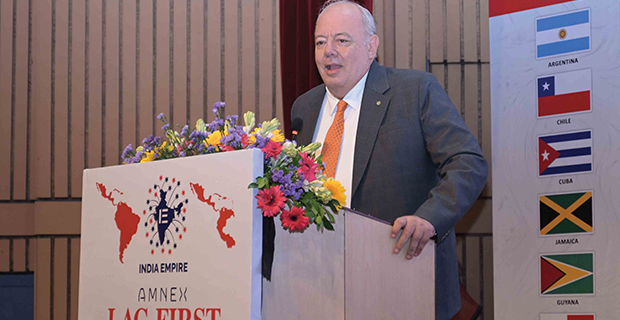
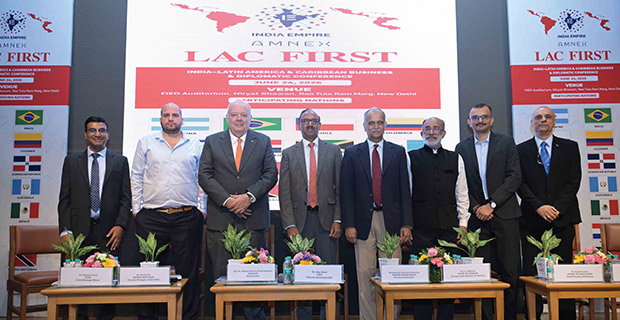
Ambassador Guani with other distinguished speakers at the plenary session
Uruguay is home to the headquarters of MERCOSUR, one of Latin America’s most influential regional economic blocs. As India seeks to deepen its engagement with the region, where do you see the greatest opportunities for cooperation between India and MERCOSUR?
India and MERCOSUR already have a strong foundation through the Preferential Trade Agreement signed in 2007. I believe the next step is to expand it substantially. Today it covers around 450 products; we would like to see that number increase to around 3,000, creating many more opportunities for trade and investment.
Beyond MERCOSUR, we have also developed a useful dialogue between India and CELAC during the United Nations General Assembly. I hope this can be strengthened through regular meetings in both India and Latin America, because sustained dialogue is the best way to deepen political understanding and commercial cooperation.
Let us turn to bilateral investment. Information technology has already emerged as a success story, but if you were addressing Indian business leaders today, which sectors would you identify as offering the greatest potential for cooperation between our two countries?
Information technology has led the way. Uruguay is one of Latin America’s leading software producers, and many international technology companies have established operations in our country.
Another example is Berkes, the Uruguayan engineering company with operations in Noida. It specialises in environmental technologies, particularly pollution control, and is expanding its presence in India.
I also see significant opportunities in pharmaceuticals. Indian medicines are recognised internationally for their quality and competitive pricing, and we would like to welcome more Indian pharmaceutical companies to Uruguay. Manufacturing, particularly electric vehicles and two-wheelers, is another promising area. Indian companies have developed considerable expertise in these sectors, and Uruguay can provide an excellent base for reaching markets across South America.
Beyond individual sectors, Uruguay is often described as an ideal gateway to South America. What geographical and logistical advantages would you highlight for Indian companies considering a regional presence?
Uruguay’s strength lies not only in its location but also in its infrastructure and logistics. We have one of the region’s best road networks, are modernising our railway system, and continue to invest in our ports.
Equally important are the facilities we offer international investors. Uruguay has a free port, a free airport and almost fifteen free economic zones that provide an efficient platform for serving markets across South America.
Tata Consultancy Services is an excellent example. Operating from one of our free economic zones, Tata has built one of Uruguay’s largest IT operations, employing around 1,000 Indian professionals alongside 2,000 Uruguayans. It demonstrates how effectively Indian companies can use Uruguay as their gateway to South America.
Related News.
-

September 2026 Gorillas Find Names
-

September 2026 India–Kiribati Deepen Cooperation
-

September 2026 India, Ethiopia Deepen Defence Ties
-

September 2026 JAMAICA AT 64,TIES DEEPEN

EDITOR'S DESK, Sep 2026
 Our cover takes us to Volcanoes National Park, where Rwanda recently hosted the 21st Kwita Izina, its annual Gorilla Naming Ceremony. Twenty-two baby mountain gorillas received their names, but the significance of the occasion went far beyond a celebration of wildlife...
more...
Our cover takes us to Volcanoes National Park, where Rwanda recently hosted the 21st Kwita Izina, its annual Gorilla Naming Ceremony. Twenty-two baby mountain gorillas received their names, but the significance of the occasion went far beyond a celebration of wildlife...
more...
Ads Spot

Comments.