

JAMAICA AT 64,TIES DEEPEN
Jamaica’s 64th Independence Day celebration in New Delhi highlighted a relationship moving beyond historic friendship and cricket towards healthcare, disaster resilience, renewable energy, capacity building, defence training and stronger economic engagement.
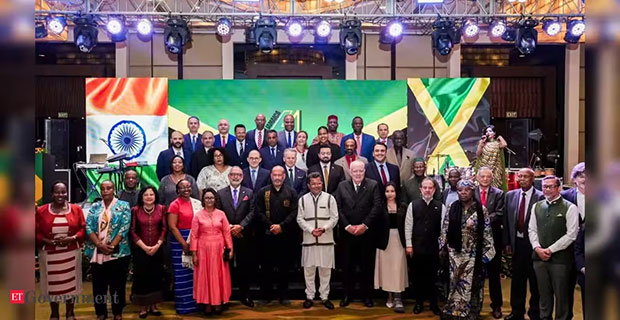
Jamaica's 64th Independence Day was celebrated in New Delhi on August 21 with a reception hosted by H.E. Jason Keats Matthew Hall, High Commissioner of Jamaica to India, bringing together ambassadors, high commissioners, members of the diplomatic corps, government representatives, business leaders, investors and friends of Jamaica. Mr. Pabitra Margherita, Minister of State for External Affairs and Textiles, attended as Chief Guest.
The evening combined diplomatic engagement with the unmistakable character of Jamaica. Blue Mountain coffee, rum and music, including a performance by Jamaican artist Hezron Clarke, gave the celebration its distinctive Caribbean flavour. Yet beneath the festivities was a wider message: a relationship rooted in history and affection is steadily acquiring greater practical depth.
H.E. Hall placed Jamaica's independence in the context of the country's long journey from slavery and colonial rule to sovereignty, paying tribute to generations whose sacrifice and resilience made independence possible. He also recalled India's longstanding friendship with Jamaica and India's support during the Covid-19 pandemic, particularly in expanding access to affordable healthcare.
A Partnership With Purpose
For H.E. Hall, the contemporary relationship is increasingly about what the two countries can do together. He highlighted cooperation in healthcare, disaster resilience, renewable energy, food and energy security, capacity building and defence training, pointing to areas where India's experience and Jamaica's requirements can intersect.
Disaster resilience has acquired particular urgency. Recalling Hurricane Melissa, which struck Jamaica last year with winds of around 190 miles per hour, H.E. Hall noted India's swift humanitarian response, including more than 25 metric tonnes of assistance for affected communities. He also pointed to India's role through the Coalition for Disaster Resilient Infrastructure and the International Solar Alliance, both relevant to Jamaica's efforts to strengthen resilience and pursue cleaner energy.
The emphasis is significant for Jamaica as a Small Island Developing State, where climate vulnerability and natural disasters can have consequences far beyond the immediate damage. India's engagement therefore carries a practical dimension, linking diplomatic solidarity with technology, medical assistance, resilient infrastructure and capacity building.
A Warm And Enduring Partnership
Mr. Margherita described India-Jamaica relations as a “warm and enduring partnership”, founded on shared democratic values, a mutual passion for cricket and deep people-to-people connections. He also highlighted the Indian-origin community in Jamaica, whose presence dates back more than 180 years and has become an enduring bridge between the two countries.
His remarks also demonstrated how far the relationship has moved beyond sentiment. India has provided 11 BHISHM mobile hospital units capable of rapid deployment during disasters and emergencies, alongside dialysis units to strengthen Jamaica's healthcare capacity. India has also supported Jamaican fishermen with fishing boats, engines and 200 GPS-enabled radio devices, aimed at improving safety, productivity and livelihoods.
Following Hurricane Melissa, India dispatched 25 tonnes of humanitarian and disaster-relief supplies, including an Aarogya Maitri mobile medical unit, essential medicines, medical equipment and water-purification kits.
“This is a reflection of our belief that friends stand by each other, particularly in times of need,” Mr. Margherita said.
Building Capacity
Capacity building has emerged as another important pillar. Jamaica has benefited from 56 scholarships under India's Indian Technical and Economic Cooperation programme, while 26 defence training slots have been provided, strengthening institutional and defence cooperation.
The figures illustrate a broader evolution in India's partnership model. Scholarships and training may lack the visibility of major infrastructure projects, but they create institutional relationships and build capabilities that can endure well beyond a single diplomatic initiative.
The same philosophy is evident in cooperation on renewable energy and institutional infrastructure, including the solarisation of The Hugh Lawson Shearer Building, which houses Jamaica's Ministry of Foreign Affairs and Foreign Trade.
Related News.
-

September 2026 Gorillas Find Names
-

September 2026 India–Kiribati Deepen Cooperation
-

September 2026 India, Ethiopia Deepen Defence Ties
-

September 2026 India, Seychelles Strengthen Parliamentary Partnership

EDITOR'S DESK, Sep 2026
 Our cover takes us to Volcanoes National Park, where Rwanda recently hosted the 21st Kwita Izina, its annual Gorilla Naming Ceremony. Twenty-two baby mountain gorillas received their names, but the significance of the occasion went far beyond a celebration of wildlife...
more...
Our cover takes us to Volcanoes National Park, where Rwanda recently hosted the 21st Kwita Izina, its annual Gorilla Naming Ceremony. Twenty-two baby mountain gorillas received their names, but the significance of the occasion went far beyond a celebration of wildlife...
more...
Ads Spot


Comments.