

Moscow Reaffirms Enduring Partnership
External Affairs Minister Dr S Jaishankar’s meeting with Russian President Mr Vladimir Putin reaffirmed the depth of India–Russia ties, while discussions on trade, energy, fertilizers, nuclear cooperation and high technology highlighted the expanding economic dimensions of a partnership shaped by decades of political trust.
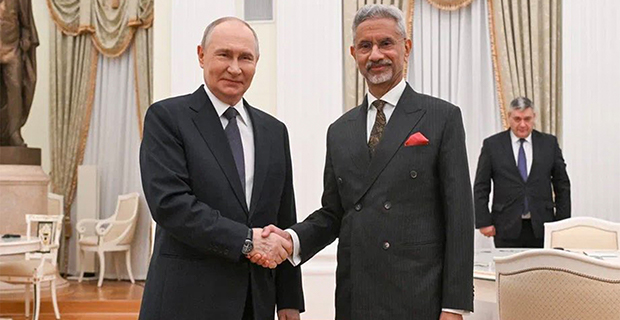
Moscow: External Affairs Minister Dr S Jaishankar called on Russian President Mr Vladimir Putin in Moscow on August 24 and handed over a personal message from Prime Minister Mr Narendra Modi. Dr Jaishankar briefed Mr Putin on the deliberations of the 27th India–Russia Inter-Governmental Commission on Trade, Economic, Scientific, Technological and Cultural Cooperation (IRIGC-TEC), while also discussing regional and global issues of importance.
Mr Putin said Dr Jaishankar’s visit reflected the level of relations established between Russia and India over several decades. He noted that the two countries continued to cooperate across governmental and inter-parliamentary channels and in the economic sphere, while welcoming the increase in bilateral trade this year. The Russian President also credited Mr Modi’s personal attention to the development of Russia–India relations and asked Dr Jaishankar to convey his best wishes to the Prime Minister.
India and Russia’s modern relationship has deep historical foundations. Political, economic, scientific, technological, cultural and defence cooperation developed substantially during the Soviet era and continued after the dissolution of the Soviet Union. The Declaration on the India–Russia Strategic Partnership, signed in October 2000, provided a new institutional framework for the relationship, which was elevated in 2010 to a Special and Privileged Strategic Partnership. Defence has remained a major pillar, alongside cooperation in energy, nuclear technology, science and technology, trade, culture and other fields.
The institutional architecture has also grown steadily. The annual summit between the Indian Prime Minister and Russian President remains the highest-level mechanism for political engagement, while the IRIGC-TEC provides a regular platform for reviewing and advancing economic, scientific, technological and cultural cooperation. The commission’s work has become particularly significant as both countries seek to expand commercial engagement and address emerging challenges in their economic relationship.
The scale of that economic relationship has changed dramatically in recent years. At the 27th IRIGC-TEC meeting, co-chaired by Dr Jaishankar and Russia’s First Deputy Prime Minister Mr Denis Manturov, Dr Jaishankar said bilateral goods trade had increased almost four-fold in five years, from around US$ 13 billion in 2021–22 to nearly US$ 60 billion in 2025–26. He also acknowledged that the trade imbalance had widened substantially, making greater market access, removal of tariff and non-tariff barriers, stronger payment mechanisms and deeper business-to-business engagement important priorities.
Energy and fertilizers were prominent on the agenda. Mr Putin said Russia was increasing fertilizer supplies and was prepared to continue doing so, specifically linking the issue to the needs of Indian farmers and agriculture. He also referred to cooperation in nuclear energy, high-technology sectors and other areas, saying that progress was continuing steadily.
Related News.
-

September 2026 Gorillas Find Names
-

September 2026 India–Kiribati Deepen Cooperation
-

September 2026 India, Ethiopia Deepen Defence Ties
-

September 2026 JAMAICA AT 64,TIES DEEPEN
EDITOR'S DESK, Sep 2026
 Our cover takes us to Volcanoes National Park, where Rwanda recently hosted the 21st Kwita Izina, its annual Gorilla Naming Ceremony. Twenty-two baby mountain gorillas received their names, but the significance of the occasion went far beyond a celebration of wildlife...
more...
Our cover takes us to Volcanoes National Park, where Rwanda recently hosted the 21st Kwita Izina, its annual Gorilla Naming Ceremony. Twenty-two baby mountain gorillas received their names, but the significance of the occasion went far beyond a celebration of wildlife...
more...
Ads Spot

Comments.