

“We Need to Bridge the Gap”
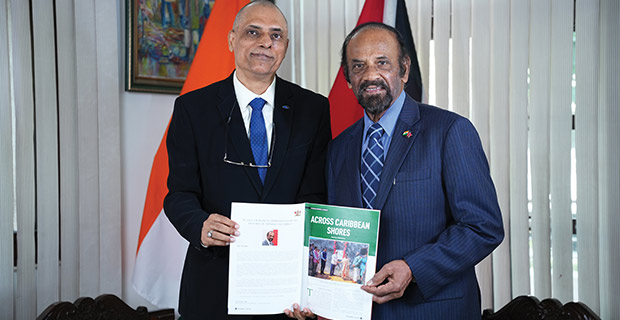
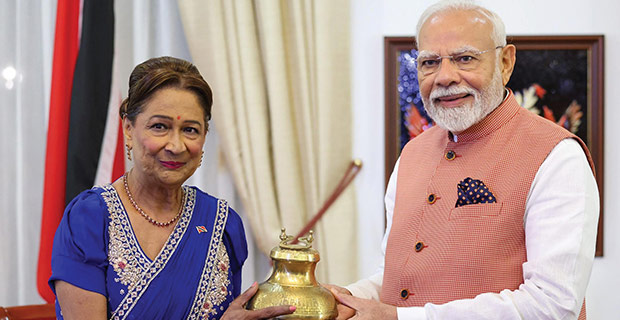
Prime Minister of India Shri Narendra Modi with Prime Minister of Trinidad and Tobago H.E. Mrs Kamla Persad-Bissessar during his state visit to the country in July 2025, when the two leaders exchanged gifts.
You have long argued that the plantation diaspora should be distinguished from the newer Indian diaspora in countries such as the United States, Canada, the United Kingdom and Australia. Why is this distinction important?
Our history and experience are different, and so are our needs. I have been emphasising this distinction since my student days in India. The plantation diaspora emerged from indentured labour, particularly on sugar plantations. Our ancestors endured enormous hardship and, over generations, their descendants rose to become leaders in politics, diplomacy, business, education and other fields.
Yet their stories were often missing from Indian history books. We need greater recognition of what these communities have achieved and a better understanding of their historical journey.
The principal interest of the plantation diaspora is to bridge the emotional gap created when our ancestors left India and never returned. Their descendants want to understand their origins, recover lost languages and reconnect with family histories.
India has made efforts to engage more closely with its diaspora, and the extension of Overseas Citizen of India facilities to additional generations is an encouraging development. But much more can be done to make it easier for people to trace their roots, access historical records and establish connections with ancestral villages.
We should also encourage the translation of books by Caribbean writers into Hindi and Bhojpuri, among other Indian languages. This would help Indian readers understand the experience of the plantation diaspora and give these authors a wider audience.
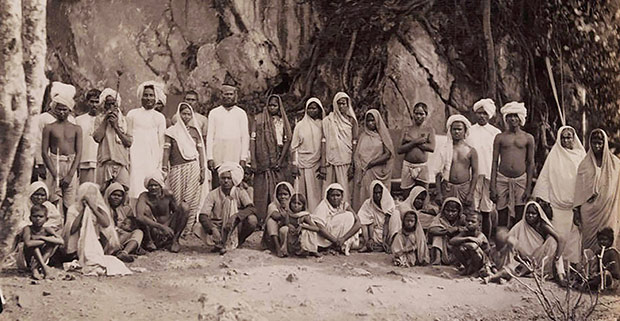
An archival photograph of Indian men, women and children in Trinidad, offering a glimpse into the lives of the early Indian communities whose migration shaped the history of the country.
You have described the Kolkata memorial as an important point of remembrance for the Girmitiya diaspora. How can India and the countries that received indentured labourers work together to give it greater recognition, potentially as a UNESCO World Heritage Site?
Recognition of the Kolkata site as a heritage destination is long overdue. It represents the point from which many of our ancestors departed for a life of uncertainty and hardship overseas. It should be recognised as an important part of world history.
The depots where emigrants were held before departure are also part of that story. A museum or heritage centre could help visitors understand the circumstances in which people left India and the challenges they faced.
Much of the work to draw attention to this history has been undertaken by diaspora organisations, researchers and individuals. The Indian government should match these efforts with a more coordinated initiative.
One practical step would be to bring together the heads of mission representing countries with significant Girmitiya populations, in consultation with India’s Ministry of Culture. Seminars, workshops and discussions at that level could build support for a museum or heritage centre and establish a pathway towards international recognition.
This is not simply a matter for Trinidad and Tobago. It concerns communities across the Caribbean and elsewhere whose histories are connected to the indenture system.
Related News.
-

November 2026 Trinidad Eyes Indian Trade
-
November 2026 “Business Needs Cultural Connection”
-

November 2026 REPORT URGES DURABLE TIES
-

November 2026 ENVOYS DISCUSS PANAMA TIES
India Empire TV


EDITOR'S DESK, Nov 2026
 A relationship between nations is rarely built on a single summit, agreement or trade figure. It takes shape over generations: through the movement of people, the exchange of ideas, the trust created by diplomacy and the practical partnerships that improve lives. This November issue of India Empire explores that wider canvas of India’s engagement with the world...
more...
Ads Spot

Comments.