

Belonging Carries Responsibilities
RSS chief Mr Mohan Bhagwat has used a major gathering in New York to place the Indian diaspora’s responsibilities, the idea of unity in diversity and the pursuit of sustainable living within a wider civilisational framework, urging Bharatiyas to serve their adopted homeland while living the values inherited from India.
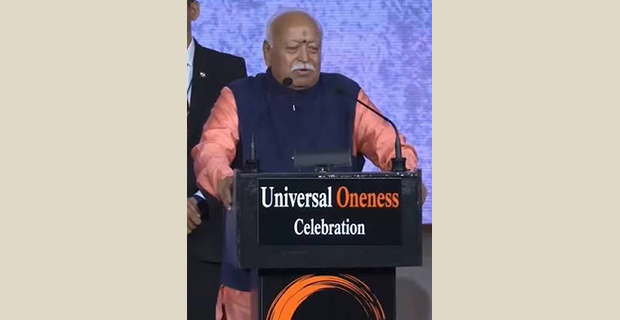
For Mr Mohan Bhagwat, the message to the Indian diaspora in the United States began with an uncomplicated proposition: belonging to a country carries responsibilities. Addressing a large gathering in New York in late August, the RSS chief told Indian-origin Americans that they should remain loyal to the country in which they live, work and earn, while continuing to practise the civilisational values inherited from India. “We are in America. We live in America. We earn in America. So we are America. And we should behave true to America,” he said.
Mr Bhagwat described the United States as the diaspora’s Karmabhoomi, or land of duty, and India as its Janmabhoomi, or land of birth. His distinction was significant because he did not frame attachment to India as requiring a competing political or national allegiance. Members of the diaspora, he said, should first fulfil their responsibilities to their adopted country. If they subsequently wished to contribute to India, they could do so, but such assistance was not obligatory. What India expected instead was that those who carried its civilisational inheritance would live its values.
That formulation placed diaspora identity within a broader argument about conduct. Mr Bhagwat said the message of India should not be delivered through preaching but demonstrated through practice. For him, the Indian diaspora's role therefore extends beyond preserving cultural identity. It involves becoming an example of the values associated with India while participating fully in the societies in which its members have made their lives.
Pluralism And Unity
The address moved from the specific question of diaspora responsibility to a much larger philosophical proposition: that diversity and unity are not opposites. Mr Bhagwat contrasted the language commonly used to describe the United States and India, observing that America is frequently associated with pluralism, while India is associated with unity in diversity. He argued that both principles are embedded in the Indian civilisational outlook.
“We appear different,” he said, referring to the many nationalities, languages, religions and ways of living that characterise humanity. But those visible differences do not eliminate a deeper connection. Diversity, in his formulation, should be celebrated, respected and accepted precisely because it decorates an underlying oneness. “We are one and due to diversity that oneness is decorated,” he said.
Mr Bhagwat extended the proposition beyond individuals to nations themselves. Nations, he argued, are more than geographical entities enclosed by borders. Each has a message, a mission and a destiny. India's civilisational role, in his formulation, is to help the world recognise unity amid its differences. But that role carries a requirement of example. Bharatiyas around the world, he said, should communicate that message through their lives rather than through sermons.
Beyond Material Satisfaction
At another point, Mr Bhagwat turned to a deceptively ordinary New York object: the doughnut. The light-hearted example became a vehicle for a much older philosophical argument about desire and satisfaction. Material abundance, he suggested, can provide pleasure but cannot guarantee lasting fulfilment. Even after consuming something one desires, the desire eventually returns.
“I am a diabetic,” he remarked while discussing how many doughnuts he could eat, before making the larger point that the same doughnut that becomes unappealing after one has eaten enough can become desirable again the following morning. Material happiness, he argued, is therefore transitory.
He illustrated the point through the story of Indra and Virochan, who possessed everything they wanted but still lacked satisfaction. Their search for lasting happiness led them towards an understanding of the Atman, the inner self that, in Mr Bhagwat’s interpretation, connects people despite differences in bodies, clothing and forms of worship. He likened humanity to beads in a necklace joined by a single thread: outwardly different, yet connected by something deeper.
The philosophical argument ultimately became an ethical one. If the same underlying principle exists in others as it does within oneself, then human life cannot be organised solely around consumption or personal advancement. Recognition of interconnectedness should lead to concern for the welfare of others and, ultimately, for the welfare of the world.
Related News.
-

September 2026 Gorillas Find Names
-

September 2026 India–Kiribati Deepen Cooperation
-

September 2026 India, Ethiopia Deepen Defence Ties
-

September 2026 JAMAICA AT 64,TIES DEEPEN

EDITOR'S DESK, Sep 2026
 Our cover takes us to Volcanoes National Park, where Rwanda recently hosted the 21st Kwita Izina, its annual Gorilla Naming Ceremony. Twenty-two baby mountain gorillas received their names, but the significance of the occasion went far beyond a celebration of wildlife...
more...
Our cover takes us to Volcanoes National Park, where Rwanda recently hosted the 21st Kwita Izina, its annual Gorilla Naming Ceremony. Twenty-two baby mountain gorillas received their names, but the significance of the occasion went far beyond a celebration of wildlife...
more...
Ads Spot

Comments.