

Belonging Carries Responsibilities
The Economics Of Giving Back
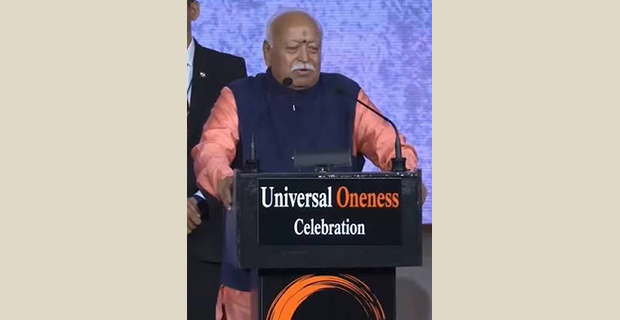
That proposition also informed Mr Bhagwat’s discussion of career, wealth and social responsibility. He did not reject material prosperity. Rather, he questioned whether earning and consumption could be regarded as the sole measures of a successful life. Every individual, he pointed out, depends upon a vast network of other people, from parents and farmers to workers and families.
“If farmers stop farming, what will you eat?” he asked, pointing to the invisible social infrastructure behind everyday life. Clothing, food and virtually every material necessity depend upon the work of others. That dependence creates an obligation to give something back. “How much we earn is not important. How much we distribute is important,” he said.
His formulation of social responsibility went beyond simply avoiding harm. The familiar idea of “live and let live”, he argued, was insufficient. Human beings should actively sustain the lives of others. “I sustain others,” he said, presenting responsibility not as a burden but as part of the purpose of human existence.
Dharma And Sustainability
The same principle was applied to the relationship between human beings and nature. Mr Bhagwat acknowledged the apparent tension between development and environmental preservation, asking how societies could continue to develop without destroying the natural world. His answer lay in a way of life in which the individual, society and environment progress together.
“We are one with human beings. We are one with nature,” he said, arguing that human intelligence should create responsibility rather than provide a licence to dominate the natural world. He described dharma not as religion or worship but as the sustaining principle through which the universe is balanced.
This understanding of dharma requires different dimensions of life to move together. Individual success should not demand the suppression of society; social progress should not destroy the individual; and economic development should not come at the expense of nature. “Individual society and the environment, they have to proceed together, progress together,” Mr Bhagwat said.
He linked the idea to the RSS programme of pancha parivartan, describing its principles as something that must first be adopted by individuals and then carried into society. The programme identifies five areas of social transformation: environmental protection, social harmony, family values, civic duties and the adoption of indigenous practices.
Oneness As Practice
The gathering, which organisers said brought together more than 6,000 people from 85 cities across 39 US states, provided an unusually broad setting for these themes. Delegates came from different generations, faiths, cultures and professions, giving the discussion of unity and diversity a physical presence of its own.
Mr Bhagwat also addressed the idea of conflict. Even enemies, he argued, remain part of the same human whole, and enmity is created by circumstances and human behaviour rather than being an eternal condition. The objective, therefore, should be to remove harmful thinking rather than seek the destruction of the person.
His concluding message returned to the relationship between unity and difference. Diversity, he said, is natural, while unity is truth. For the diaspora, that philosophy begins with something practical: fulfil the duties of the country in which one lives, contribute through responsible conduct, and carry forward the values inherited from one's civilisational home.
The result is a conception of diaspora identity that does not depend on choosing between the place of birth and the place of belonging. Karmabhoomi and Janmabhoomi can occupy different places in a person's story without demanding divided responsibility. For Mr Bhagwat, the bridge between them is conduct: living responsibly, sustaining others, respecting diversity and recognising an underlying unity.
In that sense, the message from New York was ultimately less about where people come from than about how they live where they are. The Indian diaspora, in his formulation, can serve both its adopted country and the wider world by turning the values it inherited into everyday practice. Oneness, then, is not presented as the disappearance of difference. It is the responsibility to live with difference while recognising the connection beneath it.
Related News.
-

September 2026 Gorillas Find Names
-

September 2026 India–Kiribati Deepen Cooperation
-

September 2026 India, Ethiopia Deepen Defence Ties
-

September 2026 JAMAICA AT 64,TIES DEEPEN

EDITOR'S DESK, Sep 2026
 Our cover takes us to Volcanoes National Park, where Rwanda recently hosted the 21st Kwita Izina, its annual Gorilla Naming Ceremony. Twenty-two baby mountain gorillas received their names, but the significance of the occasion went far beyond a celebration of wildlife...
more...
Our cover takes us to Volcanoes National Park, where Rwanda recently hosted the 21st Kwita Izina, its annual Gorilla Naming Ceremony. Twenty-two baby mountain gorillas received their names, but the significance of the occasion went far beyond a celebration of wildlife...
more...
Ads Spot

Comments.