

A NEW CHAPTER
The Envoy and the Opening
India’s choice of Dinesh Trivedi as its new High Commissioner to Bangladesh was another sign that New Delhi wanted to give the relationship renewed political attention. A former Union Minister and parliamentarian, High Commissioner Trivedi is an unusual appointment to a post normally held by a career diplomat. He arrived in Dhaka as both governments were trying to move beyond the strain of the preceding period.
Dhaka has made a significant diplomatic move of its own. Bangladesh’s Foreign Secretary, Asad Alam Siam, has received India’s formal approval to become Bangladesh’s next High Commissioner in New Delhi, succeeding M Riaz Hamidullah, who is moving to Geneva as the country’s Permanent Representative to the United Nations.
Sending a serving Foreign Secretary to New Delhi gives the posting considerable diplomatic weight. It places a senior career diplomat at the centre of the effort to restore regular engagement and address outstanding differences. As of October 18, the approval had been reported, while the timing of his formal assumption of the post remained subject to confirmation.
The appointment alone cannot resolve the political questions separating the two neighbours. Its value will depend on whether the diplomatic channel helps both governments address difficult issues with greater consistency and less public friction.
High Commissioner Trivedi’s public remarks have been measured. Asked about a possible November visit by Prime Minister Rahman, he said India’s invitation remained open and that there was no need to rush. Bangladesh’s State Minister for Foreign Affairs, Humaiun Kobir, has likewise said discussions are continuing, but that a visit would require a mutually conducive environment and should be based on mutual respect.
Those statements are more revealing than speculation about dates. They suggest that both sides recognise the need to prepare the ground before a prime-ministerial visit can produce meaningful results. A hurried meeting might generate headlines; a carefully prepared one could establish a framework for the work that follows.
A Mandate, Not a Blank Cheque
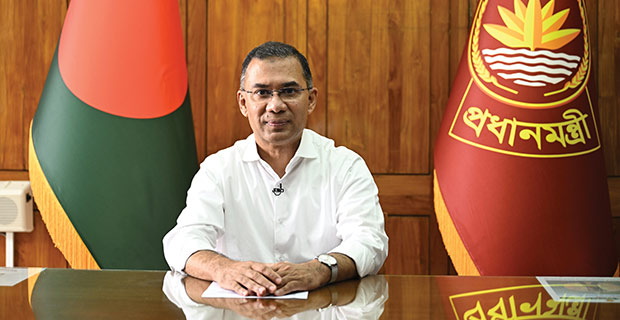
Prime Minister Rahman has presented himself as a leader who wants to restore institutions, improve public safety and rebuild confidence in the state. His election campaign also promised economic and social measures, including support for lower-income families, farmers, healthcare, education and employment. The BNP’s manifesto used the phrase “Bangladesh First” to frame its approach.
The promise now faces the test of implementation. Bangladesh must create jobs for a young population, manage economic pressures and reassure businesses that policy will be predictable. It must also show that political change can lead to stronger institutions rather than another cycle of retaliation and exclusion.
In a pre-election interview with TIME, Prime Minister Rahman put the need for national cohesion plainly: “If we cannot unify the country, it won’t be possible to take the country forward.” He has also argued that revenge would not help the country. Those are consequential words in a political environment where memories of repression, imprisonment, violence and exclusion remain fresh.
The test will be whether the government protects political pluralism, respects the rule of law and allows opponents to participate peacefully in public life. An electoral mandate gives a government authority to govern; it does not remove the obligation to listen, account for decisions or protect the rights of those who voted against it.
For India, this is not a peripheral concern. A stable, inclusive Bangladesh is in the interest of both countries. Political turbulence across the border affects commerce, transport, security and people-to-people ties. A relationship built only around the leaders of the day will be fragile; one supported by institutions, transparent agreements and regular engagement will have a better chance of enduring.
Related News.
-

September 2026 Gorillas Find Names
-

September 2026 India–Kiribati Deepen Cooperation
-

September 2026 India, Ethiopia Deepen Defence Ties
-

September 2026 JAMAICA AT 64,TIES DEEPEN


Comments.