

“Come And See Ecuador”
Ecuador and India are entering a new phase in their bilateral relationship. In this wide-ranging conversation, H.E. Mr Fernando Bucheli, Ambassador of Ecuador to India, speaks to Sayantan Chakravarty, Editor-in-Chief, India Empire, about the opportunities and challenges shaping the relationship.
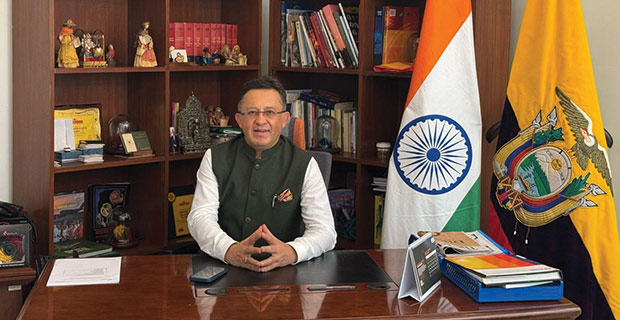
India and Ecuador have recently entered what appears to be a new phase in their bilateral relationship, with India establishing a resident Embassy in Quito and both countries giving renewed attention to economic engagement. How would you describe the relationship today, and what would you like to see achieved during this new phase?
I would describe the relationship as being at a genuine turning point. Ecuador and India have enjoyed friendly diplomatic relations since 1969, but today we are moving from a relationship based largely on goodwill towards a much more substantive partnership built around concrete interests.
The opening of India’s resident Embassy in Quito is perhaps the clearest symbol of this new phase. Ecuador established its Embassy in India in 1973 and has maintained a resident Mission in New Delhi since 2005. India’s decision therefore creates a more balanced diplomatic architecture and, importantly, gives us the ability to work continuously and directly on both sides.
The official visit to India of then Foreign Minister Gabriela Sommerfeld in April 2026 provided important political impetus and significantly broadened our bilateral agenda. This momentum has continued. Most recently, in September, Ecuador’s current Foreign Minister, Roberto Kury, met with India’s External Affairs Minister, Dr. S. Jaishankar, in New York on the margins of the United Nations General Assembly. This latest high-level engagement confirms that there is political interest on both sides in maintaining the momentum and translating it into concrete results.
We are now working simultaneously on trade and investment, healthcare and pharmaceuticals, technology, renewable energy, education, capacity building and other areas of mutual interest.
Under the leadership of President Daniel Noboa Azín, Ecuador is pursuing an outward-looking foreign policy focused on opening markets, attracting investment and building partnerships that can contribute directly to the country’s development.
What I would like to see now is implementation. We already know where many of the opportunities lie. The next phase should be about converting political goodwill into measurable outcomes: more trade, greater Indian investment in Ecuador, technology and knowledge transfer, employment, stronger institutional mechanisms and, ultimately, closer connections between our peoples.
The foundations are now in place. Our task is to build on them.
India and Ecuador have been discussing a preferential trade arrangement for several years, and the two sides have now expressed an intention to move towards negotiations for a trade agreement. What are the principal issues that need to be addressed, and how ambitious would Ecuador like this agreement to be?
We should be ambitious, but also pragmatic. Importantly, we are not starting from zero. Considerable technical work has already been undertaken. A Joint Feasibility Study was completed and concluded that a trade agreement would be feasible and mutually beneficial, and the Second JETCO, held in 2023, agreed to reactivate the process.
The first task, therefore, is to build on what has already been achieved rather than continually restarting the process.
Of course, tariffs and market access will be central, but they are only part of the equation. We also need to address sanitary and phytosanitary requirements, technical standards, certification, customs procedures, logistics and other practical barriers faced by companies. A modern trade agreement should make it genuinely easier for businesses on both sides to trade, invest and build long-term partnerships.
The Third JETCO will be particularly important in this regard. Ecuador has proposed to India that the Third JETCO be held in Quito in December this year. We hope this meeting can provide a clear roadmap for moving the trade agreement process forward, including the necessary technical steps and a realistic timetable.
Our ambition should also go beyond simply increasing existing trade flows. An agreement should help diversify trade in both directions, open opportunities for new products and services, encourage investment and connect companies from both countries more closely.
India’s own feasibility work identified significant potential gains from a possible agreement, including opportunities in both goods and services.
Ultimately, I would measure the success of an agreement not only by how much bilateral trade increases, but by how much more diversified, balanced and sophisticated that trade becomes. If, several years after implementation, we are simply exchanging larger quantities of the same few commodities, we will not have used the agreement to its full potential.
The objective should be to create new trade, new investment and, above all, new economic opportunities for both countries.
Related News.
-

October 2026 A NEW CHAPTER
-

October 2026 “We Can Be A Gateway”
-

October 2026 Confidence Across Continents
-

October 2026 THIMPHU TALKS COOPERATION

Comments.