

Trade Doors Open
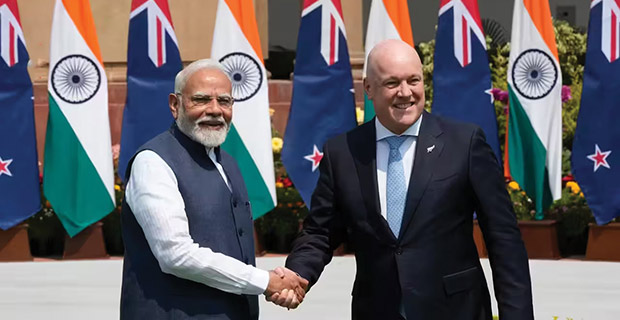
New Delhi: New Zealand’s Parliament has passed the legislation required to implement the Free Trade Agreement (FTA) with India, bringing the landmark pact a step closer to taking effect and opening a substantially wider commercial corridor between the two countries. The legislation was passed on September 17 by a vote of 93-29, with New Zealand’s Minister for Trade and Investment Todd McClay saying the agreement could come into force within the next month, once the remaining domestic processes are completed and the two countries exchange diplomatic notes. India and New Zealand are working closely to complete their respective procedures and facilitate the early entry into force of the agreement, according to the Commerce Ministry.
Signed in New Delhi on April 27, the agreement provides duty-free access for 100 per cent of Indian exports to New Zealand from the date of entry into force, creating new opportunities across a broad sweep of Indian industry. Textiles and apparel, leather and footwear, engineering goods, pharmaceuticals, agriculture and processed food products are among the sectors positioned to benefit. For New Zealand, the agreement provides enhanced and preferential access to the Indian market for products including wood, wool, sheep meat and leather raw hides. Mr McClay, speaking to IANS on September 18, said the agreement would bring immediate benefits to Indian exporters, with every tariff rate on Indian exports to New Zealand falling to zero on the first day of implementation. “So that’s a win,” he said.
The scale of the opportunity extends well beyond merchandise trade. The FTA creates new avenues in services, investment and professional, student and youth mobility, including enhanced pathways for Indian professionals and students. It also provides for facilitating $20 billion worth of investment into India, while strengthening cooperation in agricultural productivity, pharmaceuticals and medical devices, traditional medicine and AYUSH, technology and trade facilitation. Mr McClay said food exports, Indian manufactured goods and services would be among the principal areas to gain, with New Zealand businesses already preparing for greater engagement in India and companies travelling in both directions to establish commercial partnerships.
Mr McClay said the agreement could give a significant lift to two-way commerce and noted that Prime Minister Christopher Luxon and Prime Minister Narendra Modi had committed to doubling bilateral trade by 2030. “I think that is more than possible now,” he told IANS. He pointed to high-quality New Zealand food exports, particularly horticulture and meat, as areas with considerable potential in India, where demand is expanding. At the same time, Indian pharmaceuticals, machinery and manufactured goods stand to gain from improved access to the New Zealand market. Tourism and IT services could also see stronger growth, with Mr McClay saying such sectors could generate high-paying employment in both countries.
For businesses, the minister stressed the value of predictability. The agreement, he said, would provide greater certainty amid changing global tariff policies, while giving Indian companies greater predictability when considering investment in New Zealand and New Zealand companies greater confidence in pursuing opportunities in India. “We will see partnerships grow,” Mr McClay said, adding that adherence to agreed rules and greater certainty should translate into more opportunities for businesses.
Agriculture is emerging as one of the more substantive areas of potential cooperation. Mr McClay said New Zealand could share advanced technology and innovation with India to help raise farmers’ earnings. He linked this to Prime Minister Modi’s stated objective of increasing the earnings of farmers and growers by 50 per cent by 2035, saying New Zealand wanted to work with India towards that goal. “There’s a lot of advanced technology and innovation that we use in New Zealand that we will want to bring and work with India on to help increase the earnings of farmers in India, just as we have in New Zealand,” he said.
Related News.
-

October 2026 A NEW CHAPTER
-

October 2026 “We Can Be A Gateway”
-

October 2026 “Come And See Ecuador”
-

October 2026 Confidence Across Continents
India Empire TV


EDITOR'S DESK, Oct 2026
 The October 2026 issue of India Empire explores a world in which diplomacy, commerce, innovation and human connections increasingly shape one another. Across our stories, a recurring theme emerges: relationships acquire lasting value when goodwill is translated into practical outcomes...
more...
Ads Spot


Comments.