

WHEN DISTANCE LOSES MEANING
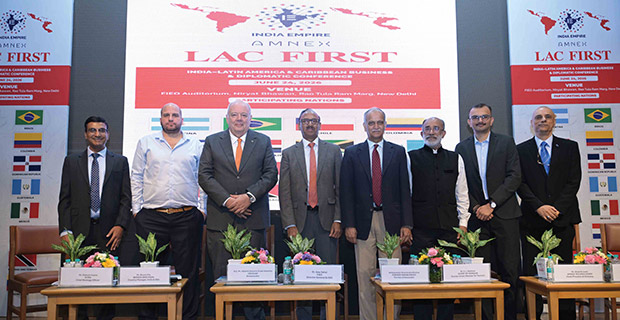
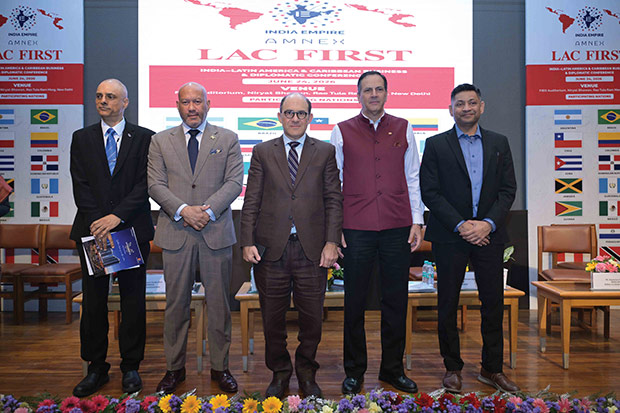
L-R: Chakravarty, H.E. Mr Jason Keats Hall, High Commissioner of Jamaica to India; H.E. Mr Mariano Agustín Caucino, Ambassador of Argentina to India; H.E. Mr Juan Carlos Marsán Aguilera, Ambassador of Cuba to India; Mr Utpal Gandhi, Managing Director, Amnex Technologies Private Limited
The opening address deliberately reached beyond commerce. Tagore’s 1924 journey to Argentina and his association with Victoria Ocampo became an early marker of a conversation that had crossed oceans before trade discovered its present vocabulary. Latin America had entered Indian imaginations through Pablo Neruda, Gabriel García Márquez, Octavio Paz, Jorge Luis Borges and, more recently, Paulo Coelho. Ideas and culture had travelled ahead of diplomacy; the contemporary relationship now had to acquire economic depth.
If the welcome address sought to widen the imagination, H.E. Alberto Antonio Guani Amarilla, Ambassador of Uruguay to India and Coordinator of GRULAC, brought the room quickly to unfinished business. India, he said, was coming “a little bit late” to an opportunity in which there remained much to do. He welcomed the expansion of India’s diplomatic presence, including the expected opening of an Embassy in Uruguay and another in Costa Rica, and placed current India-LAC trade at around US$50 billion, possibly US$53 billion for the year, with the expectation that it could double by 2030.
Ambassador Guani also urged Indian businesses to engage directly with the region by travelling to Latin American countries and understanding the distinct strengths of individual markets. Commercial relationships, he observed, are built not only through statistics and presentations, but through first-hand engagement, mutual confidence and sustained interaction. As Indian companies become more familiar with the region, he suggested, opportunities for trade, investment and long-term partnerships would naturally expand.
But Ambassador Guani’s intervention was more interesting than a recital of numbers. Latin America and the Caribbean, he insisted, could not be approached as an indistinct block. Businesses had to travel, understand individual countries and encounter their different realities. His impatience extended to institutional theatre. Chambers of commerce might sound impressive, but effectiveness mattered more than nomenclature. The subtext was unmistakable: relationships do not deepen because institutions exist on paper. They deepen when institutions produce movement.
Related News.
-

September 2026 Gorillas Find Names
-

September 2026 India–Kiribati Deepen Cooperation
-

September 2026 India, Ethiopia Deepen Defence Ties
-

September 2026 JAMAICA AT 64,TIES DEEPEN

EDITOR'S DESK, Sep 2026
 Our cover takes us to Volcanoes National Park, where Rwanda recently hosted the 21st Kwita Izina, its annual Gorilla Naming Ceremony. Twenty-two baby mountain gorillas received their names, but the significance of the occasion went far beyond a celebration of wildlife...
more...
Our cover takes us to Volcanoes National Park, where Rwanda recently hosted the 21st Kwita Izina, its annual Gorilla Naming Ceremony. Twenty-two baby mountain gorillas received their names, but the significance of the occasion went far beyond a celebration of wildlife...
more...
Ads Spot

Comments.