

WHEN DISTANCE LOSES MEANING
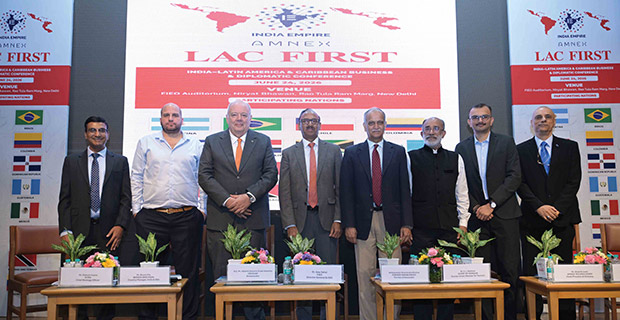
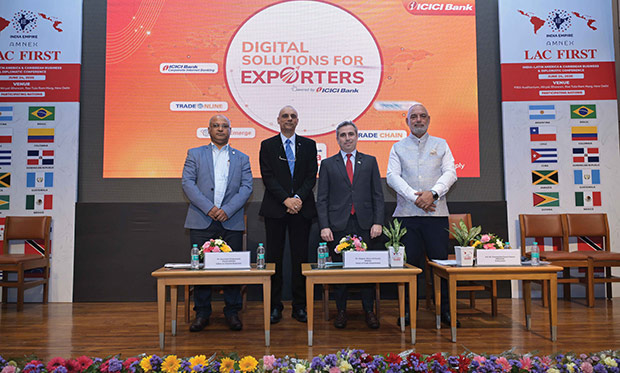
Mr Jayant Borkar from Valterra Corporate Advisors; Chakravarty; Mr Bruno Berrettini Campones do Brasil, Head of the Political Section, Embassy of Brazil; H.E. Mr Fleming Raul Duarte Ramos, Ambassador of Paraguay to India
THE PLENARY
The plenary then moved into the harder mechanics of engagement. Ambassador Amarendra Khatua, drawing on his experience as India’s Ambassador to Argentina, Uruguay and Paraguay and as former Secretary (Special Assignment) in the Ministry of External Affairs, argued for commercial architecture rather than episodic enthusiasm. India’s requirements in pulses and lentils, he suggested, should compel closer attention to Latin America. Warehousing and processing systems could be developed in countries such as Paraguay and Uruguay, creating stable supplier relationships and potentially serving onward markets in Africa and the Middle East. Critical minerals added urgency, particularly lithium and Indian investment already taking place in Argentina. Financial presence mattered too: banking, credit and industrial finance had to accompany ambition. Beneath all these structures lay an elemental requirement. Businesspeople had to travel, meet counterparts and build relationships.
Mr Shamik Joshi, Head-Presales & Gateway, Amnex Technologies Private Limited, turned to India’s experience in digital public infrastructure, arguing that technology had enabled government schemes to reach citizens more widely while reducing systemic leakages. He spoke of sovereign digital architecture, AI-enabled services in vernacular languages and identity systems such as Aadhaar, before moving into sector-specific applications. Farmer IDs, he explained, could connect land and crop information with government support, preferential lending and insurance processes. His proposition to the region was direct: India’s experience across identity, health, agriculture and payments could be adapted for LAC countries in ways that respected local sovereignty and participation. Technology, in this telling, was not simply another export sector. It could become an instrument through which social programmes reached citizens and trust in public systems deepened.
Mr Bruno Vila, Country Manager, India & SEA, BERKES-BWE India Private Limited, then brought something rarer to the plenary: the view of a Latin American executive learning India from inside the market. The Uruguay-founded Berkes Group had built an engineering office and sourcing hub in India, while its energy business had installed biomass and waste-to-energy boilers, including systems using rice residue. Vila’s verdict on the market was emphatic: “India is a today opportunity.” But opportunity came with its own operating grammar. “Relationship comes before contract,” he said. Face-to-face meetings mattered; trust mattered; speed mattered. An RFQ could move towards pricing and quotation with startling rapidity. Trying to manage India remotely, he warned, was “not possible”. Companies needed presence, cultural understanding and the ability to react fast. For a conference preoccupied with the distance between regions, Mr Vila offered the evidence of someone who had actually crossed it.
Related News.
-

September 2026 Gorillas Find Names
-

September 2026 India–Kiribati Deepen Cooperation
-

September 2026 India, Ethiopia Deepen Defence Ties
-

September 2026 JAMAICA AT 64,TIES DEEPEN

EDITOR'S DESK, Sep 2026
 Our cover takes us to Volcanoes National Park, where Rwanda recently hosted the 21st Kwita Izina, its annual Gorilla Naming Ceremony. Twenty-two baby mountain gorillas received their names, but the significance of the occasion went far beyond a celebration of wildlife...
more...
Our cover takes us to Volcanoes National Park, where Rwanda recently hosted the 21st Kwita Izina, its annual Gorilla Naming Ceremony. Twenty-two baby mountain gorillas received their names, but the significance of the occasion went far beyond a celebration of wildlife...
more...
Ads Spot

Comments.