

WHEN DISTANCE LOSES MEANING
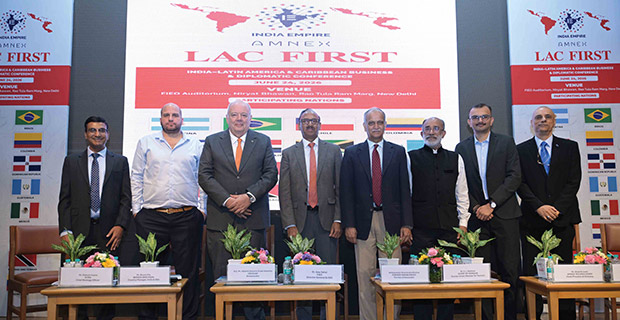
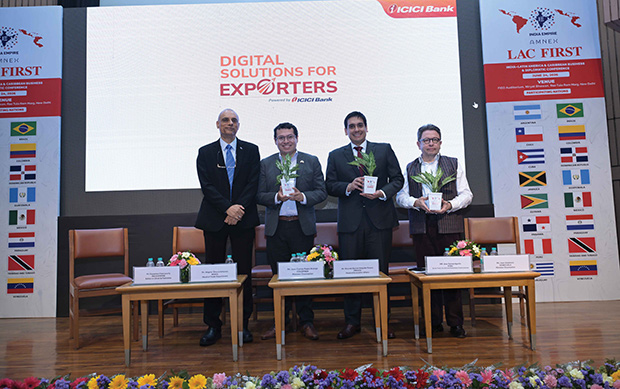
L-R: Chakravarty; Mr Ricardo Daniel Delgado Muñoz, Head of Economic Affairs, Embassy of Mexico; Mr. Jose Galvez Agurto, Senior Trade, Tourism and Investment Commissioner, Commercial Office of Peru in India; Mr. Juan Goldnick, Minister Counsellor, Embassy of Venezuela
Mr Rakesh Gupta, Chief Strategy Officer, RITES, shifted the lens to infrastructure. The Government of India enterprise, he said, was present in more than 55 countries and handling more than 700 projects across railways, highways, ports, airports, metros, urban mobility, sustainability, locomotive leasing and rolling-stock exports. Its capabilities ran from feasibility studies and detailed design to project management and supervision. Mr Gupta’s central argument was that infrastructure could become a strong pillar of India-LAC relations because it created not only economic growth but connectivity, jobs, international competitiveness and trade. He identified opportunities for collaboration across railways, highways, urban transport, logistics, ports, sustainability and capacity-building. “We are not merely consultants,” he said. “We aspire to be long term partners with LAC region.”
The morning’s argument was now acquiring layers. Ambassador Guani had warned against lateness. Dr Sahai had named the mental block. Ambassador Khatua had asked for commercial architecture. Mr Joshi had opened the digital field. Mr Vila embodied a business bridge already crossed, while Mr Gupta brought infrastructure into the conversation. The relationship was beginning to look less like a distant aspiration and more like a set of practical systems waiting to be connected.
The plenary closed with Dr K.J. Alphons, former Union Minister (Independent Charge) for Tourism, who approached the question from a more insurgent angle. He urged entrepreneurs to “dream like an elephant”, to think bigger and refuse the habit of waiting for institutions to solve every problem. “Don’t leave it to anybody. Do it yourself,” he said, returning repeatedly to individual agency and India’s own experience of transformation. His intervention eventually widened beyond entrepreneurship into a larger geopolitical appeal: countries needed to work together towards a world in which people could live with dignity. The tone differed from Ambassador Khatua’s commercial architecture or Dr Sahai’s statistical diagnosis, but the underlying impatience was related. Opportunity without agency remained only possibility.
Related News.
-

September 2026 Gorillas Find Names
-

September 2026 India–Kiribati Deepen Cooperation
-

September 2026 India, Ethiopia Deepen Defence Ties
-

September 2026 JAMAICA AT 64,TIES DEEPEN

EDITOR'S DESK, Sep 2026
 Our cover takes us to Volcanoes National Park, where Rwanda recently hosted the 21st Kwita Izina, its annual Gorilla Naming Ceremony. Twenty-two baby mountain gorillas received their names, but the significance of the occasion went far beyond a celebration of wildlife...
more...
Our cover takes us to Volcanoes National Park, where Rwanda recently hosted the 21st Kwita Izina, its annual Gorilla Naming Ceremony. Twenty-two baby mountain gorillas received their names, but the significance of the occasion went far beyond a celebration of wildlife...
more...
Ads Spot

Comments.