

WHEN DISTANCE LOSES MEANING
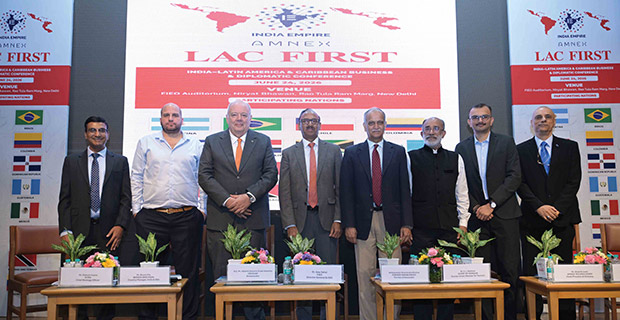
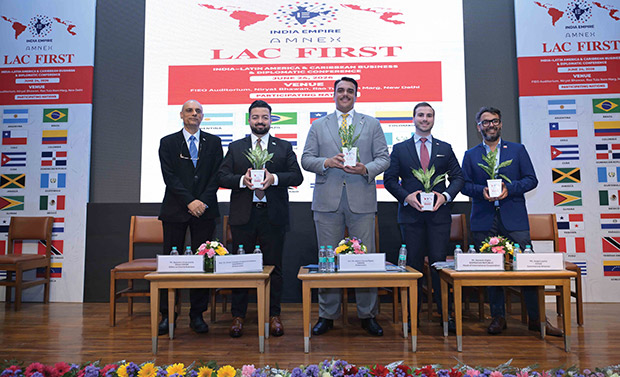
L-R: Chakravarty; H.E. Mr. Omar Lisandro Castañeda Solares, Ambassador of Guatemala to India; H.E. Mr Alonso Correa Miguel, Ambassador of Panama to India; Mr. Gerardo Giglio, Head of International Cooperation, Embassy of the Dominican Republic; Mr Jorge Loyola, Commercial Director, Embassy of Chile
That impatience found a harder economic edge in Dr Ajay Sahai, Director General and CEO of FIEO. India’s exports in calendar year 2025, he told the conference, stood at US$447 billion, while exports to Latin America and the Caribbean were US$21.5 billion, or 4.6 per cent. Against the region’s global imports of US$1.5 trillion, India’s share was only 1.4 per cent. Even in sectors where Indian industry possessed established strengths, penetration remained modest. Distance, freight, language and market access were familiar explanations. Dr Sahai’s diagnosis was less forgiving: “It is the mental block.”
Dr Sahai challenged the notion that distance remained the principal barrier to stronger India-LAC trade. The real challenge, he suggested, was one of mindset. If Indian companies could successfully serve distant global markets, Latin America too should be viewed as a natural destination for exports, investment and long-term business engagement.
The phrase landed because it stripped away a comfortable defence. Geography was real; so were logistics. But neither fully explained the scale of India’s under-engagement. Dr Sahai then shifted the argument from exports to the changing architecture of the global economy. The world, he said, was no longer looking merely for the most efficient supply chain. It was looking for one that was safe and secure. India and Latin America could build such supply chains together. In a period of geopolitical fracture, resilience itself had become an economic asset.
That sense of unfinished terrain was echoed outside the formal interventions by Mr Utpal Gandhi, Managing Director of title sponsor Amnex Infotechnologies. In a short interview, he described India’s business ties with Latin American and Caribbean markets as being at a “very nascent stage” and said the surface had barely been scratched. Initiatives such as India Empire’s LAC First bringing business and diaspora communities together, he argued, complemented India’s wider Global South policy.
Related News.
-

September 2026 Gorillas Find Names
-

September 2026 India–Kiribati Deepen Cooperation
-

September 2026 India, Ethiopia Deepen Defence Ties
-

September 2026 JAMAICA AT 64,TIES DEEPEN

EDITOR'S DESK, Sep 2026
 Our cover takes us to Volcanoes National Park, where Rwanda recently hosted the 21st Kwita Izina, its annual Gorilla Naming Ceremony. Twenty-two baby mountain gorillas received their names, but the significance of the occasion went far beyond a celebration of wildlife...
more...
Our cover takes us to Volcanoes National Park, where Rwanda recently hosted the 21st Kwita Izina, its annual Gorilla Naming Ceremony. Twenty-two baby mountain gorillas received their names, but the significance of the occasion went far beyond a celebration of wildlife...
more...
Ads Spot

Comments.